Main Points :
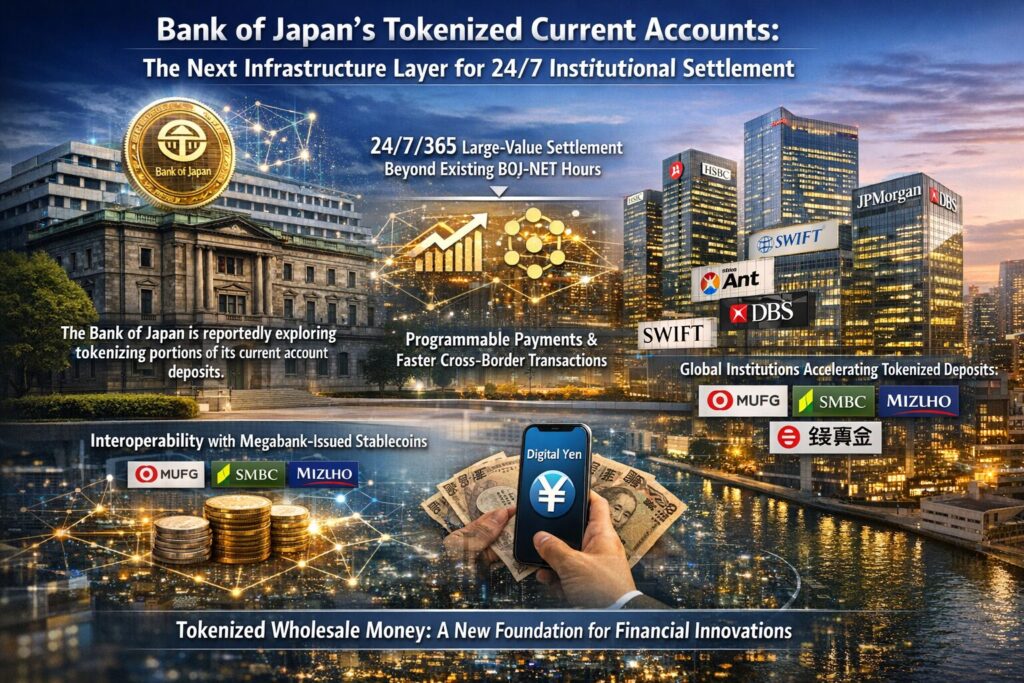
- The Bank of Japan is reportedly exploring tokenizing portions of its current account deposits.
- The objective is 24/7/365 large-value settlement beyond existing BOJ-NET operating hours.
- Tokenization may enable programmable payments, cost reduction, and faster cross-border transactions.
- Interoperability with megabank-issued stablecoins is under consideration.
- Japan is simultaneously advancing a retail-oriented digital yen (CBDC) framework.
- Global institutions such as HSBC, SWIFT, Ant International, JPMorgan, and DBS are accelerating tokenized deposit infrastructure.
- For investors and builders, tokenized wholesale money could become a foundational liquidity layer for next-generation financial applications.
1. Tokenizing Central Bank Current Accounts: What Is Actually Being Proposed?
According to recent reports, the Bank of Japan is considering tokenizing a portion of its current account deposits held by commercial banks. These current accounts represent reserves that private financial institutions hold at the central bank and are used for large-value interbank settlements.
Under the proposed structure, these reserves would be represented as blockchain-based tokens. Instead of relying solely on existing BOJ-NET batch operating hours, institutions could potentially transact using tokenized claims that move in real time across a distributed ledger environment.
This is not retail digital cash. It is not a cryptocurrency in the public sense. Rather, it is an institutional-grade settlement asset—central bank money—repackaged into a programmable digital form.
The strategic implications are profound. If implemented, Japan would be placing central bank reserves onto a blockchain-based infrastructure layer, effectively merging traditional central bank liabilities with distributed ledger functionality.
For readers seeking emerging crypto-linked opportunities, this signals that tokenized fiat liquidity may soon sit at the heart of institutional blockchain ecosystems.
2. 24/7/365 Large-Value Settlement: Why It Matters
Japan’s existing settlement infrastructure does not operate continuously throughout nights and weekends. By tokenizing central bank deposits, the system could theoretically enable:
- Continuous settlement capability
- Instant finality
- Automated conditional execution
- Reduced operational friction
Below is a conceptual illustration of expected impact areas:
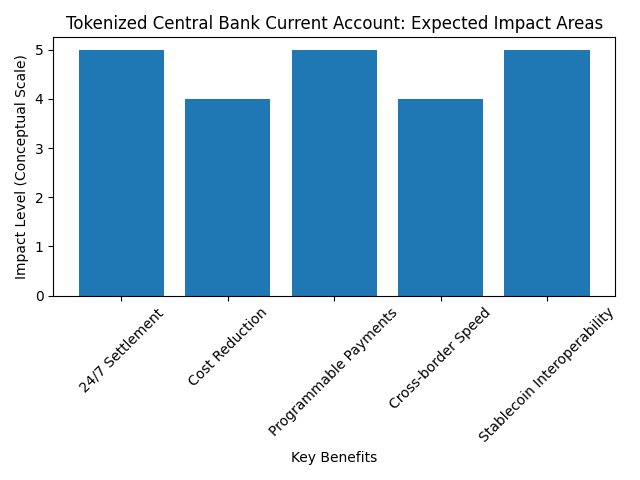
The most transformative element is programmability. Smart contracts could enable conditional payments—such as releasing funds only upon delivery confirmation, regulatory compliance validation, or FX rate triggers.
This opens the door to:
- Real-time trade finance automation
- Atomic delivery-versus-payment settlement
- On-chain collateral management
- Integrated treasury optimization
For international payments, tokenized reserves could compress settlement timelines from days to near-instant execution, potentially lowering costs measured in basis points that compound at scale.
For fintech builders, this suggests that future liquidity rails may shift from messaging-based settlement (e.g., SWIFT instructions) to asset-based programmable movement.
3. Interoperability with Megabank Stablecoins
In November, Japan’s three megabanks—Mitsubishi UFJ Bank, Sumitomo Mitsui Banking Corporation, and Mizuho Bank—announced experimentation toward jointly issued stablecoins.
If central bank current account tokens become operational, interoperability between:
- Bank-issued stablecoins (commercial bank liabilities)
- Tokenized central bank reserves (central bank liabilities)
could dramatically improve liquidity architecture.
In today’s structure:
- Stablecoins settle on private bank deposits.
- Final settlement ultimately depends on underlying reserve balances.
A tokenized reserve layer could enable atomic swaps between stablecoins and central bank tokens, reducing settlement risk and counterparty exposure.
For investors exploring next-generation yield or infrastructure plays, the opportunity lies not necessarily in retail coins—but in middleware layers:
- Settlement bridges
- Compliance oracles
- Tokenized collateral frameworks
- On-chain treasury analytics
The infrastructure stack will likely generate enterprise software revenue before retail speculation benefits.
4. Stablecoins Explained in Institutional Context
Stablecoins are crypto assets designed to maintain price stability, often pegged to the US dollar ($1). Examples globally include fiat-backed coins such as USDT and USDC.
In Japan’s case, regulatory clarity around stablecoins has evolved significantly. Policymakers have expressed support for practical deployment rather than speculative experimentation.
When central bank tokenization and regulated stablecoins converge, we approach a layered system:
- Central bank tokenized reserves
- Commercial bank tokenized deposits
- Retail-facing stablecoins
- Application-layer programmable finance
This layered architecture mirrors how internet protocols stack functionality. It suggests blockchain is moving from asset speculation toward infrastructure monetization.
5. Retail Digital Yen vs Tokenized Deposits
The Bank of Japan has also published its second interim report on Central Bank Digital Currency (CBDC), outlining a possible retail digital yen.
The digital yen would:
- Be denominated in yen
- Be a liability of the central bank
- Serve retail payments
This differs from tokenized current accounts, which are primarily wholesale institutional instruments.
Below is a conceptual comparison:
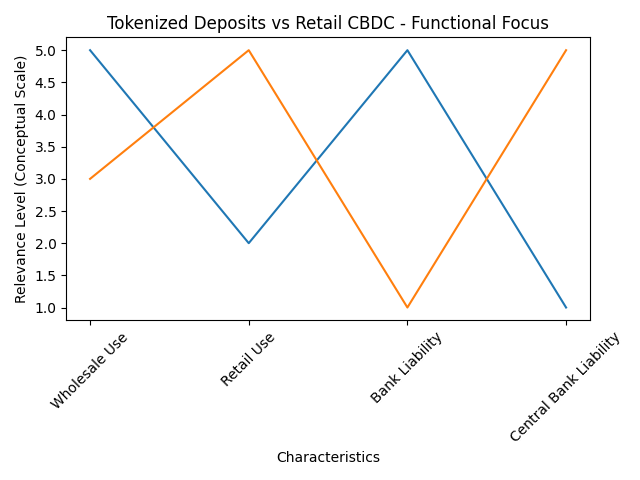
The distinction is critical:
- Tokenized deposits modernize interbank infrastructure.
- Retail CBDC targets consumer payments and financial inclusion.
From an investment lens, wholesale tokenization may scale faster because it requires fewer consumer behavior shifts.
6. Global Institutional Momentum
Japan is not alone.
Recently, HSBC, SWIFT, and Ant International successfully tested tokenized deposits enabling real-time cross-border transfers between Singapore and Hong Kong branches.
Separately, JPMorgan and DBS announced plans for a new interbank tokenized deposit transfer framework aimed at interoperability.
These initiatives signal:
- A shift from proof-of-concept to interoperability experimentation.
- Competition to define the standards layer of tokenized banking.
- Increasing convergence between fintech infrastructure and central banking.
Below is an illustrative institutional adoption momentum index:
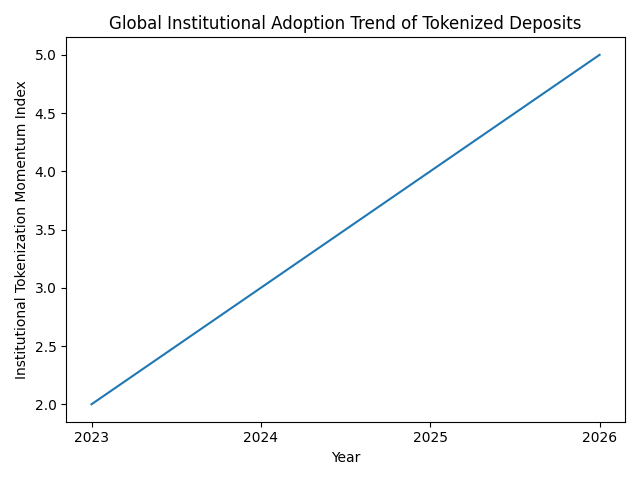
The trajectory suggests 2026–2028 may represent a structural buildout phase rather than speculative hype.
7. Where the Real Opportunities May Lie
For readers seeking new crypto assets or revenue streams, the more sustainable opportunities may not be in volatile tokens, but in enabling layers such as:
- On-chain compliance systems
- Institutional wallet infrastructure
- Cross-chain settlement protocols
- Risk analytics for tokenized liabilities
- Programmable liquidity marketplaces
If central banks and megabanks tokenize balance sheet components, liquidity fragmentation will increase before it consolidates. Interoperability solutions could command enterprise-level contracts.
Yield strategies may also evolve:
- Short-duration tokenized treasury pools
- Automated liquidity provisioning for institutional corridors
- FX arbitrage within programmable frameworks
However, regulatory alignment will be decisive. Projects aligned with central bank and megabank infrastructure are more likely to achieve sustainable scale.
Conclusion: From Speculation to Infrastructure
The Bank of Japan’s exploration of tokenizing current account deposits represents more than technical experimentation. It signals a structural shift toward programmable sovereign liquidity.
Combined with megabank stablecoin experiments and global institutional trials, the next phase of blockchain adoption appears infrastructure-centric.
For investors and builders, the message is clear:
The future edge may not lie in speculative coins, but in building the plumbing of programmable money.
Japan’s initiative may become one of the clearest case studies in how central banking and blockchain converge—not to replace each other, but to merge into a more automated financial backbone.