Main Points :
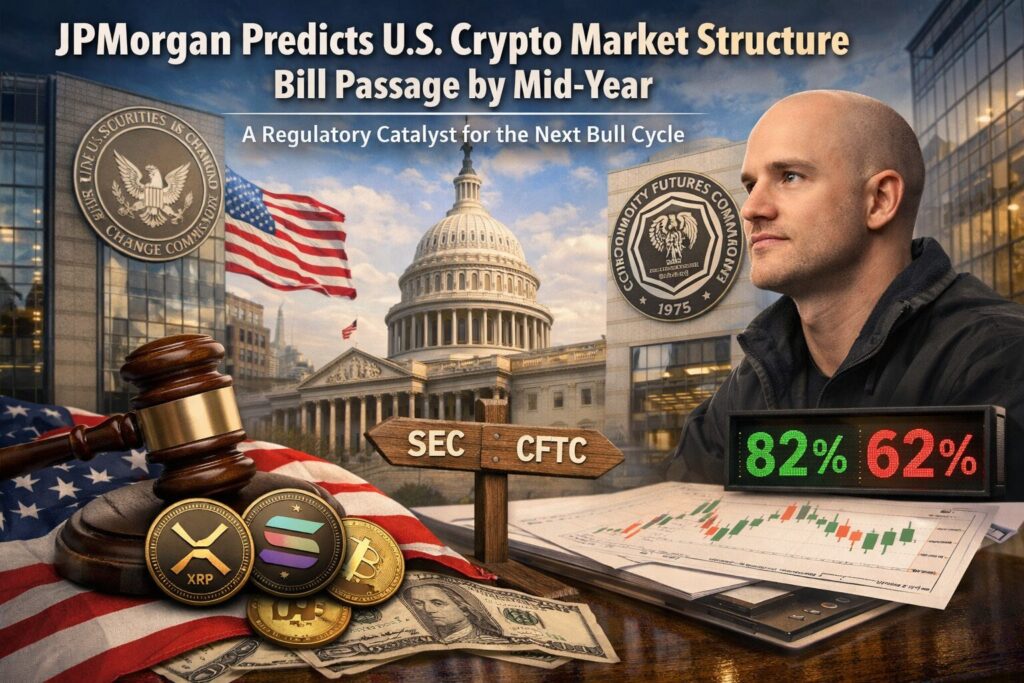
- JPMorgan analysts believe the U.S. “Clarity” crypto market structure bill could pass by mid-2026, potentially acting as a catalyst for a second-half market recovery.
- The bill would clarify jurisdiction between the U.S. Securities and Exchange Commission (SEC) and the Commodity Futures Trading Commission (CFTC), ending years of regulation-by-enforcement.
- A “grandfather clause” could ease regulatory pathways for ETF-linked assets such as XRP, Solana (SOL), and Litecoin (LTC).
- Stablecoin reward conflicts between banks and crypto firms, as well as conflict-of-interest rules for government officials, remain obstacles in the Senate.
- Prediction market Polymarket odds peaked at 82% after optimistic comments from Brian Armstrong, then fell back to 62%, reflecting ongoing uncertainty.
1. Regulatory Clarity as a Second-Half Catalyst
According to reporting by The Block, analysts at JPMorgan Chase project that the U.S. crypto market structure legislation—commonly referred to as the “Clarity” bill—could pass by mid-2026. If enacted, the bill may serve as a positive catalyst for digital asset markets in the latter half of the year.
The report, led by Managing Director Nikolaos Panigirtzoglou, acknowledges that crypto market sentiment remains fragile. Volatility in $BTC and major altcoins, macroeconomic tightening, and geopolitical risk have kept risk appetite subdued. However, JPMorgan argues that regulatory clarity could mark a structural inflection point.
For investors seeking the next revenue stream or early exposure to emerging blockchain sectors, regulatory clarity is not a secondary issue—it is foundational. Markets do not merely rally on liquidity; they rally on certainty. The Clarity bill represents a potential shift from ambiguous enforcement to rule-based governance.
2. Ending “Regulation by Enforcement”
For years, the crypto industry in the United States has operated under overlapping and sometimes conflicting interpretations from the SEC and the CFTC. The SEC has argued that many tokens constitute securities, while the CFTC has asserted oversight over digital commodities such as $BTC and potentially $ETH.
The Clarity bill would delineate jurisdiction between these agencies. By explicitly defining which digital assets fall under securities law and which qualify as commodities, the legislation aims to end the era of enforcement-driven policymaking.
This shift is not merely bureaucratic. It directly affects:
- Token issuance frameworks
- Exchange listing standards
- Custodial requirements
- Institutional onboarding processes
For blockchain entrepreneurs, this may lower legal overhead and accelerate tokenization initiatives—particularly in areas such as real-world asset (RWA) tokenization, on-chain treasury products, and compliant DeFi infrastructure.
3. The Grandfather Clause and ETF-Linked Assets
A key feature of the bill is a “grandfather clause” designed to protect existing digital assets from retroactive regulatory reclassification. This clause could allow assets already trading widely—such as $XRP, $SOL, and $LTC—to transition into a lighter regulatory regime.
This is particularly relevant for ETF-linked assets. Since the approval of spot $BTC ETFs in 2024 and growing discussions around $ETH and multi-asset ETFs, institutional exposure to crypto has accelerated. If assets like $XRP or $SOL receive regulatory clarity, ETF expansion could follow.
For yield-oriented readers, this has two implications:
- Capital Rotation Opportunities: Assets that shift from regulatory ambiguity to compliance clarity often experience valuation repricing.
- Derivative and Structured Product Growth: Futures, options, and structured yield strategies may expand once regulatory status stabilizes.
4. Stablecoin Reward Disputes: The Banking Friction
Despite optimism, Senate deliberations remain difficult. One of the central points of contention is stablecoin reward mechanisms.
Banks argue that allowing crypto firms to offer yield or rewards on stablecoins could undermine traditional deposit structures. Crypto firms counter that programmable dollar instruments require competitive incentives to scale.
The White House reportedly convened three private discussions in February, setting March 1 as an informal deadline for compromise text submission. However, the divide persists.
This debate is critical for blockchain’s practical applications:
- On-chain payments
- Cross-border remittance
- Treasury management automation
- Embedded finance in Web3 platforms
Stablecoins serve as the bridge between traditional finance and decentralized systems. Any restriction on rewards or yield mechanisms directly impacts DeFi adoption and payment innovation.
5. Political Timelines and Legislative Pressure
Although the bill passed the House in July 2025 with bipartisan support, Senate review has stalled. The Senate Banking Committee postponed its markup session originally scheduled for January 14.
Complicating matters further, Coinbase withdrew support at one stage, triggering political hesitation.
With midterm elections approaching, August 2026 is widely viewed as the practical legislative deadline. Political capital will narrow as campaigns intensify.
For market participants, this timeline matters. Regulatory catalysts often trigger anticipatory positioning months before actual passage.
6. Prediction Markets and Sentiment Volatility
Prediction platform Polymarket provides a real-time gauge of market belief. After Brian Armstrong stated there was a 90% chance of passage by late April, odds spiked to 82%. They have since retraced to 62%.
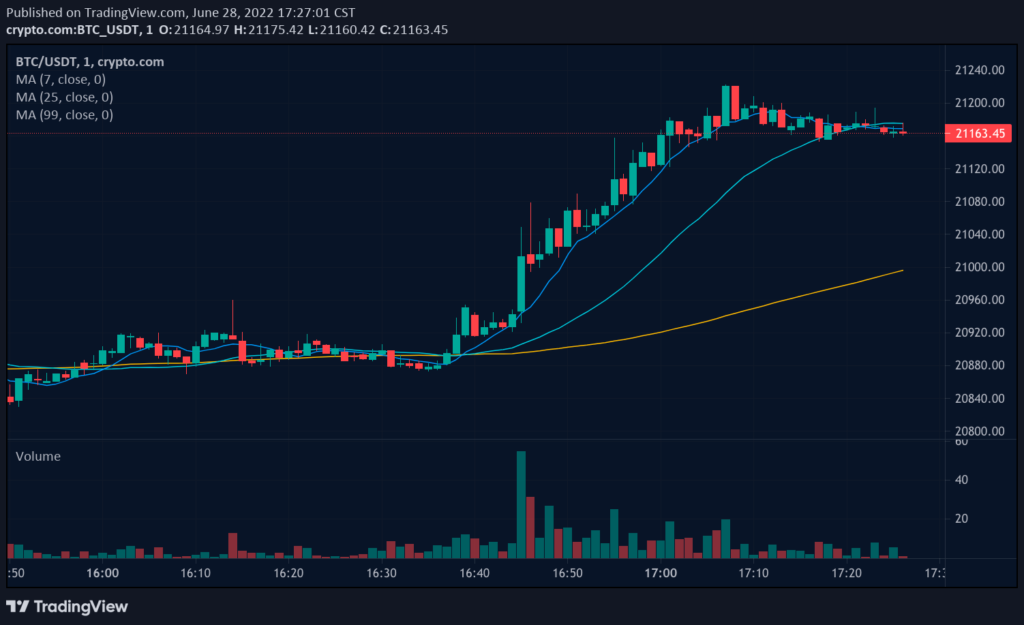
Insert this image group after Section 6 to illustrate prediction market volatility.
Prediction markets increasingly function as forward-looking sentiment indicators. For traders, they can signal asymmetric positioning opportunities.
7. Broader Industry Trends: Tokenization and Institutionalization
Beyond this legislation, broader industry currents reinforce JPMorgan’s thesis:
- Expansion of tokenized U.S. Treasury products
- Growth in RWA platforms
- Increased bank experimentation with blockchain settlement layers
- Corporate adoption of on-chain treasury management
Institutional blockchain adoption is no longer hypothetical. Major financial institutions have tested or launched tokenization pilots, especially in fixed income and repo markets.
If the Clarity bill passes, it could accelerate:
- Custodian bank digital asset divisions
- Compliance-native DeFi protocols
- Tokenized fund distribution platforms
8. Strategic Implications for Investors and Builders
For readers seeking new crypto assets and revenue streams, consider the following frameworks:
Short-Term (Speculative Positioning):
- Monitor ETF-linked altcoins that may benefit from regulatory easing.
- Watch prediction market probability shifts for momentum trades.
Medium-Term (Structural Plays):
- Invest in infrastructure tokens supporting tokenization and compliance tooling.
- Evaluate stablecoin ecosystems positioned for regulatory approval.
Long-Term (Institutional Alignment):
- Focus on platforms bridging traditional finance and decentralized infrastructure.
- Identify projects enabling compliant yield generation and asset tokenization.
Conclusion: Clarity as the Foundation of the Next Cycle
Markets thrive on liquidity, but they expand sustainably on clarity. JPMorgan’s projection that the Clarity bill may pass by mid-2026 introduces a structural narrative for the second half of the year.
While Senate gridlock and stablecoin reward disputes inject uncertainty, the direction of travel appears clear: institutional integration, defined jurisdiction, and expanded tokenization.
For investors, entrepreneurs, and blockchain operators, this moment is less about short-term volatility and more about regulatory architecture. If clarity arrives, it may not simply lift prices—it may redefine the operating framework of the digital asset economy.
The next cycle may not be driven solely by speculation. It may be driven by structure.