
Main Points :
- Crypto ETFs began February with sharp volatility, marked by rapid risk-on and risk-off rotations.
- Bitcoin spot ETFs recorded $318 million in weekly net outflows, despite late-week dip buying.
- Ethereum ETFs extended their losing streak, posting a third consecutive week of net redemptions.
- XRP spot ETFs stood out with $39 million in net inflows, defying broader market stress.
- Capital rotation signals a shift in investor psychology, with selective appetite beyond Bitcoin and Ethereum.
- ETF flows are becoming a real-time barometer of institutional sentiment toward crypto assets.
1. A Violent Opening to February: ETF Volatility Returns
The first week of February delivered a sharp emotional swing across the crypto ETF landscape. Heavy selling pressure at the beginning of the week was followed by an aggressive rebound toward the end. Yet despite a strong Friday recovery, the broader damage could not be fully reversed.
The rapid reversal pattern reflects a fragile market environment. Institutional investors appear caught between macro uncertainty, profit-taking behavior, and renewed dip-buying interest. Rather than steady conviction, flows showed hesitation—large redemptions early in the week, followed by opportunistic re-entry.
This push-and-pull dynamic is typical of transitional phases in asset cycles. After the explosive ETF-driven rally seen in previous months, capital now appears more selective. Not all crypto assets are being treated equally.
2. Bitcoin Spot ETFs: Large Outflows Despite Dip Buying
Bitcoin spot ETFs collectively ended the week with $318 million in net outflows.
While Friday alone saw approximately $371 million in inflows, this was insufficient to offset early-week redemptions. The largest products saw significant volatility:
- BlackRock IBIT absorbed midweek redemptions but closed the week down $115 million.
- Fidelity FBTC faced persistent selling pressure, finishing down $166 million.
- Grayscale GBTC recorded $173 million in outflows, continuing its structural redemption trend.
- Smaller inflows into products like Invesco BTCO and WisdomTree BTCW provided only marginal relief.
This suggests that Bitcoin remains institutionally held, but investor conviction is weakening at current price levels. Rather than structural abandonment, the pattern resembles tactical rebalancing.
Bitcoin Spot ETF Weekly Net Flows ($ millions)
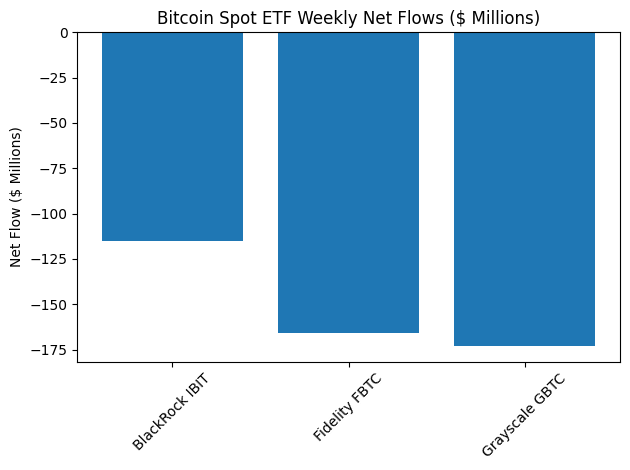
(Bar chart showing major funds and net weekly flows in $)
Interpretation: The graph visually demonstrates that inflows were concentrated in limited sessions, while cumulative weekly pressure remained negative.
3. Ethereum Spot ETFs: A Third Consecutive Week of Weakness
Ethereum spot ETFs extended their fragile trajectory with $166 million in weekly net outflows, marking three consecutive negative weeks.
The primary drag came from:
- BlackRock ETHA: –$152 million
- Fidelity FETH: –$60 million
- Grayscale ETHE: –$19 million
Although smaller products such as Bitwise ETHW, VanEck ETHV, and Invesco QETH saw intermittent inflows, these were insufficient to reverse the broader trend.
Ethereum’s ETF performance reflects a market in wait-and-see mode. Investors appear cautious ahead of scaling developments, regulatory clarity, and staking-related policy shifts. While Ethereum retains strong long-term fundamentals—including Layer-2 growth and tokenization momentum—short-term flows indicate reduced urgency to accumulate exposure.
Ethereum Spot ETF Weekly Net Flows ($ millions)
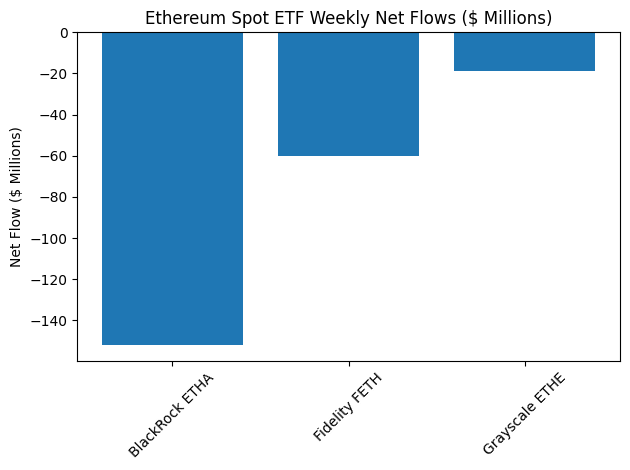
Interpretation: The persistent negative bars highlight ongoing redemption pressure concentrated in flagship funds.
4. XRP Spot ETFs: The Unexpected Winner
In stark contrast to Bitcoin and Ethereum, XRP spot ETFs recorded $39 million in weekly net inflows, making XRP the clear standout.
Key contributors included:
- Franklin XRPZ: +$20 million
- Bitwise XRP ETF: +$20 million
- Canary XRPC: +$3 million
Although Grayscale’s GXRP saw minor redemptions, the broader trend remained firmly positive.
This reversal from the prior week’s net outflows signals renewed confidence. XRP’s resilience may reflect:
- Improved regulatory clarity following legal developments.
- Institutional interest in cross-border payment infrastructure.
- Growing diversification beyond Bitcoin and Ethereum.
The key takeaway is not merely that XRP saw inflows—but that it did so during a week of broad crypto ETF stress.
Comparative Weekly ETF Flows — BTC vs ETH vs XRP ($ millions)
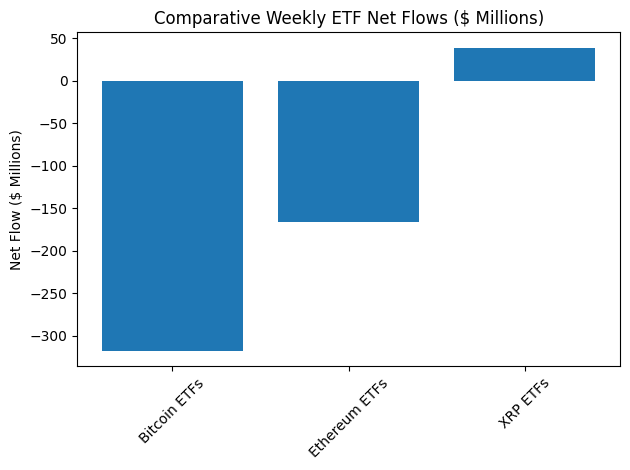
Interpretation: The side-by-side comparison highlights capital rotation into XRP during market turbulence.
5. Solana ETFs: Searching for Direction
Solana spot ETFs ended the week with $9 million in net outflows. Bitwise BSOL experienced notable midweek redemptions, partially offset by inflows into Fidelity FSOL.
Solana remains a high-beta asset—attractive during risk-on phases, but vulnerable during hesitation cycles. Its ETF flows suggest neither strong abandonment nor aggressive accumulation. Instead, investors appear to be monitoring ecosystem development, DeFi recovery, and real-world application growth.
6. Broader Trends: What ETF Flows Reveal About Institutional Strategy
The February volatility reveals several deeper structural trends:
6.1 Capital Is Rotating, Not Exiting
Total crypto ETF assets remain historically elevated. The flows suggest tactical repositioning rather than systemic withdrawal. Investors are reallocating within crypto rather than abandoning the asset class.
6.2 Selective Conviction Is Emerging
Bitcoin and Ethereum are no longer automatic beneficiaries of inflows. Capital now differentiates between narratives:
- Bitcoin: macro hedge and institutional store of value
- Ethereum: programmable settlement layer
- XRP: payments infrastructure and regulatory clarity narrative
- Solana: performance-driven ecosystem growth
XRP’s inflow suggests that investors are seeking differentiated exposure rather than defaulting to the two largest assets.
6.3 ETF Flows Are Now a Real-Time Sentiment Gauge
Unlike previous cycles driven by retail speculation, spot ETFs provide transparent daily flow data. Institutional risk appetite can now be tracked in near real-time.
For investors searching for emerging opportunities, monitoring ETF flows offers a practical edge. Flow divergence often precedes price divergence.
7. Strategic Implications for Investors Seeking the Next Revenue Source
For readers seeking new crypto assets or revenue streams, several practical insights emerge:
- Flow divergence matters. Assets attracting inflows during broad stress may signal narrative resilience.
- ETF approval alone does not guarantee sustained inflows. Conviction must align with macro context.
- Capital rotation can precede altcoin cycles. XRP’s performance may indicate early-stage selective alt momentum.
- Institutional access expands arbitrage and hedging opportunities. ETF-based exposure allows cross-market strategies between spot, futures, and derivatives.
In practical blockchain applications, institutional ETF adoption also supports:
- Treasury diversification strategies
- Collateralization frameworks
- Structured yield products
- Risk-managed crypto allocation models
8. Conclusion: February’s Message Is Rotation, Not Collapse
The first week of February did not signal the end of crypto ETF momentum. Instead, it revealed a maturing market.
Bitcoin stumbled under tactical selling.
Ethereum extended its cooling phase.
Solana searched for footing.
XRP quietly absorbed capital and emerged as the week’s standout performer.
The broader story is one of capital rotation and selective conviction. Institutional investors are no longer buying crypto indiscriminately. They are choosing narratives, allocating strategically, and responding dynamically to regulatory clarity and macro signals.
For investors seeking the next opportunity, the lesson is clear:
Follow the flows.
Watch the divergence.
And understand that ETF capital often moves before headlines do.
The turbulence of February may ultimately be remembered not as a setback—but as the beginning of a more differentiated, opportunity-rich phase in the crypto ETF market.