Main Points :
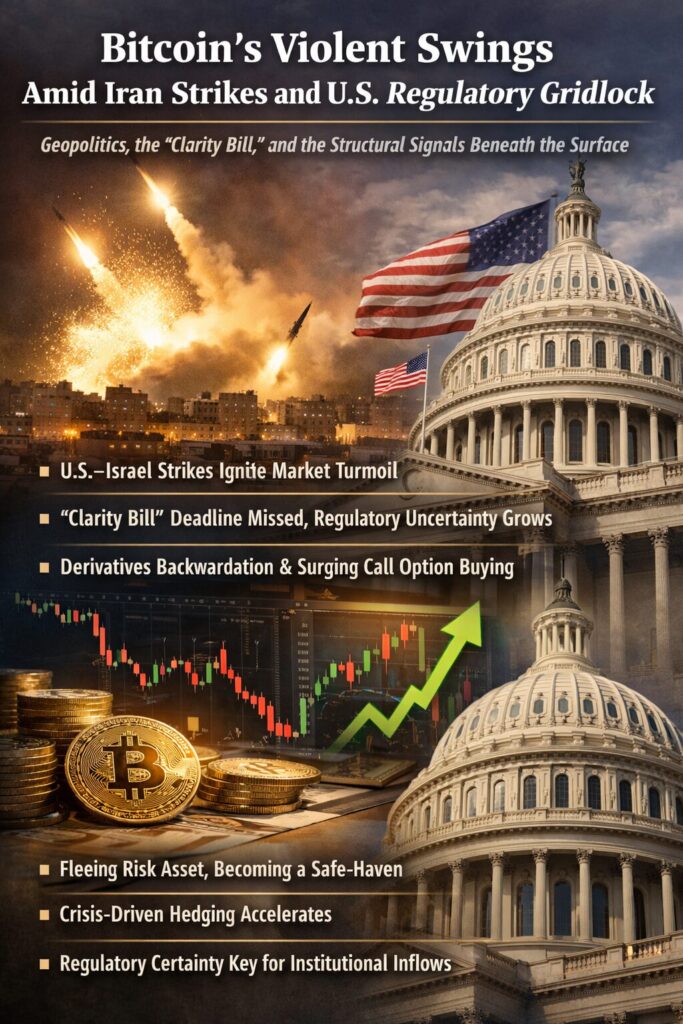
- Bitcoin experienced extreme volatility between March 1–2 following reports of U.S.–Israel strikes on Iran.
- Initial risk-off selling shifted to safe-haven buying as geopolitical tensions escalated.
- Comments suggesting a prolonged conflict reignited uncertainty and triggered renewed downside pressure.
- The failure of the U.S. “Clarity Bill” to meet its White House deadline intensified regulatory uncertainty.
- Derivatives markets show backwardation, signaling short-term supply-demand imbalances.
- Options markets reveal growing upside call positioning amid geopolitical hedging.
- Historical patterns suggest Bitcoin often transitions from risk asset to capital flight hedge during crises.
- Regulatory clarity remains the most important medium-term catalyst for institutional capital flows.
1. A Weekend Shock: Military Escalation and Immediate Market Reaction
Between March 1 and 2, Bitcoin (BTC) experienced unusually large price swings for a weekend session. The trigger was a series of reports indicating coordinated military strikes by the United States and Israel against Iran.
As news of the attacks surfaced, investors initially adopted a wait-and-see posture. Risk assets broadly weakened, and Bitcoin fell sharply as traders reduced exposure. This reaction was consistent with the cryptocurrency’s short-term correlation with equities during global uncertainty events.
However, as subsequent reports suggested deeper escalation—including the alleged killing of Iran’s Supreme Leader and potential disruption threats in the Strait of Hormuz—the market narrative began to shift. Bitcoin’s identity as a non-sovereign, censorship-resistant asset resurfaced in investor discourse. Buying pressure increased, and BTC rebounded as traders reconsidered its role as a hedge against capital controls and currency risk.
Yet volatility did not end there. Former U.S. President Donald Trump commented that the conflict could last approximately four weeks. This projection of extended instability revived uncertainty, and Bitcoin once again retreated as investors recalibrated risk.
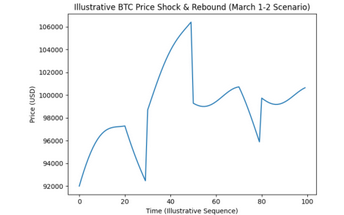
The episode demonstrated Bitcoin’s dual personality: initially treated as a risk asset, but rapidly reassessed as a geopolitical hedge.
2. The Regulatory Shadow: The U.S. “Clarity Bill” Stalls
Overlaying geopolitical instability was another critical development: the failure of the U.S. cryptocurrency market structure legislation—commonly referred to as the “Clarity Bill”—to meet the White House’s March 1 deadline.
The bill was widely anticipated as a framework to define jurisdictional boundaries between regulatory agencies such as the U.S. Securities and Exchange Commission (SEC) and the Commodity Futures Trading Commission (CFTC). Its delay prolongs uncertainty regarding token classification, exchange compliance, and institutional participation standards.
For institutional investors, regulatory clarity is not optional—it is foundational. Pension funds, asset managers, and major banks require legal certainty before deploying large-scale capital into digital assets. The absence of finalized legislation therefore risks delaying institutional adoption cycles.
Historically, Bitcoin bull cycles have been amplified when structural gateways—such as regulated futures markets, ETFs, and custody frameworks—are clarified. Conversely, ambiguity suppresses capital inflows and compresses valuation multiples.
The stalled bill, therefore, may represent a more profound medium-term headwind than the immediate geopolitical shock.
3. Derivatives Market Signals: Backwardation and Short-Term Imbalance
One of the most notable structural signals during the March 1–2 session was the emergence of backwardation in Bitcoin futures markets.
Backwardation occurs when futures prices trade below spot prices. This condition often signals short-term liquidity stress or heightened demand for immediate settlement.
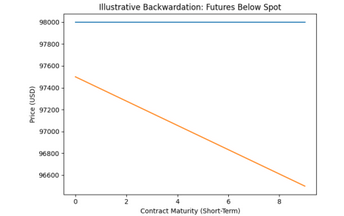
In this case, futures pricing below spot suggests traders demanded immediate Bitcoin exposure rather than deferred delivery. This can reflect short-covering activity or direct spot accumulation amid uncertainty.
Meanwhile, the options market showed increased open interest in out-of-the-money call options above current prices. This positioning implies that investors are hedging for upside scenarios, potentially driven by geopolitical escalation.
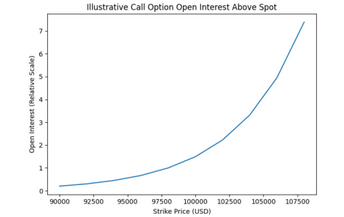
Order book data further supported a constructive bias: thick buy walls below the current price contrasted with relatively thin sell orders above. Such asymmetry suggests stronger support levels and easier upward price movement if buying momentum accelerates.
For professional traders, these microstructure signals are often more revealing than headline-driven narratives.
4. Historical Pattern: From Risk Asset to Crisis Hedge
Bitcoin’s behavior during geopolitical stress often follows a two-phase pattern:
- Initial liquidation phase – Investors sell BTC alongside equities to raise liquidity.
- Revaluation phase – Bitcoin is reconsidered as a hedge against capital controls and fiat instability.
This pattern has been observed during past crises, including regional conflicts and banking stress episodes.
In early stages, algorithmic trading and cross-asset risk reduction dominate. However, as conflict persists, capital flow restrictions and currency devaluation risks become tangible concerns. At this point, Bitcoin’s fixed supply and decentralized architecture gain renewed relevance.
If tensions between the U.S., Israel, and Iran continue, a similar revaluation dynamic could unfold.
5. Macro Calendar and Broader Catalysts
Beyond geopolitics and regulation, several macroeconomic events may influence near-term direction:
- U.S. ISM Manufacturing Index (March 3)
- FIN/SUM fintech event in Japan (March 3–6)
- U.S. Retail Sales (March 6)
Strong macro data could strengthen the U.S. dollar, potentially weighing on Bitcoin in the short term. Conversely, weak economic indicators could reinforce the narrative of monetary easing, supporting digital asset valuations.
Japan’s FIN/SUM event is also significant. As one of Asia’s most regulated yet innovation-friendly crypto markets, Japan’s fintech policy direction often serves as a leading indicator for regional adoption frameworks.
6. Implications for Investors Seeking New Crypto Opportunities
For readers searching for new crypto assets, yield opportunities, or practical blockchain applications, the current environment offers layered insights:
- Volatility creates asymmetric entry points.
- Derivatives data can signal positioning before price breaks.
- Regulatory milestones often precede structural rallies.
- Geopolitical crises may accelerate decentralized finance adoption.
Altcoin markets may also benefit if Bitcoin stabilizes and capital rotates outward. Infrastructure tokens tied to custody, compliance, and cross-border settlement could see renewed interest if institutional engagement resumes once regulatory clarity improves.
Additionally, decentralized finance (DeFi) platforms may gain attention as global capital mobility concerns intensify.
Conclusion: The Crossroads of War and Regulation
Bitcoin’s violent swings between March 1–2 were not random fluctuations but the intersection of two powerful forces:
- Geopolitical escalation in the Middle East.
- Regulatory stagnation in the United States.
In the short term, price action reflects headline sensitivity and derivative positioning. In the medium to long term, however, regulatory clarity remains the decisive factor for institutional capital expansion.
History suggests that Bitcoin often transitions from risk asset to crisis hedge when geopolitical stress persists. Whether that transformation unfolds again depends on the duration of the Iran conflict and the progress of U.S. crypto legislation.
For strategic investors, this is not merely a volatility event—it is a structural inflection point.