Main Points :
- Bitcoin is being reconsidered as a strategic reserve asset at the U.S. state level.
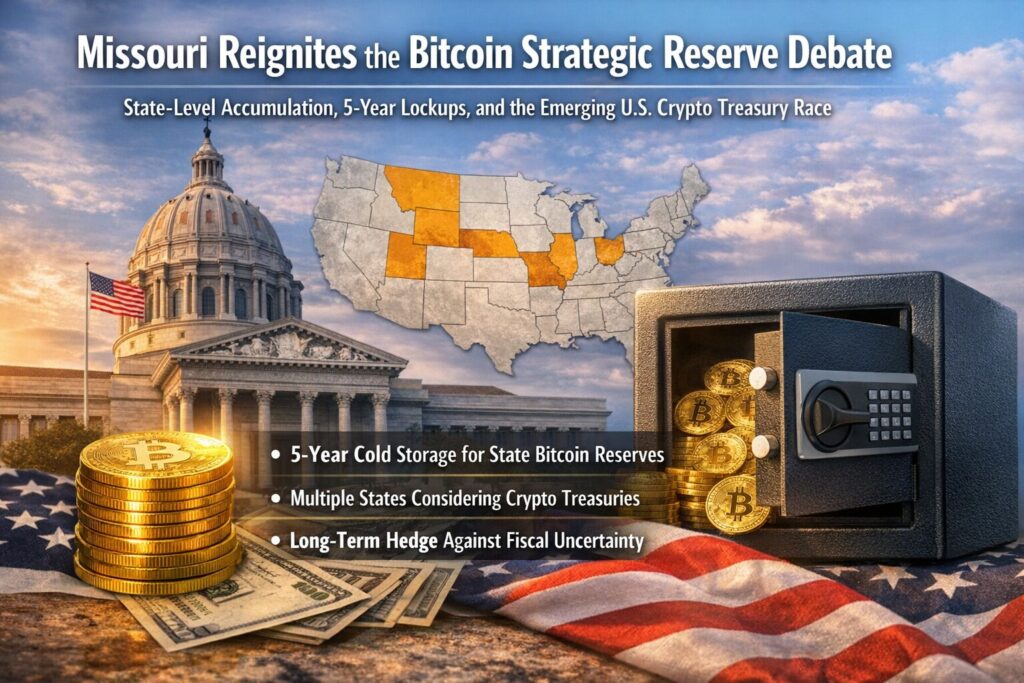
- Missouri has reintroduced HB 2080, enabling state-level Bitcoin accumulation with a mandatory 5-year cold storage holding period.
- The bill allows donations, grants, and government-held crypto acceptance, avoiding direct taxpayer allocation.
- Multiple states—including Arizona, South Dakota, Kansas, Utah, Pennsylvania, and Texas—are advancing similar frameworks.
- A 5-year lock-up model reframes Bitcoin from speculation to long-term fiscal hedge.
- This trend signals structural institutionalization of Bitcoin beyond ETFs and corporate treasuries.
1. Missouri’s HB 2080: A Structured Path Toward State Bitcoin Reserves
The Missouri legislature has advanced House Bill 2080 (HB 2080), reintroducing the concept of a state-level Bitcoin strategic reserve. Sponsored by Representative Ben Keathley, the bill was referred to the House Commerce Committee on February 19, 2026, and awaits public hearing.
Unlike earlier symbolic resolutions seen in some jurisdictions, HB 2080 proposes operational structure. It authorizes the State Treasurer to:
- Accept Bitcoin donations, grants, gifts, and bequests from qualified Missouri residents or governmental entities.
- Invest, purchase, and hold Bitcoin using designated mechanisms.
- Establish a formal “Bitcoin Strategic Reserve Fund.”
Crucially, the legislation avoids allocating direct taxpayer funds. Instead, it builds the reserve through voluntary or externally sourced digital asset contributions. This design lowers political friction while creating infrastructure for future expansion.
If passed, Missouri would formally recognize Bitcoin not merely as a speculative digital commodity, but as a treasury-class asset.
2. The Five-Year Cold Storage Mandate: Discipline Over Volatility
The core innovation of HB 2080 lies in its 5-year mandatory cold storage rule. Any Bitcoin acquired for the strategic reserve must remain in cold storage for at least five years before being transferred, liquidated, converted, or repurposed.
Cold storage is legally defined as private-key protection in an offline environment. The bill amends Chapter 30 of Missouri statutes to formally define:
- Bitcoin as a decentralized digital asset without a central administrator.
- Cold storage as offline cryptographic key protection.
This matters.
A five-year lock-up changes the narrative. It transforms Bitcoin from:
Short-term speculative trade
→ into
Long-duration fiscal hedge.
From a portfolio theory standpoint, Bitcoin historically exhibits high volatility but strong long-term return asymmetry. By enforcing time discipline, Missouri effectively removes short-term political pressure from treasury decisions.
Below is an illustrative growth scenario.
[Hypothetical 5-Year Holding Impact]
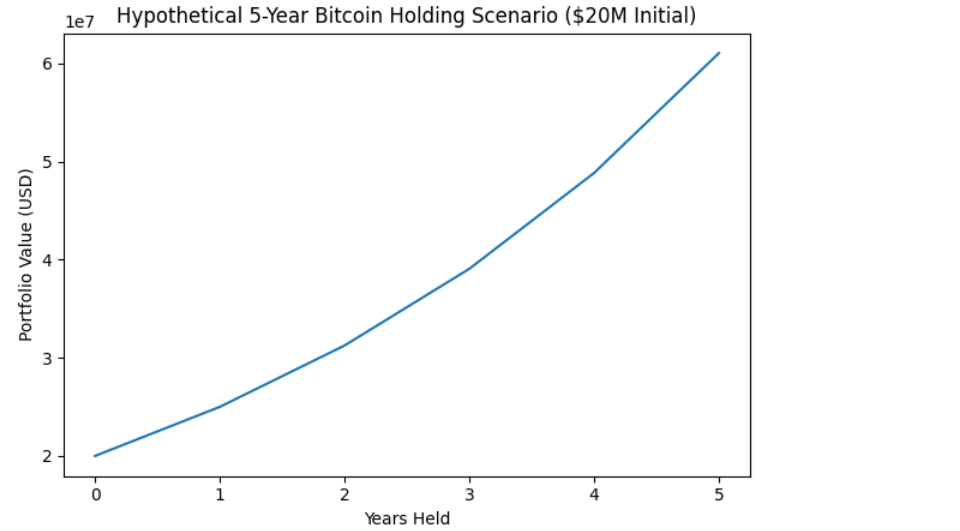
This chart models a hypothetical $20,000,000 allocation with 25% annualized growth. While purely illustrative, it demonstrates why policymakers may see long-term holding as rational fiscal experimentation.
3. A Broader State-Level Accumulation Race
Missouri is not alone.
Arizona has passed legislation enabling use of seized digital assets for reserve purposes. South Dakota, Kansas, Utah, and Pennsylvania have introduced related proposals. Texas reportedly purchased approximately $20,000,000 worth of Bitcoin in November of the prior year.
[IStates Exploring Bitcoin Reserve Frameworks]
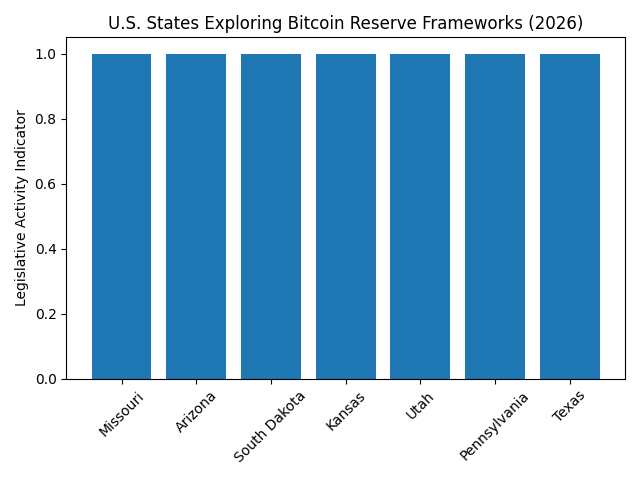
This chart illustrates active legislative exploration across multiple states. While each bill differs in funding source and custody model, the macro trend is unmistakable:
Bitcoin is migrating from private balance sheets to public ones.
This mirrors earlier institutional waves:
- Corporate Treasury Adoption (2020–2022)
- Spot ETF Approval and Institutional Custody Expansion (2024–2025)
- State-Level Strategic Reserve Exploration (2025–2026)
The strategic significance lies not in size—but in precedent.
4. Why Now? Macro Drivers Behind the Shift
Several macro forces likely contribute:
4.1 Inflation and Fiscal Hedge Narrative
Even if CPI stabilizes, long-term structural debt remains elevated in the United States. States are seeking asymmetric upside assets that:
- Cannot be debased.
- Have global liquidity.
- Remain politically independent of federal monetary policy.
Bitcoin’s fixed supply of 21 million coins supports its digital scarcity thesis.
4.2 Institutional Maturity
Bitcoin custody infrastructure has matured significantly. Independent U.S.-based third-party crypto service providers can now:
- Provide multi-signature cold storage.
- Conduct SOC audits.
- Implement regulatory reporting compliance.
HB 2080 explicitly allows Missouri to contract with independent U.S.-based crypto firms, reinforcing operational security.
4.3 Political Signaling
State-level Bitcoin adoption also functions as economic signaling. Pro-innovation states may attract:
- Blockchain startups.
- Mining operations.
- Custody providers.
- Venture capital allocation.
For states competing in fintech and digital infrastructure, Bitcoin reserve policy becomes branding.
5. Practical Implications for Crypto Investors and Builders
For readers seeking new crypto assets or income opportunities, Missouri’s move carries several implications.
5.1 Liquidity Compression Risk
If states accumulate Bitcoin with 5-year lockups, circulating supply effectively tightens. Long-term cold storage by public entities may reduce sell-side pressure.
5.2 Institutional Validation
State reserves legitimize Bitcoin in public finance discourse. That institutional validation can:
- Lower perceived regulatory risk.
- Encourage pension exposure experimentation.
- Stimulate municipal bond-tokenization experiments.
5.3 Adjacent Opportunities
The real alpha may not be Bitcoin itself—but infrastructure layers:
- Cold storage custody firms.
- Treasury accounting software for digital assets.
- Blockchain-based tax payment gateways.
- Secure multi-party computation services.
Missouri’s proposal includes allowing state agencies to accept approved digital assets for tax and fee payments. That opens practical use-case expansion beyond reserve holding.
6. Risks and Political Constraints
No treasury model is without risk.
- Bitcoin volatility remains extreme.
- Public backlash could arise during drawdowns.
- Custody security is paramount.
- Federal regulatory shifts may complicate state-level autonomy.
The 5-year lock mitigates emotional liquidation but increases exposure duration risk.
However, Missouri’s donation-based accumulation model softens fiscal exposure while building optionality.
7. If HB 2080 Passes: Structural Consequences
Should HB 2080 become law (effective August 2026), Missouri would join a small but growing group of states formally recognizing Bitcoin as a strategic reserve asset.
This would:
- Create legal precedent.
- Normalize cold storage definitions in state code.
- Establish reporting frameworks.
- Institutionalize multi-year holding discipline.
The psychological impact could outweigh initial balance sheet size.
Markets move not just on capital—but on legitimacy.
Conclusion
Missouri’s reintroduction of HB 2080 is more than a legislative event. It represents a shift in how Bitcoin is perceived within public finance architecture.
By mandating 5-year cold storage, avoiding taxpayer allocation, and enabling structured oversight, the bill reframes Bitcoin from speculative instrument to strategic macro hedge.
As more states explore similar frameworks, a new frontier emerges:
Bitcoin not merely as an investment.
But as sovereign-adjacent digital reserve infrastructure.
For investors and builders, the opportunity may lie not only in holding Bitcoin—but in constructing the custody, reporting, and compliance rails that make state-level adoption sustainable.
The state accumulation era may be just beginning.