Main Points :
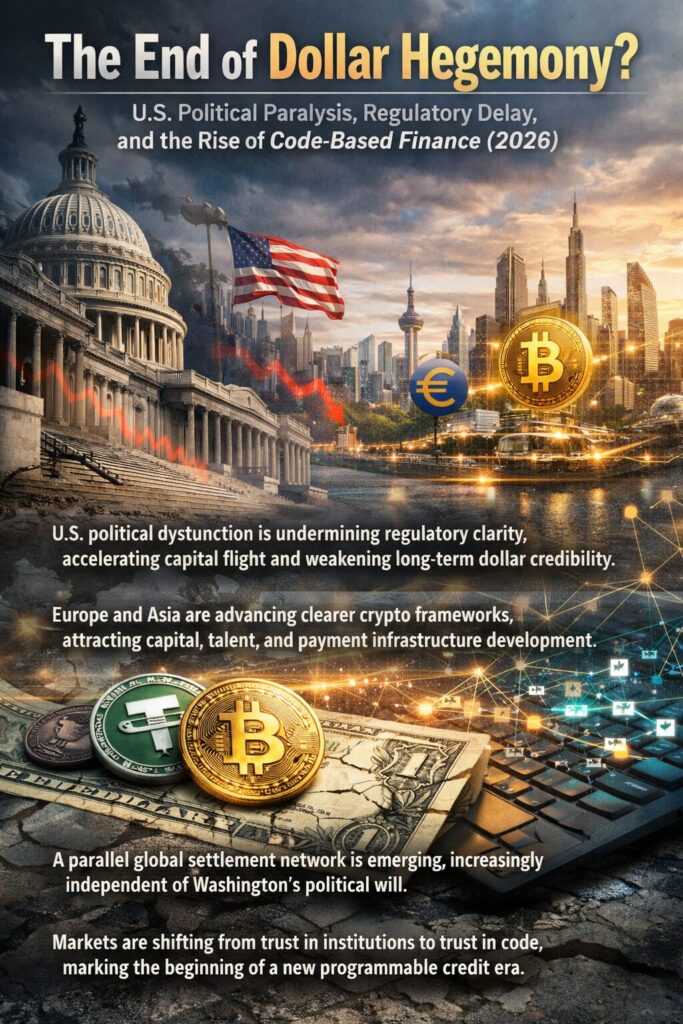
- U.S. political dysfunction is undermining regulatory clarity, accelerating capital flight and weakening long-term dollar credibility.
- Stablecoins represent the digital evolution of the dollar, but delayed legislation such as the proposed CLARITY Act risks pushing innovation offshore.
- Europe and Asia are advancing clearer crypto frameworks, attracting capital, talent, and payment infrastructure development.
- A parallel global settlement network is emerging, increasingly independent of Washington’s political will.
- Markets are shifting from trust in institutions to trust in code, marking the beginning of a new programmable credit era.
1. Washington’s Paralysis and the Cost of Technological Illiteracy
Repeated legislative gridlock in Washington has exposed a widening gap between political process and financial reality. While Congress debates frameworks like the proposed CLARITY Act, global capital flows are already migrating into programmable systems that operate 24/7 without jurisdictional pause.
In previous decades, U.S. financial dominance rested on three pillars:
- Deep Treasury markets
- Federal Reserve liquidity supremacy
- Dollar settlement dominance
However, in 2026, financial infrastructure is no longer solely institutional—it is increasingly computational.
Stablecoins—most prominently USDT and USDC—have collectively exceeded $250 billion in circulating supply globally (converted to $ value). These tokens are not speculative fringe instruments; they function as digital dollars embedded directly into blockchain settlement layers.
If legislation remains delayed, the issue is not merely innovation loss—it is control loss.
When law fails to keep pace with infrastructure, entrepreneurs and engineers relocate. Regulatory arbitrage is not ideological; it is economic. Jurisdictions that offer clarity attract both capital and talent.
The United States has historically transformed friction into innovation. Today, however, bureaucratic inertia risks converting friction into stagnation.
If engineers migrate and stablecoin issuance shifts offshore, the United States will gradually lose oversight over dollar-denominated liquidity operating beyond Federal Reserve reach.
The cost is not immediate collapse. The cost is slow erosion.
2. Stablecoins: The Digital Dollar Beyond Borders
[Global Stablecoin Market Capitalization Growth (2019–2026, in $)]
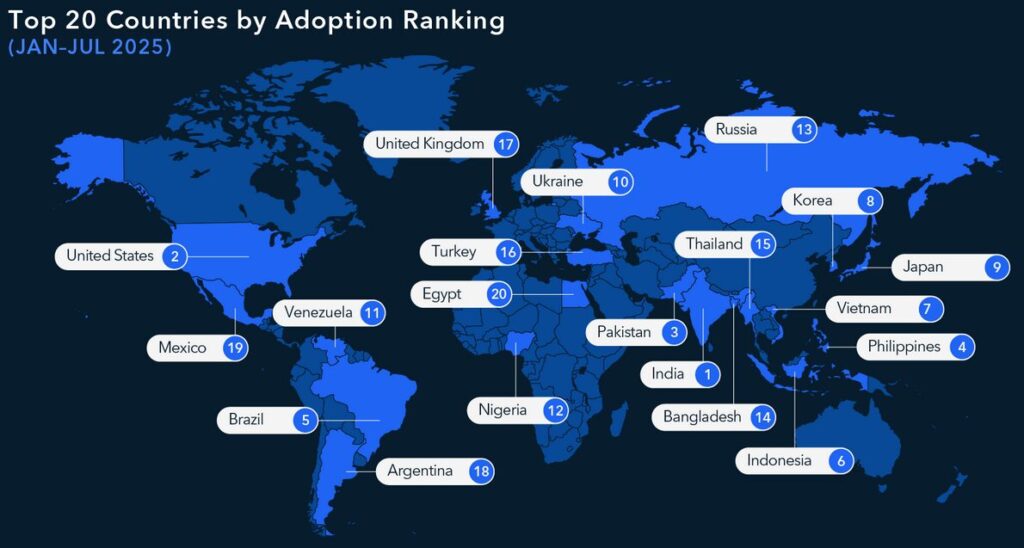
Stablecoins represent a profound structural shift.
Unlike traditional bank deposits, stablecoins:
- Settle instantly on-chain
- Operate without banking hours
- Move across borders without SWIFT
- Integrate into DeFi, exchanges, and tokenized asset platforms
When dollar liquidity migrates onto blockchain rails, it effectively becomes programmable monetary infrastructure.
The strategic dilemma for the U.S. is this:
If Washington delays clear federal legislation, stablecoin issuers increasingly anchor themselves in jurisdictions with regulatory certainty—such as:
- European Union under MiCA
- Singapore
- United Arab Emirates
The European MiCA framework, implemented in 2024–2025, already provides operational clarity around reserve backing and supervision. Meanwhile, Asian financial hubs are aggressively courting tokenized finance.
If dollar-backed stablecoins operate under foreign legal regimes, then dollar liquidity becomes partially decoupled from U.S. political leverage.
This is historically unprecedented.
3. The Self-Inflicted Weakening of Financial Hegemony
[Share of USD in Global Reserves vs. Growth of Alternative Settlement Networks (2010–2026, in $ terms)]
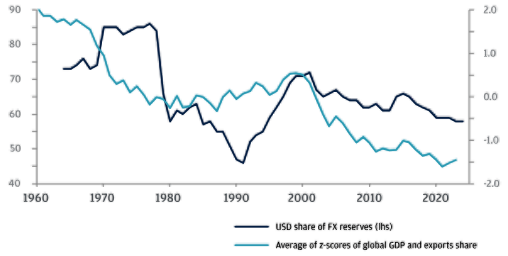
Dollar dominance has already declined from over 70% of global reserves in the early 2000s to around 58%–59% in recent years (converted to $ values).
Simultaneously:
- BRICS trade blocs are experimenting with alternative clearing mechanisms.
- Cross-border blockchain settlement volumes have increased exponentially.
- Commodity trade invoicing diversification has accelerated.
None of these alone dethrone the dollar. But collectively, they indicate structural fragmentation.
If stablecoin infrastructure grows outside U.S. jurisdiction, the Federal Reserve’s traditional monetary weapon—liquidity control—becomes less effective internationally.
The paradox is striking:
While the U.S. debates regulation, the world builds parallel rails.
Financial leadership is no longer about military projection or sanctions dominance alone. It is about:
- Code architecture
- Regulatory sophistication
- Settlement efficiency
The countries that combine these elements will define the next financial era.
4. Market Self-Defense: Capital Chooses Clarity
By 2026, market participants are no longer waiting for benevolent political resolution.
Venture capital funding in blockchain infrastructure has increasingly flowed toward:
- Singapore-based exchanges
- UAE tokenization platforms
- European regulated digital asset custodians
When regulatory clarity exists, cost of capital decreases.
When ambiguity persists, risk premiums rise.
For builders and investors seeking the next revenue frontier, clarity is oxygen.
In an environment where U.S. rules remain fragmented between the SEC, CFTC, and state regulators, capital simply relocates.
This is not ideological migration.
It is operational risk management.
5. Code as the New Credit Engine
[On-Chain Settlement vs. Traditional Settlement Time Comparison]
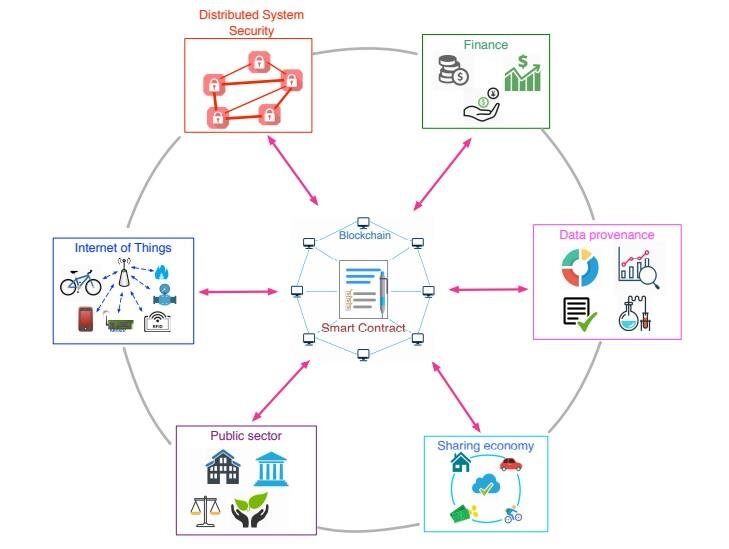
In traditional finance, trust flows through:
- Banks
- Clearinghouses
- Legal contracts
In programmable finance, trust increasingly flows through:
- Smart contracts
- Cryptographic verification
- Public ledgers
This transition marks the beginning of what may be called The Code-Based Credit Century.
Tokenized U.S. Treasury bonds—already issued by major asset managers—allow yield-bearing exposure on-chain. DeFi lending markets dynamically adjust rates via algorithmic liquidity.
The implications are vast:
- Capital efficiency improves
- Settlement risk decreases
- Access becomes borderless
However, absent clear regulatory frameworks, U.S. institutions may participate defensively rather than offensively.
If the U.S. cannot provide clarity, it risks losing first-mover advantage in programmable finance.
6. Strategic Implications for Investors and Builders
For readers seeking new crypto assets, income streams, or practical blockchain deployment opportunities, the structural shift presents three opportunities:
(1) Infrastructure Tokens
Layer-1 and Layer-2 ecosystems enabling stablecoin settlement may gain strategic importance.
(2) Tokenized Real-World Assets (RWA)
Tokenized bonds, commodities, and private credit platforms represent yield-oriented blockchain expansion.
(3) Cross-Border Payment Networks
Startups building compliant cross-jurisdiction rails are positioned to benefit from geopolitical fragmentation.
The core theme is not speculation—it is infrastructure.
Where infrastructure migrates, economic gravity follows.
7. Conclusion: The Cost of Silence
Political delay does not stop technological progress.
It merely determines who benefits from it.
If the United States continues regulatory paralysis, the outcome will not be dramatic collapse—but gradual decentralization of dollar influence.
Stablecoins will not eliminate the dollar.
They will redefine it.
The decisive question of 2026 is not whether blockchain will integrate into global finance—it already has.
The question is whether the United States will lead that integration—or watch it unfold offshore.
History suggests that financial dominance belongs to those who align law, capital, and code.
If those three diverge, power diffuses.
The battle for transparency and programmable trust has only begun.