

Main Points :
- The Digital Asset Market Clarity Act of 2025 (CLARITY Act, H.R.3633) aims to clearly divide regulatory authority between the SEC and CFTC.
- The bill passed the U.S. House in July 2025 and is under Senate review in early 2026.
- It proposes registration frameworks for exchanges and brokers, tailored disclosure rules for token issuers, and strengthened AML/CFT requirements.
- Stablecoin yield regulation and jurisdictional authority remain major political debates.
- If enacted, the law could reduce legal uncertainty, accelerate institutional capital inflows, and intensify global regulatory competition.
- The implications extend beyond the U.S., influencing Europe, Asia, and markets such as Japan.
1. What Is the CLARITY Act?
The Digital Asset Market Clarity Act of 2025 (CLARITY Act, H.R.3633) is one of the most significant crypto regulatory reform proposals ever debated in the United States. Passed by the House of Representatives in July 2025 and currently under consideration by the Senate Banking Committee as of February 2026, the bill attempts to resolve a problem that has haunted the U.S. crypto market for years: regulatory ambiguity.
For more than a decade, market participants have struggled with a fundamental question: which digital assets are securities under the jurisdiction of the U.S. Securities and Exchange Commission (SEC), and which are commodities overseen by the Commodity Futures Trading Commission (CFTC)? The absence of statutory clarity has resulted in enforcement-driven policymaking, litigation risk, and a chilling effect on innovation.
The CLARITY Act seeks to address this by establishing a structured classification framework. Broadly speaking:
- Highly decentralized assets that do not depend on managerial efforts or profit expectations tied to an issuer would be categorized as “digital commodities” and primarily overseen by the CFTC.
- Tokens tied to issuer-driven business activities or investor profit expectations would fall under SEC securities oversight.
By drawing clearer lines between asset categories, the bill aims to shift U.S. crypto regulation away from ambiguity toward predictable rulemaking.
2. Core Provisions of the Bill
2.1 Registration Framework for Exchanges and Brokers
The CLARITY Act introduces a structured registration regime for digital asset exchanges, brokers, and dealers. Entities facilitating digital commodity trading would be required to:
- Segregate customer assets
- Disclose conflicts of interest
- Maintain minimum capital requirements
- Implement transparent reporting practices
This could resemble a hybrid model combining traditional commodity market standards with tailored crypto safeguards.
2.2 Disclosure Framework for Token Issuers
Rather than forcing token issuers into legacy securities registration systems, the Act proposes a digital-asset-specific disclosure model. This recognizes that decentralized protocols differ fundamentally from equity issuers.
Key disclosure elements may include:
- Governance structure
- Token supply mechanics
- Network functionality
- Risk disclosures
This may reduce compliance friction while still ensuring investor protection.
2.3 Safe Harbor Considerations for Developers
One controversial area has been whether developers, validators, or wallet providers could be treated as financial intermediaries. The bill appears to include provisions preventing mere software developers or self-custody tool providers from automatically being categorized as regulated intermediaries.
This is critical for open-source ecosystems and Web3 infrastructure growth.
2.4 Strengthened AML/CFT Obligations
The Act reinforces compliance with U.S. Bank Secrecy Act (BSA) obligations, including anti-money laundering (AML) and counter-terrorism financing (CFT) requirements.
Crypto intermediaries would remain subject to:
- Know-your-customer (KYC) procedures
- Suspicious Activity Reporting (SAR)
- Sanctions compliance
Rather than deregulation, the bill represents regulatory clarification combined with enforcement consolidation.
3. Senate Negotiations and Political Controversies
Despite House passage, Senate deliberations remain complex. Three primary debates dominate:
3.1 Stablecoin Yield Regulation
A central controversy involves yield-bearing stablecoins. Traditional banks argue that interest-generating stablecoins could trigger deposit outflows, destabilizing banking liquidity. Crypto advocates counter that yield mechanisms are integral to innovation and decentralized finance (DeFi).
If yield-bearing stablecoins are deemed securities, they may fall under stricter SEC rules, significantly reshaping stablecoin economics.
3.2 Jurisdictional Allocation Between SEC and CFTC
The power balance between regulators remains sensitive. Historically, the SEC has pursued enforcement-based expansion of authority. The CFTC has advocated a more commodity-based interpretation for decentralized assets.
The CLARITY Act attempts to legislate this division rather than leave it to court interpretation.
3.3 Ethical and Political Concerns
Some lawmakers have raised concerns about political donations from crypto industry participants influencing legislative neutrality. With the 2026 U.S. political cycle approaching, negotiations are intertwined with electoral considerations.
Prediction markets have suggested a roughly balanced probability of enactment, underscoring legislative uncertainty.
4. Political Drivers Behind Regulatory Acceleration
U.S. Treasury officials and policymakers have increasingly emphasized investor protection and financial stability. Several forces accelerate legislative urgency:
- Global regulatory competition (Europe’s MiCA framework already active)
- Institutional investor demand for legal certainty
- Stablecoin systemic risk considerations
- Election cycle timing
Early 2026 represents a key negotiation window.
5. Market Impact Analysis
5.1 Legal Certainty as a Capital Catalyst
One of the most immediate effects of enactment would be reduced legal ambiguity. Regulatory predictability lowers compliance risk premiums and could attract larger pools of capital.
5.2 Institutional Capital Inflows
Pension funds, insurance companies, sovereign wealth funds, and asset managers often cite regulatory clarity as a prerequisite for exposure.
The following conceptual chart illustrates the expected relationship between regulatory clarity and institutional allocation growth.
[“Projected Institutional Crypto Allocation Growth Post-Regulatory Clarity” Line Graph Image File]
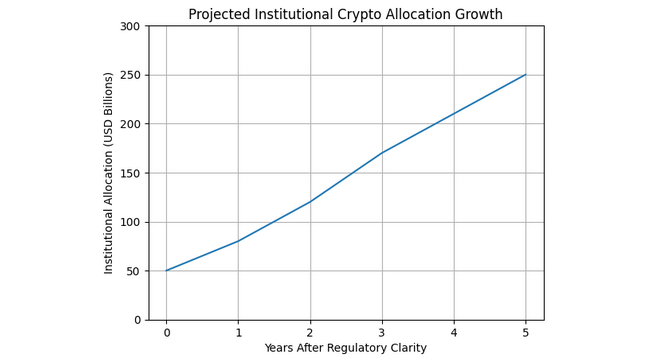
This graph visually demonstrates hypothetical growth in institutional allocation from $50 billion to over $250 billion within five years under a clarified regulatory regime.
5.3 Market Integrity Improvements
Enhanced exchange registration and reporting could reduce manipulation risks, improving market credibility. However, critics warn that compliance burdens may disproportionately affect smaller startups.
6. Stablecoins and Systemic Finance
Stablecoins sit at the intersection of banking and blockchain. The regulatory classification of yield-bearing stablecoins could fundamentally alter DeFi models.
The diagram below illustrates regulatory branching outcomes.
[“Stablecoin Regulatory Classification Flow Diagram” Image File]
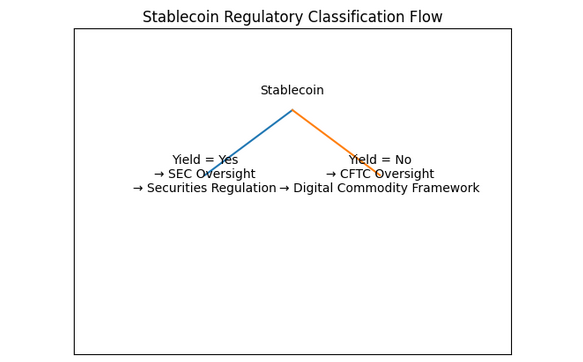
If classified as securities:
- SEC oversight
- Prospectus-like disclosures
- Potential limitations on yield
If classified as digital commodities:
- CFTC oversight
- Commodity-based compliance structure
7. Global Regulatory Competition
The U.S. does not operate in isolation. Europe’s Markets in Crypto-Assets (MiCA) framework has already implemented comprehensive licensing regimes. Meanwhile:
- Hong Kong has introduced retail crypto licensing
- Singapore continues to refine its Payment Services Act
- Japan debates digital asset financial instrument reforms
The comparative regulatory timeline is illustrated below.
[“Global Crypto Regulatory Timeline: US vs EU vs Asia” Image File]

The United States risks capital migration if legislative clarity lags behind competitors.
8. Implications for Investors and Builders
For investors seeking new digital assets and yield opportunities, regulatory clarity reduces asymmetric information risk. For builders, classification clarity enables strategic product design.
For example:
- Projects may design tokens explicitly to meet “digital commodity” decentralization thresholds.
- Institutional-grade custodial solutions may expand.
- Tokenized real-world asset (RWA) platforms may accelerate under clearer jurisdictional pathways.
In dollar terms, global crypto market capitalization—currently fluctuating around several trillion dollars—could see structural expansion if institutional inflows accelerate under a stable regulatory regime.
9. Legislative Process Ahead
Before becoming law, the bill must:
- Pass Senate committee review
- Pass a Senate floor vote
- Reconcile differences with the House (if amended)
- Obtain Presidential signature
Timing remains uncertain and dependent on political negotiation dynamics.
10. Conclusion
The CLARITY Act represents more than a regulatory technicality—it symbolizes a turning point in how the world’s largest economy treats digital assets. By clearly distinguishing between digital commodities and securities, the bill attempts to replace enforcement ambiguity with statutory predictability.
If enacted, the likely consequences include:
- Lower compliance uncertainty
- Greater institutional participation
- Enhanced global competitiveness
- Accelerated tokenized asset innovation
Yet political risk remains real. Senate negotiations, stablecoin yield debates, and inter-agency jurisdictional tensions may delay or reshape the bill.
For market participants, preparation—not speculation—is prudent. Regulatory clarity, when it comes, will not simply affect prices; it will reshape infrastructure, capital flows, and competitive dynamics across the global blockchain ecosystem.
The next phase of crypto growth may depend less on technological breakthroughs and more on legislative resolution.


