
Main Points :
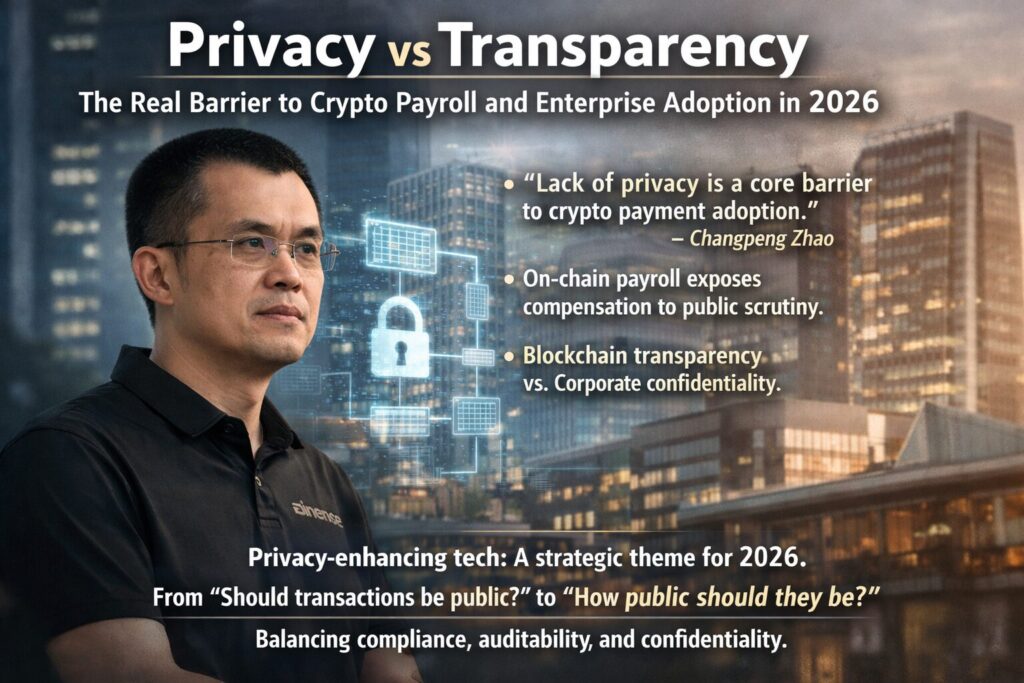
- Changpeng Zhao argues that lack of privacy is a core barrier to crypto payment adoption.
- On-chain payroll exposes compensation structures to public scrutiny.
- Public blockchain transparency conflicts with corporate confidentiality.
- Privacy-enhancing technologies are becoming a 2026 strategic theme.
- The industry debate is shifting from “should transactions be public?” to “how public should they be?”
- Institutional adoption depends on balancing compliance, auditability, and confidentiality.
1. CZ Raises the Core Question: Is Transparency Too Transparent?
On February 15, 2026, Changpeng Zhao (CZ), founder of Binance, posted on X that one of the main obstacles to widespread crypto payment adoption may be the absence of privacy.
The argument is not theoretical. It is structural.
If a company pays employee salaries directly on-chain using cryptocurrencies such as Bitcoin or Ethereum, every transaction is permanently recorded on a public ledger. The sending address, receiving address, and transaction amount are visible to anyone.
While blockchain transparency was designed to enhance trust, prevent fraud, and enable verification, the same property creates complications in corporate contexts. Once wallet addresses are linked to identifiable individuals, third parties can estimate salary levels, compensation structures, and internal hierarchies.
In traditional finance, payroll data is confidential. In public blockchains, confidentiality is not native.
This contradiction lies at the heart of CZ’s warning.
2. The Structural Risk of On-Chain Payroll Visibility
Public blockchains function as open ledgers. Anyone can examine transaction histories through block explorers. That openness is central to decentralization.
However, corporate payroll introduces a new dimension:
- Compensation levels may become inferable.
- Internal pay gaps could be externally analyzed.
- Executive compensation structures might be mapped.
- Competitive intelligence risks increase.
- Employees with high balances become visible security targets.
For example, if a technology firm pays 50 employees monthly in stablecoins worth $5,000–$50,000 each, and the company wallet is known, observers could reconstruct the salary distribution curve over time.
This is not hypothetical—it is mathematically trivial once address clustering techniques are applied.
Blockchain analytics firms already perform address linkage for compliance and AML monitoring. The same tools can be used for competitive surveillance.
In this sense, transparency becomes a double-edged sword.
3. Transparency vs Privacy: A Structural Tradeoff
(Transparency vs Privacy Conceptual Tradeoff)
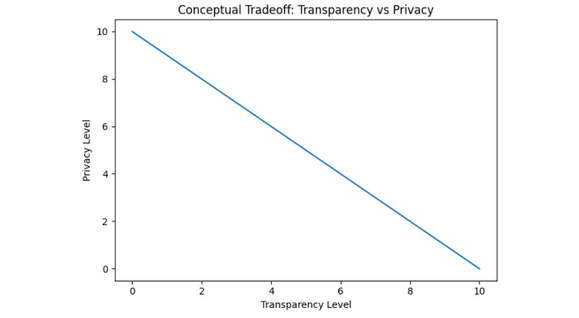
Public blockchains sit at the high-transparency, low-privacy end of the spectrum.
Traditional corporate finance sits at the high-privacy, low-transparency end.
The adoption challenge is therefore not about transaction speed or fees alone. Stablecoin transfers already settle in minutes at costs often below $1. Cross-border remittance friction is decreasing.
The real barrier is information exposure.
Enterprises do not hesitate because blockchain is slow. They hesitate because it is too open.
4. The 2026 Theme: Privacy as Strategic Infrastructure
Venture capital research groups such as a16z crypto have increasingly highlighted privacy as a central theme for 2026.
The narrative shift is notable:
2017–2021: Scalability
2021–2024: Institutionalization and regulation
2025–2026: Programmable privacy and compliance-aligned confidentiality
As traditional finance integrates with blockchain rails—through tokenized assets, stablecoin settlements, and programmable payments—the limitations of full transparency become more evident.
Financial institutions are comfortable with auditability. They are not comfortable with radical openness.
5. Existing Privacy Approaches
5.1 Privacy Coins
One example is Monero, which uses ring signatures and stealth addresses to obscure transaction participants and amounts.
Advantages:
- Strong privacy guarantees
- Transaction unlinkability
Challenges:
- Regulatory scrutiny
- Exchange delistings in some jurisdictions
- AML tension
Privacy coins demonstrate that technical privacy is possible. The issue is regulatory compatibility.
5.2 Zero-Knowledge Proof Systems
Zero-knowledge (ZK) proofs allow verification of transaction validity without revealing underlying details.
This model could enable:
- Salary payments validated as compliant
- Proof of sufficient reserves
- Regulatory reporting without public disclosure
ZK-based rollups and privacy layers are becoming foundational infrastructure rather than niche experiments.
5.3 Layer 2 and Off-Chain Systems
Lightning Network processes transactions off-chain before settling on the base layer.
Benefits:
- Increased speed
- Reduced fee exposure
- Partial reduction of public traceability
However, it does not guarantee full anonymity.
Layer 2 improves efficiency more than confidentiality.
6. Institutional Voices and Industry Alignment
CZ’s remarks received support from figures such as Barry Silbert of Digital Currency Group, parent of Grayscale Investments.
Institutional investors increasingly recognize that the next wave of adoption depends on configurable transparency.
Not secrecy. Not opacity.
But selective disclosure.
The debate is no longer “public vs private.” It is about disclosure granularity.
7. Enterprise Adoption vs Privacy Protection
(Enterprise Adoption vs Privacy Level)
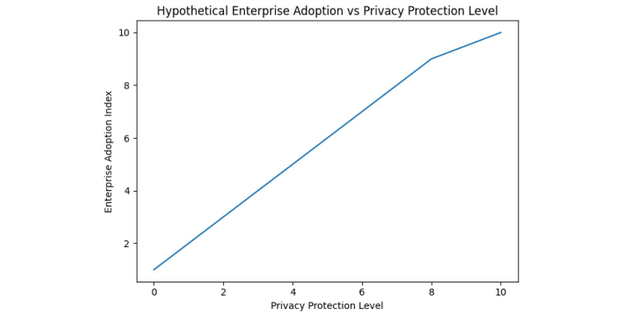
The hypothetical model suggests that enterprise adoption increases as privacy protections improve—provided regulatory compliance remains intact
If systems offer:
- Audit trails for regulators
- Privacy from competitors
- Protection for employees
- Risk mitigation against targeted attacks
Then adoption curves steepen.
This is particularly relevant for multinational firms handling payroll in jurisdictions with heightened security risks.
8. The Compliance Balancing Act
Privacy cannot mean evasion.
Regulators require:
- AML traceability
- Sanctions screening
- Reporting capabilities
- Transaction monitoring
The challenge is designing systems where:
Regulators can access necessary data
But competitors and the public cannot
Programmable disclosure may become the defining architecture of next-generation payment networks.
9. Comparing Privacy Technology Approaches
(Privacy Technology Comparison)
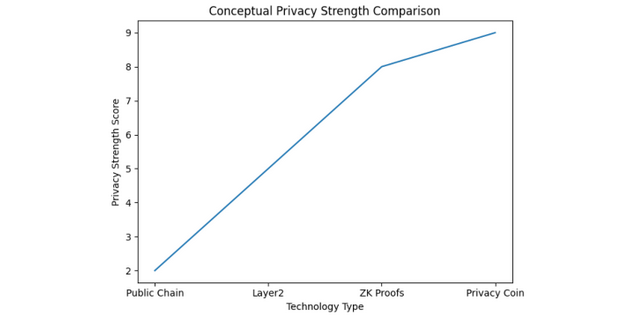
Conceptually:
Public chains: High transparency, low privacy
Layer 2: Moderate efficiency gains, partial privacy
Zero-knowledge systems: Adjustable privacy with verification
Privacy coins: Maximum confidentiality, regulatory complexity
No single solution is dominant.
Hybrid architectures are likely.
10. Stablecoins, Corporate Treasury, and Payroll Evolution
Enterprise crypto usage is growing in:
- Cross-border settlement
- Treasury diversification
- Vendor payments
- Payroll for remote workers
Stablecoins denominated in USD ($) provide predictable accounting and FX neutrality.
However, if payroll data is public, competitive firms could analyze:
- Hiring trends
- Compensation inflation
- Geographic expansion
Information asymmetry becomes information leakage.
This is why privacy is no longer ideological—it is operational.
11. Physical Security Considerations
An overlooked dimension is personal risk.
If executives receive $500,000 equivalent annually in visible crypto transfers, that data may expose them to:
- Phishing campaigns
- Targeted cyber attacks
- Physical threats
Privacy in finance has historically been linked to safety.
Public blockchains disrupt that norm.
12. The Next Battleground: Disclosure Scope
The core industry debate is evolving:
How public should financial data be?
Transparency strengthens trust.
Privacy strengthens security.
The winning architecture will allow:
- Public auditability of systems
- Confidentiality of individuals
- Regulatory oversight
- Competitive secrecy
That balance defines 2026’s strategic frontier.
Conclusion: Privacy as the Missing Layer of Web3 Finance
Crypto payments are no longer limited by infrastructure speed or transaction cost.
They are limited by visibility.
Changpeng Zhao’s observation reframes the adoption debate. Transparency, once celebrated as blockchain’s greatest virtue, may now be its largest institutional hurdle.
The solution is not abandoning transparency—but refining it.
For investors seeking new crypto opportunities, the next growth wave may emerge from:
- Privacy-preserving infrastructure
- ZK-based payment rails
- Compliance-aligned confidentiality systems
- Enterprise-focused blockchain middleware
For builders and operators, the question is no longer “Can we process payments on-chain?”
It is:
“Can we protect what should not be public while proving what must be verified?”
The answer to that question will define the next phase of crypto’s integration into global finance.


