
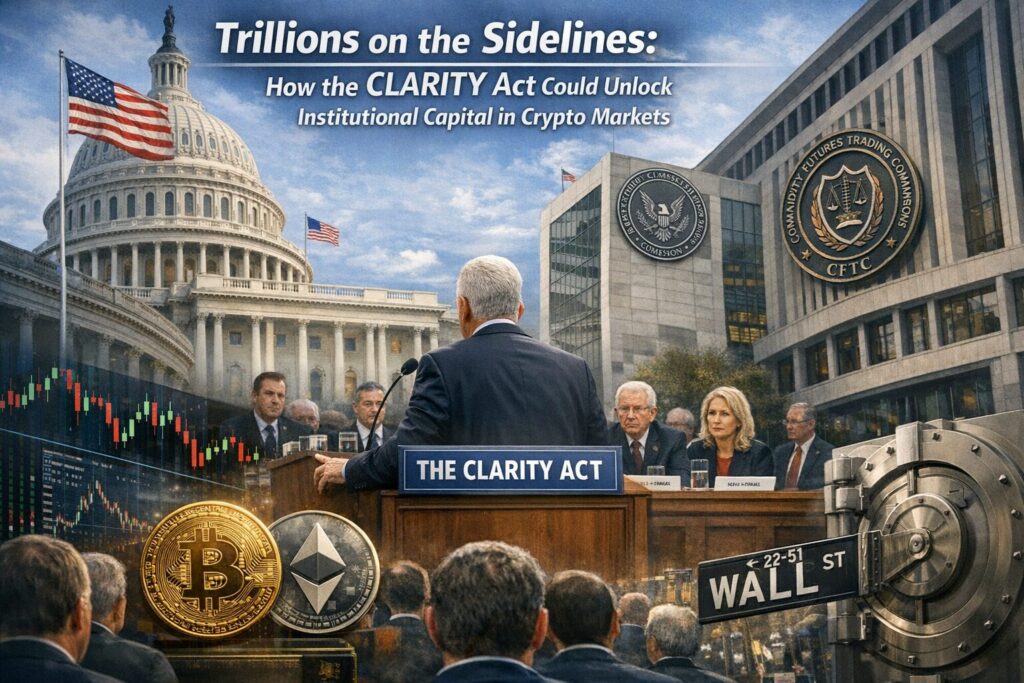
Main Points :
- A senior White House official stated that trillions of dollars in institutional capital are waiting on regulatory clarity before entering crypto markets.
- The CLARITY Act aims to define the regulatory boundaries between the SEC and CFTC.
- Regulatory ambiguity has suppressed pension funds, banks, and asset managers from direct crypto exposure.
- Stablecoin provisions and bank-sector concerns remain key negotiation points in the Senate.
- Passage of the CLARITY Act could represent a structural turning point for Bitcoin, Ethereum, and digital asset markets.
- The policy outcome will directly influence market infrastructure, custody frameworks, exchange participation, and capital allocation.
1. A Trillion-Dollar Waiting Game: White House Signals Institutional Readiness
In a recent interview with Yahoo Finance on February 14, 2026, Patrick Witt, Executive Director of the President’s Digital Assets Advisory Council at the White House, made a striking statement: trillions of dollars in institutional capital are prepared to enter the digital asset market—but are waiting for regulatory clarity.
This was not a casual remark about speculative inflows. Witt emphasized that internal compliance frameworks at pension funds, asset managers, and banking institutions prevent direct participation in digital assets unless legal classification and supervisory authority are clearly defined. According to Witt, “Regulatory clarity is the key.”
The capital he referenced is not hypothetical. U.S. pension funds alone manage more than $30 trillion in assets. Even a modest allocation of 1–3% toward digital assets would represent hundreds of billions of dollars in inflows. Add sovereign wealth funds, endowments, insurance firms, and global asset managers, and the number easily reaches into the trillions.
Unlike previous bull cycles driven by retail speculation, this phase is about institutional compliance gating. Capital is not absent due to lack of interest—it is constrained by legal uncertainty.
2. What Is the CLARITY Act?
The CLARITY Act is a comprehensive market-structure bill designed to codify digital asset regulation in the United States. Its primary goal is to resolve jurisdictional ambiguity between:
- The U.S. Securities and Exchange Commission (SEC)
- The Commodity Futures Trading Commission (CFTC)
At the heart of the issue is asset classification. Are certain tokens securities? Commodities? Payment instruments? Something entirely new?
Without statutory definitions, regulators have relied on enforcement actions. This has created uncertainty for exchanges, custodians, banks, and token issuers.
The CLARITY Act seeks to:
- Define digital asset categories
- Establish supervisory boundaries
- Clarify registration requirements
- Outline compliance frameworks for exchanges and intermediaries
If enacted, the Act would allow institutional compliance departments to formally approve digital asset allocations under existing fiduciary rules.
3. Why Regulatory Uncertainty Suppressed Institutional Entry
Institutional capital does not move based on enthusiasm—it moves based on legal certainty.
For banks and pension funds, compliance committees must evaluate:
- Custody risk
- Counterparty exposure
- Regulatory classification
- Reporting obligations
- Capital reserve requirements
Without clear statutory treatment, any allocation could violate fiduciary standards.
This explains why, despite the approval of spot Bitcoin ETFs in prior years, direct market participation remained limited. ETFs provide exposure through regulated wrappers, but they do not fully integrate crypto into banking infrastructure or treasury operations.
The CLARITY Act aims to bridge that gap.
4. Structural Market Impact if Passed
If regulatory clarity is achieved, several structural shifts may occur:
A. Exchange Participation Expands
Banks could directly offer digital asset brokerage and custody services.
B. Custody Becomes Institutional-Grade
Clear rules enable trust banks and regulated custodians to scale operations.
C. Treasury Allocations Normalize
Corporations may allocate reserves beyond Bitcoin into broader crypto assets.
D. Stablecoins Integrate with Banking Rails
Regulatory definitions could formalize stablecoin issuance and yield structures.
This is not about short-term price spikes. It is about infrastructure normalization.
5. Stablecoin Debate: A Critical Pressure Point
One of the most contentious issues in Senate negotiations involves stablecoins.
Banking-sector representatives have raised concerns about:
- Yield-bearing stablecoins competing with bank deposits
- Liquidity risk
- Monetary transmission effects
Meanwhile, crypto industry advocates argue that restrictive provisions could stifle innovation.
Stablecoins are critical because they function as:
- Settlement rails
- Collateral instruments
- DeFi liquidity layers
- Cross-border payment tools
If stablecoin rewards are restricted or heavily regulated, DeFi yield models could be reshaped. If approved with workable guidelines, stablecoins could become a formal extension of digital dollar infrastructure.
6. Political Timelines and Treasury Pressure
Treasury Secretary Scott Bessent has urged Congress to finalize the Act by Spring 2026, adding urgency to the legislative timeline.
When Treasury leadership publicly references a deadline, markets pay attention.
However, negotiations continue behind closed doors. Amendments involving SEC authority, CFTC scope, and banking exemptions remain under discussion.
The final language matters more than the headline.
7. Broader Market Context: Bitcoin, Ethereum, and Beyond
Bitcoin currently trades within a volatile range around $60,000–$72,000. Ethereum struggles near $2,100–$2,200 resistance levels.
Institutional capital waiting on regulation creates a paradox:
- Markets are liquid but structurally undercapitalized.
- Sentiment is cautious but allocation interest remains strong.
If regulatory clarity unlocks capital flows, price discovery mechanisms could shift from retail-driven volatility to institutionally driven trend formation.
[“Institutional Capital Potential vs Current Crypto Market Cap”]
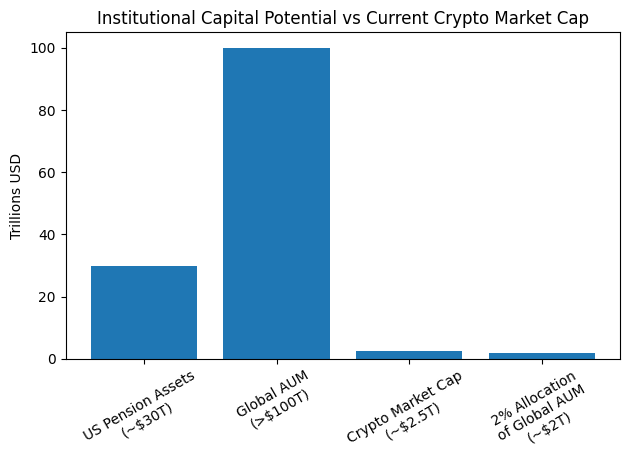
This visual should illustrate:
- Total U.S. pension assets (~$30T)
- Global asset manager AUM (~$100T+)
- Current total crypto market cap (~$2–3T)
The graph demonstrates how even 2% allocation would materially expand market capitalization.
[“Regulatory Uncertainty vs Institutional Allocation Flow”]
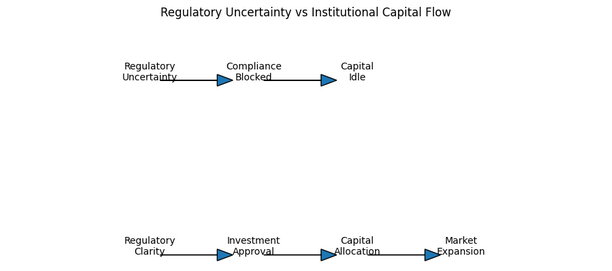
A conceptual flow diagram showing:
Unclear Regulation → Compliance Block → Capital Idle
Clear Regulation → Approval Process → Allocation → Market Expansion
8. Practical Implications for Investors Seeking Opportunity
For readers seeking:
- New digital assets
- Yield opportunities
- Practical blockchain applications
The CLARITY Act represents a structural catalyst rather than a speculative narrative.
Areas to monitor include:
- Regulated custody providers
- Infrastructure tokens
- Compliance-focused blockchain networks
- Tokenized real-world asset platforms
- Stablecoin issuers aligned with bank frameworks
Capital does not enter randomly—it enters through compliant channels.
Projects aligned with regulatory integration may benefit first.
9. The Real Question: Is This the Next Institutional Cycle?
Every crypto cycle has had a defining driver:
- 2017: ICO speculation
- 2020–2021: DeFi and retail liquidity
- 2024–2025: ETF-driven legitimization
The next phase may be regulatory normalization.
If trillions truly sit on the sidelines, the transition will not resemble previous bull runs. It will resemble the gradual institutionalization of markets like commodities and derivatives.
But if negotiations stall or overregulation emerges, capital could remain dormant.
The outcome is binary—but the implications are structural.
Conclusion: Policy as the Primary Catalyst
Patrick Witt’s statement is not a price forecast—it is a structural observation.
Capital is waiting.
Compliance is the gatekeeper.
The CLARITY Act is the key.
Whether the Act passes intact, amended, or delayed will shape the next era of crypto markets.
For long-term participants interested in blockchain’s practical adoption—not just speculative volatility—the legislative trajectory in Washington may matter more than short-term price charts.
The market’s next move may not begin on an exchange.
It may begin in Congress.


