
Main Points :
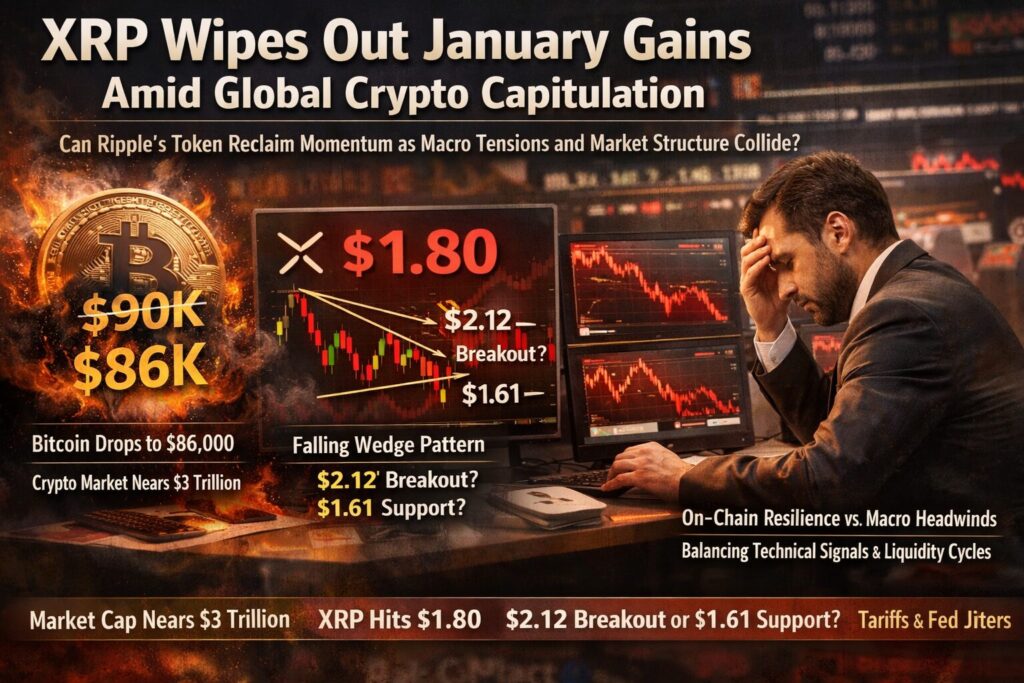
- XRP fell to $1.80, erasing nearly all of its January gains amid a broad crypto market sell-off.
- Macro headwinds including tariff tensions and U.S. Federal Reserve uncertainty amplified risk-off sentiment.
- Bitcoin’s drop from near $90,000 to $86,000 acted as a market anchor, dragging total crypto market capitalization toward $3 trillion.
- XRP is forming a falling wedge (compression pattern), with a potential breakout above $2.12 or a flush toward $1.61 within 21 days.
- On-chain resilience and long-term payment use cases remain structurally intact despite short-term volatility.
- Investors seeking new revenue streams must balance technical signals with macro liquidity cycles.
1. Macro Shockwaves: Tariffs, Risk Aversion, and the Crypto Contagion
In late January, a broad cryptocurrency sell-off rippled through global markets, dragging XRP down to $1.80, its lowest level since mid-December. The drop erased nearly all of XRP’s early-year gains and pushed weekly losses beyond 5%. Billions of dollars were wiped from the token’s market capitalization in a matter of days.
The immediate catalyst was not crypto-specific. Instead, renewed tariff rhetoric from U.S. political leadership reignited concerns about trade wars and global economic fragmentation. Investors, already sensitive to liquidity conditions, interpreted the rhetoric as inflationary and potentially restrictive for global trade.
Simultaneously, attention turned to upcoming U.S. Federal Reserve decisions following fresh Personal Consumption Expenditures (PCE) data. Markets feared that persistent inflation might delay interest-rate cuts or prolong restrictive monetary policy. When liquidity expectations tighten, speculative assets—particularly cryptocurrencies—often react first and most violently.
Bitcoin nearly touched $90,000 over the weekend before reversing sharply to $86,000. That retracement served as an anchor on the broader digital asset complex. Total crypto market capitalization drifted dangerously close to the psychologically important $3 trillion support level.
The contagion spread quickly:
- Ethereum fell to approximately $2,787
- BNB slipped toward $855
- Solana retreated to $117
Yet, a wave of dip-buying shortly after the panic stabilized the market cap around $3.04 trillion, suggesting that institutional liquidity remains present even during volatility spikes.
2. XRP’s January Rally — And Its Collapse
XRP began 2026 quietly optimistic, trading around $1.84 on January 1. By January 6, bullish sentiment intensified, pushing the token above the psychological $2.40 barrier.
This rally, however, proved fragile.
After a brief consolidation above $2.00, momentum faded. On January 19, the broader macro pullback triggered renewed selling pressure. XRP slipped below $2.00, testing $1.95, and then eventually plunging to $1.80 during peak capitulation.
What makes this reversal notable is its structural similarity to previous XRP cycles:
- Rapid retail enthusiasm
- Institutional hesitation
- Macro-driven correction
- Technical compression phase
Despite the damage, XRP managed to remain marginally above its January 1 opening price—an important psychological benchmark.
3. Technical Structure: Falling Wedge Compression
From a technical perspective, XRP is now trading within what analysts describe as a falling wedge or compression pattern. This formation often precedes a decisive breakout.
Current Technical Indicators
- Relative Strength Index (RSI): hovering between 44–47 (neutral-to-slightly bearish)
- MACD: below signal line, though histogram suggests weakening selling pressure
- Volume: declining, consistent with consolidation
Technical traders are watching two critical levels:
- Bullish breakout target: Above $2.12
- Bearish flush scenario: Down toward $1.61
Most analysts estimate that a decisive move could occur within 21 days, as compression narrows price volatility.
[XRP Falling Wedge Pattern]
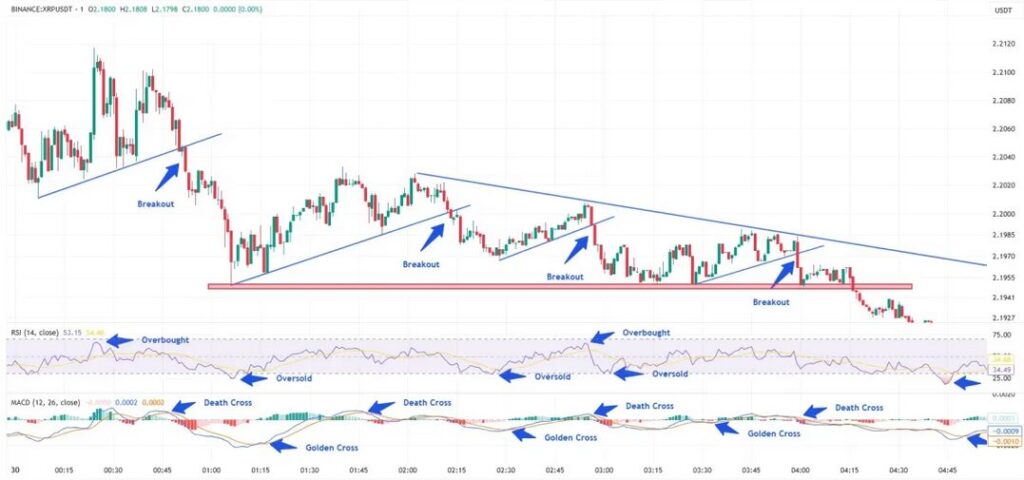
Example visualization of falling wedge compression and momentum indicators.
4. Bitcoin’s Influence and Market Liquidity Cycles
XRP rarely moves in isolation. Bitcoin’s liquidity dominance remains a primary directional force.
Historically, when Bitcoin corrects sharply after nearing major psychological levels (such as $90,000), altcoins experience magnified drawdowns. This is due to capital rotation dynamics:
- BTC rallies attract liquidity.
- Altcoins follow with higher beta exposure.
- Macro shock triggers BTC pullback.
- Altcoins correct more aggressively.
However, the rapid dip-buying response suggests that large participants are accumulating selectively rather than exiting entirely.
5. Beyond Price: XRP’s Practical Blockchain Utility
For readers interested in practical blockchain use cases and long-term revenue models, price action is only part of the story.
XRP’s core thesis remains cross-border settlement efficiency:
- Near-instant transaction finality
- Low transaction costs
- Institutional remittance corridors
- Liquidity bridge functionality
Financial institutions exploring blockchain-based treasury solutions continue to examine tokenized settlement rails. In a world of rising geopolitical fragmentation, decentralized liquidity bridges may become strategically valuable.
For fintech operators and payment companies, XRP remains relevant in:
- Cross-border treasury optimization
- FX liquidity management
- On-demand liquidity solutions
- Emerging market remittance networks
Short-term volatility does not eliminate structural use cases.
6. What Comes Next? Scenario Modeling
Bullish Scenario
- Macro tensions ease.
- Federal Reserve signals accommodative posture.
- Bitcoin stabilizes above $88,000.
- XRP breaks $2.12, retesting $2.40.
Bearish Scenario
- Trade tensions escalate.
- Inflation persists.
- BTC falls below $84,000.
- XRP flushes toward $1.61 before stabilization.
Neutral Consolidation
- Continued compression between $1.80–$2.05
- Breakout delayed into late February
[Crypto Market Cap Reaction]
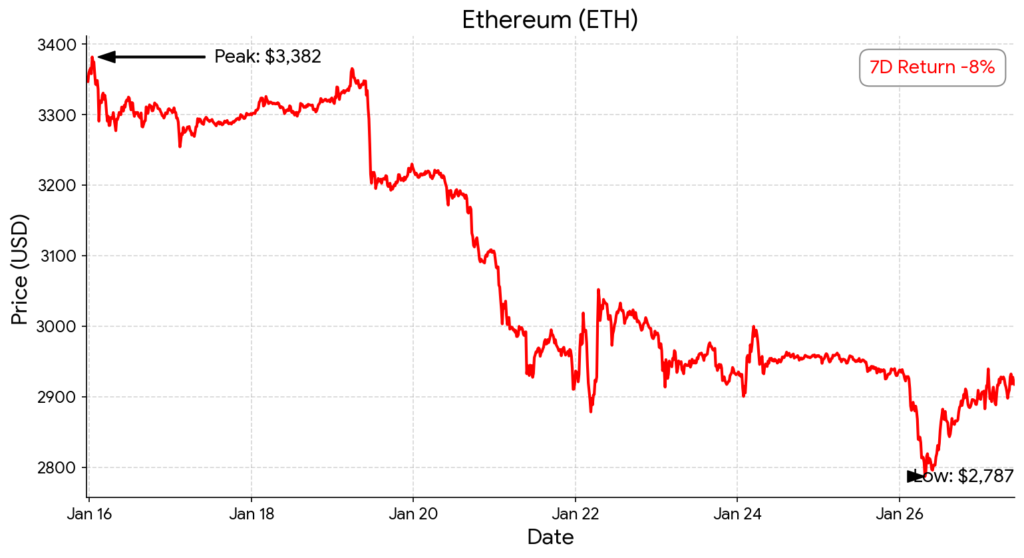
Market-wide reaction to Bitcoin correction and macro catalysts.
7. Strategic Takeaways for Investors Seeking New Crypto Opportunities
For readers searching for new crypto assets or yield opportunities, this environment requires discipline.
Key considerations:
- Monitor liquidity cycles, not just token narratives.
- Use compression patterns to time entry zones.
- Evaluate tokens with real payment or infrastructure utility.
- Diversify between high-beta assets (e.g., SOL) and settlement-oriented assets (e.g., XRP).
- Hedge macro exposure through portfolio sizing.
Periods of capitulation often precede structural opportunities—but only when macro liquidity stabilizes.
Conclusion: Volatility as a Structural Feature, Not a Flaw
XRP’s January rally has effectively been erased, but the broader structural thesis remains intact. The token now sits at a technical crossroads: compression suggests a decisive move within weeks.
Macro liquidity will likely determine direction. Investors must balance technical signals, macro conditions, and practical blockchain utility when evaluating next steps.
The crypto market remains a high-beta reflection of global risk appetite. For disciplined participants, volatility is not merely risk—it is opportunity in compressed form.


