
Main Points :
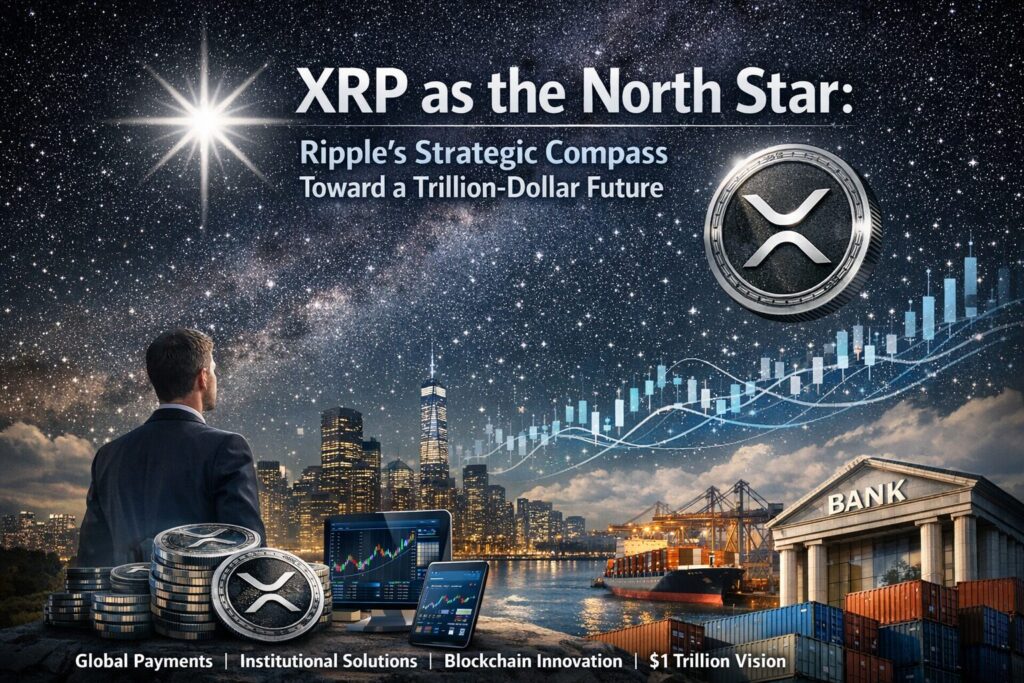
- XRP is described by Ripple’s CEO as the “North Star” guiding all corporate strategy.
- Ripple’s product lines—including payments, prime brokerage, treasury, custody, and stablecoin operations—are designed to enhance XRP and XRPL utility.
- 2026 is positioned as a year of integration following major acquisitions in 2025.
- Large-scale acquisitions are unlikely early in 2026, but may resume later in the year.
- A $1 trillion crypto company is viewed as achievable, and Ripple sees itself as a candidate.
- The long-term opportunity lies in real-world blockchain infrastructure, liquidity efficiency, and institutional adoption.
1. “XRP Is Our North Star”
At the XRP Community Day 2026 event hosted on X Spaces, Ripple CEO Brad Garlinghouse made a symbolic yet strategic declaration: “XRP is Ripple’s North Star.”
The metaphor is powerful. A North Star is not just a guiding light; it is a fixed reference point used for navigation across vast uncertainty. By describing XRP this way, Garlinghouse positioned the digital asset not as a secondary liquidity instrument or legacy token, but as the core axis around which Ripple’s entire corporate structure revolves.
He emphasized that whenever Ripple develops products such as Ripple Payments, Ripple Prime, Ripple Treasury, Custody services, or RLUSD (Ripple’s stablecoin initiative), the central question is always the same:
How can this improve the utility, trust, speed, and liquidity of XRP and the XRP Ledger (XRPL)?
This framing is critical. It signals that Ripple does not view XRP as incidental to its business. Instead, XRP is treated as the strategic gravity center of the organization.
2. Expanding Utility: XRPL as Financial Infrastructure
XRP Community Day brought together token holders, developers, enterprises, and Ripple executives to celebrate real-world impact. The discussion centered not on speculation, but on usability and adoption.
XRPL has evolved beyond a simple settlement layer. It now supports:
- On-demand liquidity (ODL)
- Tokenization of real-world assets
- Institutional custody solutions
- Enterprise-grade treasury management
- Stablecoin issuance infrastructure
The importance of this expansion cannot be overstated. In the current crypto cycle, infrastructure plays are increasingly outperforming purely speculative narratives.
(“Conceptual Growth of XRP Ecosystem Utility”)
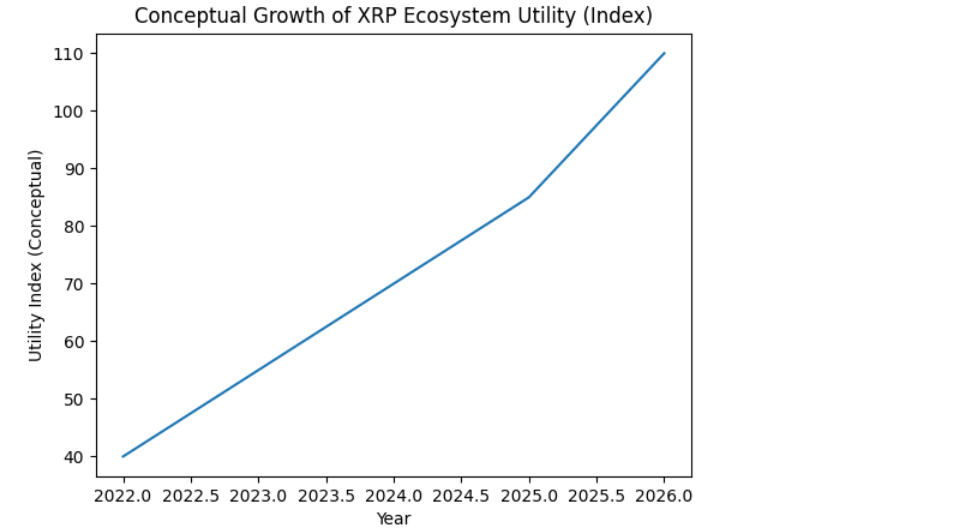
The chart above illustrates a conceptual growth trajectory in XRPL ecosystem utility from 2022 through 2026. While illustrative, it reflects broader industry dynamics: blockchain networks that demonstrate practical integration tend to experience structural demand rather than cyclical hype.
For investors and builders seeking the next revenue frontier, infrastructure-layer assets offer compounding advantages. Transaction fees, liquidity routing, enterprise adoption, and tokenization flows create diversified value streams beyond price appreciation alone.
3. Strategic Acquisitions: Building Institutional Depth
In 2025, Ripple made notable acquisitions including:
- Hidden Road (a prime brokerage firm)
- G-Treasury (a treasury management software provider)
These acquisitions signal a strategic shift. Rather than competing purely as a blockchain company, Ripple is positioning itself at the intersection of traditional finance and digital asset liquidity.
Garlinghouse stated that 2026 will focus primarily on integration rather than large-scale new acquisitions. That discipline is telling. Many crypto firms historically expanded too aggressively during bullish cycles, only to face operational strain later.
(“Ripple Strategic Acquisitions”)
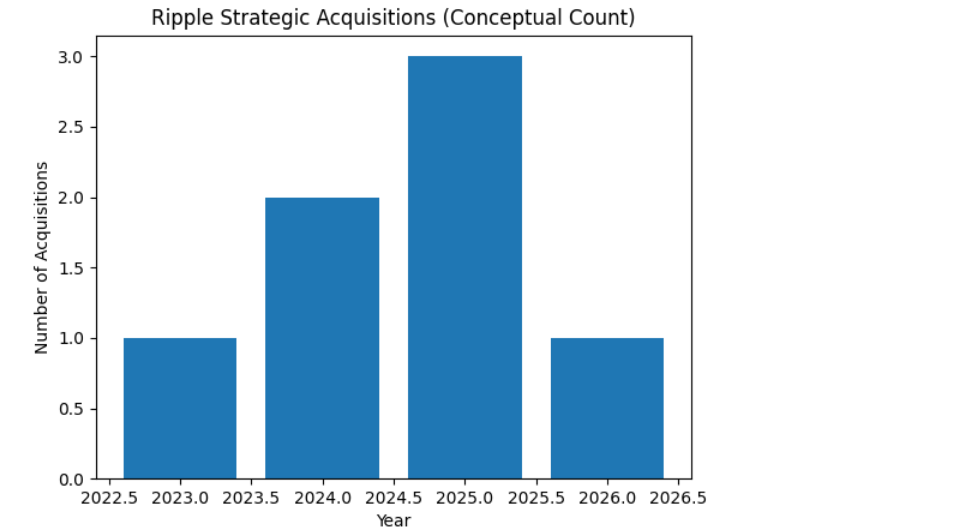
The above chart conceptually represents Ripple’s acquisition tempo. The 2026 slowdown suggests consolidation and operational refinement rather than expansion for expansion’s sake.
However, Garlinghouse also hinted that the second half of 2026 could see renewed merger and acquisition activity.
For readers seeking new income opportunities, this matters. M&A activity often precedes ecosystem expansion, new service verticals, and partnership revenue streams. Strategic integration tends to drive enterprise adoption, which in turn strengthens network liquidity demand.
4. The $1 Trillion Question
Perhaps the most ambitious statement from the event was Garlinghouse’s view that at least one crypto company could achieve a $1 trillion market capitalization—and that Ripple has a legitimate chance.
To put this in perspective, only a handful of companies globally have ever reached that scale, including NVIDIA and Apple.
(“Illustrative Market Cap Comparison”)
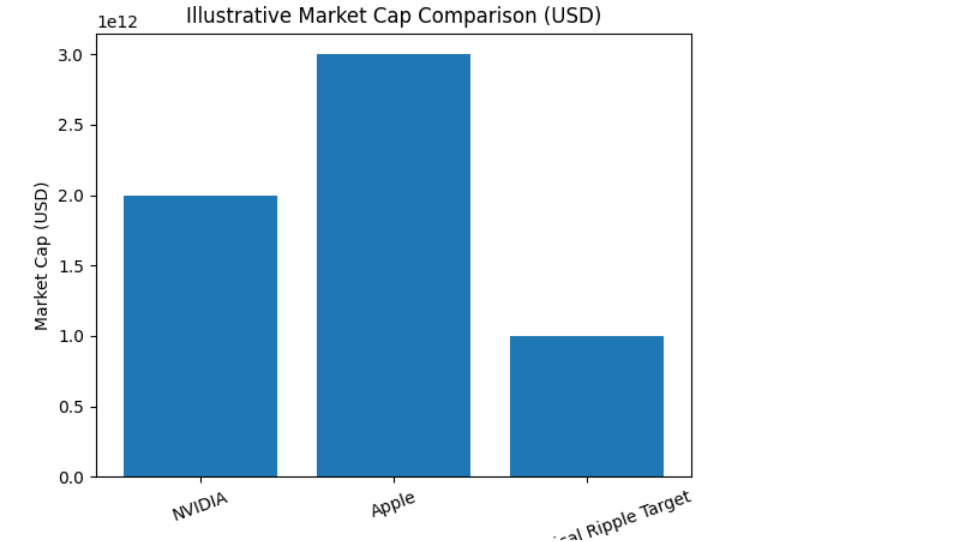
The comparison above illustrates the scale required. A $1 trillion valuation is not merely symbolic; it implies:
- Dominant market infrastructure
- Massive liquidity throughput
- Global enterprise penetration
- Regulatory clarity
- Sustainable revenue generation
For Ripple to reach such a level, XRP and XRPL must become foundational components of cross-border finance, treasury settlement, or tokenized asset markets.
The trillion-dollar thesis therefore depends not on speculation, but on structural financial integration.
5. Ripple Without IPO: A Different Growth Path
Garlinghouse has repeatedly stated that Ripple has no immediate plans for an IPO.
This is strategically interesting. Remaining private allows Ripple to:
- Prioritize long-term infrastructure goals
- Avoid quarterly earnings pressure
- Maintain ecosystem-first alignment
For crypto investors, this means value capture may concentrate within XRP and XRPL rather than traditional equity markets.
In practical terms, if Ripple expands enterprise partnerships globally while XRP functions as the liquidity bridge, token demand becomes structurally embedded in the system.
6. Broader Industry Context: 2026 Trends
The 2026 crypto landscape is increasingly defined by:
- Stablecoin institutionalization
- Tokenized treasury bills
- Cross-border settlement efficiency
- Central bank digital currency interoperability
- Compliance-integrated blockchain systems
Ripple’s alignment with treasury software, prime brokerage infrastructure, and stablecoin issuance positions it within this macro shift.
Importantly, institutional capital is prioritizing:
- Speed of settlement
- Capital efficiency
- Regulatory clarity
- Interoperability
XRP’s low transaction cost and high throughput architecture directly addresses these criteria.
7. Practical Revenue Angles for Builders
For entrepreneurs and developers seeking practical blockchain applications, XRPL offers opportunities in:
- Tokenization platforms
- Payment routing services
- Liquidity aggregation tools
- Custodial compliance services
- Stablecoin arbitrage mechanisms
- Treasury automation systems
Rather than focusing solely on token price speculation, builders can leverage XRPL’s speed and liquidity model to create transaction-based revenue systems.
In a world where traditional finance increasingly integrates blockchain rails, infrastructure-layer positioning becomes a long-duration opportunity.
8. Risks and Realities
However, reaching trillion-dollar scale requires:
- Regulatory harmonization across major jurisdictions
- Sustained institutional onboarding
- Competitive differentiation versus Ethereum, Solana, and emerging L2s
- Security robustness
- Liquidity depth
Moreover, XRP’s market performance will continue to be influenced by broader macro cycles, ETF flows, and global liquidity conditions.
Investors must separate narrative optimism from structural adoption metrics.
Conclusion: North Star or Strategic Narrative?
When Garlinghouse calls XRP Ripple’s “North Star,” he is doing more than motivating a community. He is signaling that Ripple’s future corporate valuation, product design, acquisition strategy, and ecosystem alignment all orbit around XRP and XRPL utility.
The trillion-dollar ambition is not framed as a speculative target, but as an infrastructure milestone.
For readers searching for the next digital asset frontier, the critical question is not whether XRP rallies in the next quarter. It is whether XRPL becomes indispensable to cross-border liquidity and institutional treasury systems.
If that happens, valuation expansion becomes a consequence, not a cause.
In the evolving digital financial order, the real winners may not be the loudest tokens—but the ones quietly embedded as financial plumbing.
Ripple is betting that XRP will be that plumbing.


