

Main Points :
- A reported $3.76 billion 24-hour net outflow from Binance triggered temporary market anxiety.
- Binance disputed the figure, citing data inaccuracies from third-party sources.
- Blockchain analytics platform OKLink showed a dramatically lower outflow of $46.58 million.
- The discrepancy highlights the fragility of crypto data aggregation systems.
- Binance proposed an annual industry-wide “Withdrawal Day” stress test to improve transparency.
- The event underscores broader issues of exchange solvency narratives, proof-of-reserves, and investor psychology during a crypto winter.
1. The $3.76 Billion Outflow Shock: What Happened?
On February 12, 2026, multiple media outlets reported that cryptocurrency data platform CoinGlass showed a 24-hour net outflow of $3.76 billion from Binance, the world’s largest cryptocurrency exchange by trading volume.
The figure quickly circulated across social media platforms, prompting speculation about exchange stability and user confidence. In a market environment already described by many analysts as a prolonged “crypto winter,” the magnitude of the number amplified anxiety among investors.
However, Binance responded with an official statement rejecting the reported figure, claiming the data was inaccurate and sourced from problematic third-party aggregation feeds.
According to blockchain analytics platform OKLink, Binance’s actual 24-hour net outflow stood at approximately $46.58 million, with a seven-day net outflow of about $19.14 million. The discrepancy between $3.76 billion and $46.58 million represents roughly an 80-fold difference — a gap too large to ignore.
At the center of the debate lies a fundamental question: Which data reflects on-chain reality?
2. Data Aggregation Risks in Crypto Markets
Unlike traditional financial systems, cryptocurrency markets rely heavily on public blockchain data. However, the interpretation and aggregation of that data vary widely depending on methodology.
CoinGlass reportedly referenced third-party data feeds, and similar inconsistencies have been observed previously on platforms like DefiLlama, where restoration of accurate data sometimes requires 24–48 hours.
Binance asserted that the erroneous figures stemmed from a data source issue rather than actual capital flight.
This situation highlights a critical reality:
- Blockchain data is public.
- Interpretation layers are not standardized.
- API aggregation pipelines can misclassify wallets.
- Internal wallet restructuring can appear as withdrawals.
- Cross-chain bridges and custodial sub-wallet movements can distort net flow metrics.
For sophisticated investors and builders, this is a reminder that on-chain data is not equal to clean financial accounting.
3. Visualizing the Discrepancy
[“24-Hour Net Outflow Comparison: CoinGlass vs OKLink”]
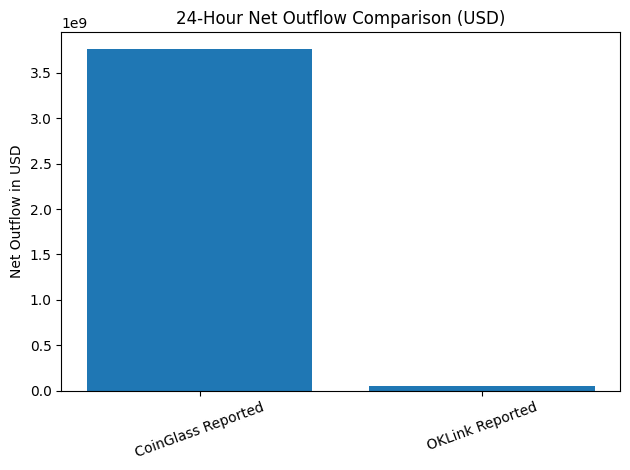
The graph should illustrate:
- CoinGlass: $3.76B outflow
- OKLink: $46.58M outflow
- Ratio difference (~80x)
This visualization helps clarify the scale of the discrepancy and how dramatically market perception can shift based on data source alone.
[“7-Day Net Outflow Trend According to OKLink”]
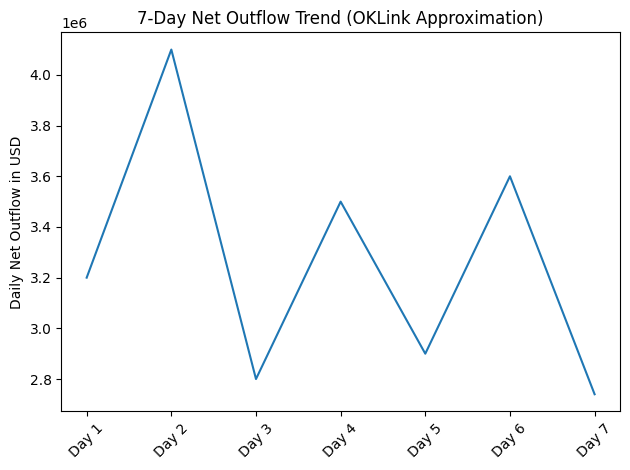
This second chart should show:
- Day-by-day net flow
- Net cumulative $19.14M
- Relative stability compared to exchange reserves
4. Exchange Solvency, Proof-of-Reserves, and Market Psychology
The reaction to the report reflects lingering trauma in crypto markets. Following past exchange collapses (e.g., FTX in 2022), large withdrawal figures are immediately interpreted as solvency stress.
Binance’s response included an interesting proposal: the creation of an annual “Withdrawal Day,” during which users are encouraged to test withdrawal functionality across exchanges.
This proposal reframes the narrative from defensiveness to proactive transparency.
Why Withdrawal Stress Tests Matter
- Demonstrates liquidity readiness.
- Tests operational robustness.
- Encourages user self-custody awareness.
- Strengthens industry standards.
The concept echoes traditional banking stress tests but in a decentralized context.
For investors searching for the next yield opportunity or emerging blockchain applications, this development signals something larger:
The industry is transitioning from speculative growth to infrastructure resilience.
5. Broader Market Context: Crypto Winter and Institutional Scrutiny
The incident occurred amid tightening liquidity conditions and heightened regulatory oversight worldwide.
In the United States and Europe, exchanges are facing stricter compliance frameworks. In Asia, jurisdictions like Hong Kong and Singapore are advancing regulated exchange licensing regimes.
Large-scale outflow rumors, even if inaccurate, can:
- Increase volatility.
- Trigger leveraged liquidations.
- Influence funding rates.
- Affect token prices tied to exchange ecosystems.
For builders and entrepreneurs, this environment demands:
- Transparent treasury reporting.
- Real-time proof-of-reserves dashboards.
- Clear wallet labeling.
- Robust API monitoring systems.
6. Practical Implications for Crypto Operators and Builders
For those interested in practical blockchain applications and new revenue sources, this episode offers actionable lessons.
A. Data Infrastructure Investment
If you operate:
- A VASP
- An EMI
- A custodial wallet
- A market-making platform
You must implement:
- Multiple independent blockchain data feeds.
- Real-time anomaly detection.
- Cross-verification logic between analytics providers.
- Internal ledger reconciliation separate from public dashboards.
B. Communication Strategy
Market panic spreads in minutes.
Exchanges need:
- Pre-drafted crisis statements.
- Live proof-of-reserve snapshots.
- On-chain wallet transparency portals.
C. Opportunity for Analytics Startups
This incident also exposes a business opportunity.
There is demand for:
- Reliable on-chain flow auditing tools.
- Institutional-grade data reconciliation engines.
- AI-based anomaly detection in wallet movements.
- Standardized exchange flow reporting frameworks.
Builders focused on infrastructure could capitalize on this transparency gap.
7. Exchange Transparency as Competitive Advantage
Binance’s suggestion of an annual withdrawal day could evolve into a formal industry standard.
Imagine:
- Exchanges publishing standardized reserve attestations.
- Public liquidity ratio dashboards.
- Smart contract-based solvency oracles.
- Industry-wide real-time capital adequacy metrics.
Transparency may become a differentiator, not just a compliance burden.
For investors, exchanges that voluntarily adopt transparent practices may deserve premium trust allocation.
8. The Investor Perspective: Signal vs Noise
The key takeaway is not whether $3.76 billion left Binance.
The key question is:
How quickly can markets distinguish data error from structural risk?
In crypto, information spreads faster than verification.
Advanced investors should:
- Cross-check multiple analytics platforms.
- Monitor stablecoin balances.
- Review exchange reserve composition.
- Avoid reacting to single-source metrics.
Conclusion: From Data Error to Industry Evolution
The reported $3.76 billion outflow from Binance ultimately appears to stem from data aggregation inaccuracies rather than systemic exchange instability.
However, the incident reveals deeper structural truths:
- Crypto markets remain hypersensitive to liquidity signals.
- Data infrastructure is fragmented.
- Transparency standards are still evolving.
- Investor psychology remains fragile in downturn cycles.
For those seeking the next generation of crypto opportunities, the opportunity may not lie solely in tokens — but in infrastructure.
Blockchain analytics, solvency verification tools, liquidity transparency dashboards, and compliance automation systems represent a growing frontier.
If the industry embraces standardized transparency practices such as withdrawal stress testing, the next cycle of crypto growth may be built not only on speculation — but on measurable resilience.


