
Main Points :
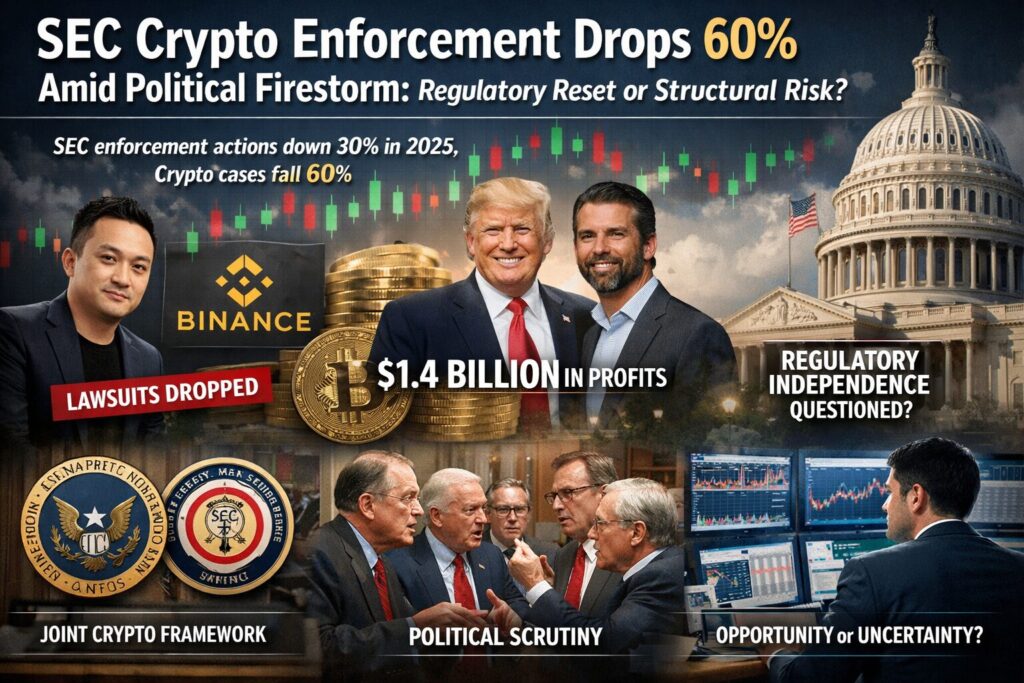
- SEC enforcement actions declined 30% overall in 2025, with crypto-related cases falling 60%.
- Lawsuits against Binance and Justin Sun were withdrawn or paused.
- President Trump’s family-linked crypto ventures reportedly generated approximately $1.4 billion.
- Lawmakers question regulatory independence amid conflict-of-interest concerns.
- SEC and CFTC are moving toward coordinated crypto rulemaking, including a regulatory sandbox framework.
- Market structure legislation may be reshaped by political scrutiny.
- For investors, regulatory recalibration may create both opportunity and systemic uncertainty.
A Historic Drop in Crypto Enforcement
In early 2026, the United States Securities and Exchange Commission (SEC) found itself under intense congressional scrutiny. During a House Financial Services Committee hearing, Chairman Paul Atkins faced sharp questioning from Democratic lawmakers over the agency’s decision to withdraw or pause several high-profile cryptocurrency enforcement actions.
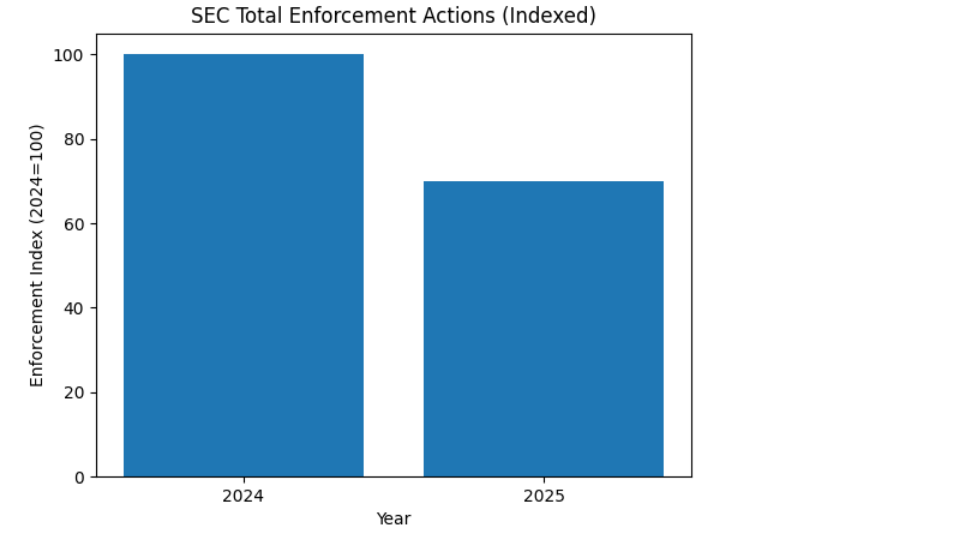
According to data from Cornerstone Research, total SEC enforcement actions in 2025 declined approximately 30% year-over-year. More strikingly, crypto-related enforcement fell by roughly 60%.
[SEC Total Enforcement Decline]
[SEC Crypto Enforcement Decline]
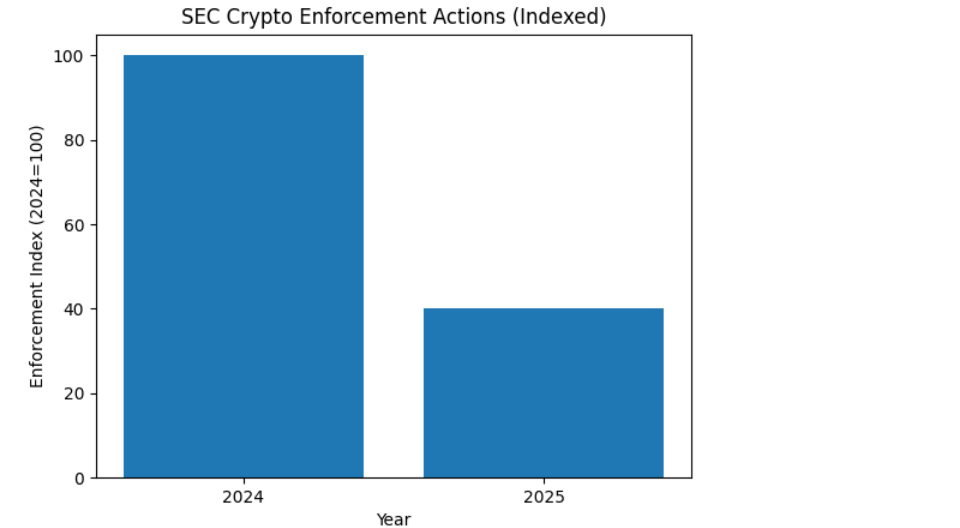
This dramatic contraction in crypto litigation marks one of the sharpest regulatory pivots since the SEC began aggressively policing digital assets under prior administrations.
In May 2025, the SEC withdrew its lawsuit against Binance. Earlier in February, it requested a pause in litigation against TRON founder Justin Sun, leaving the possibility of settlement open. These moves stand in contrast to the Biden-era SEC, which in 2023 had accused Sun of selling unregistered securities and engaging in wash trading of the TRX token to manipulate prices. Binance, for its part, had faced allegations of operating unregistered services and making misleading statements.
Binance and its founder Changpeng Zhao (CZ) previously agreed to pay over $4 billion to resolve U.S. Department of Justice investigations related to Bank Secrecy Act violations. However, the regulatory temperature appears to have cooled considerably since President Donald Trump returned to office.
Political Crossfire and Conflict-of-Interest Allegations
The controversy deepened when reports emerged that an Abu Dhabi investment firm used a stablecoin issued by World Liberty Financial (WLFI)—a crypto company linked to the Trump family—to facilitate a $2 billion investment into Binance.
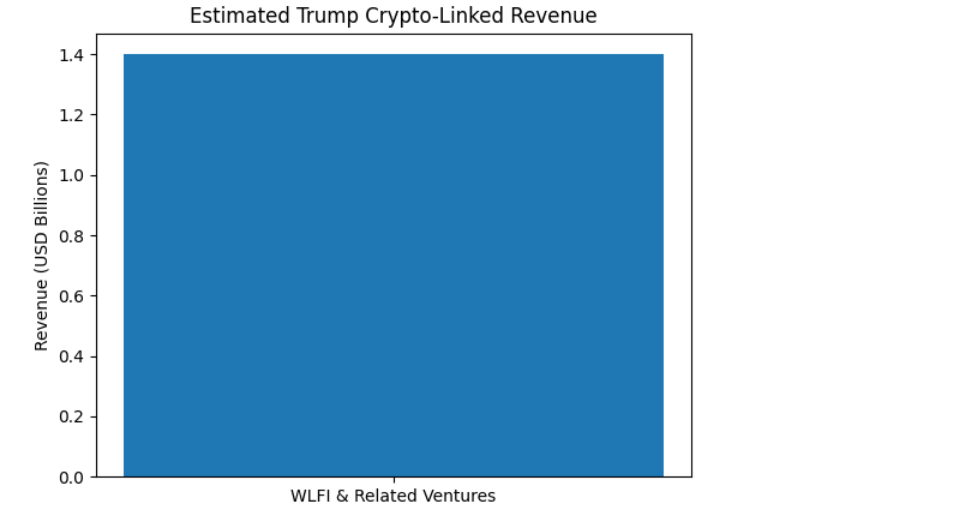
Bloomberg estimated that President Trump’s crypto-related ventures, including WLFI, generated approximately $1.4 billion in revenue.
[Estimated Trump Crypto-Linked Revenue]
Lawmakers such as Representative Stephen Lynch sharply criticized what they described as a loss of institutional credibility. Representative Sylvia Garcia questioned whether the White House or cabinet officials had directed SEC enforcement decisions. Chairman Atkins denied any such interference and emphasized that the SEC continues active enforcement efforts.
Still, the optics are complex. The intertwining of political leadership and crypto capital flows introduces reputational risk for regulators at a critical juncture in digital asset market development.
A Shift Toward Cooperative Regulation
Simultaneously, the SEC and the Commodity Futures Trading Commission (CFTC) have begun coordinated efforts to develop joint crypto regulatory frameworks. Chairman Atkins signaled plans to introduce an “innovation exemption” regime—a sandbox-style structure designed to accelerate product launches in lower-risk environments while maintaining investor protection.
This signals a philosophical shift from enforcement-first regulation toward structured market integration.
Recent industry trends support this pivot:
- Spot Bitcoin ETFs have seen renewed institutional inflows.
- Tokenized U.S. Treasury products surpassed $2 billion in on-chain issuance.
- Stablecoin market capitalization remains above $150 billion globally.
- Major banks continue exploring blockchain settlement rails.
For innovators and investors, the regulatory thaw may accelerate capital formation and experimentation.
What This Means for New Crypto Opportunities
For readers searching for new digital asset opportunities or practical blockchain applications, the enforcement decline presents a dual-edged dynamic.
On one hand, reduced litigation risk may:
- Encourage new token launches.
- Improve exchange liquidity conditions.
- Facilitate cross-border capital formation.
- Accelerate institutional entry.
On the other hand, regulatory ambiguity can increase systemic risk if oversight weakens excessively.
Emerging sectors to watch include:
1. Stablecoin Infrastructure
With political connections spotlighting WLFI and stablecoin usage in cross-border capital flows, compliant stablecoin issuance and treasury-backed tokenization may gain regulatory clarity. Investors should monitor yield-bearing stablecoins and real-world asset (RWA) tokenization projects.
2. Market Structure Legislation
Comprehensive digital asset market structure bills are currently under negotiation. If enforcement activity declines while legislative frameworks strengthen, the U.S. could transition from adversarial oversight to codified industry integration.
3. Exchange Risk Management
Binance’s previous $4 billion settlement demonstrates that criminal exposure remains distinct from civil enforcement trends. Exchanges must maintain robust AML/KYC controls, regardless of shifting SEC posture.
Institutional Trust: The Core Variable
At its heart, this controversy is less about a single lawsuit and more about regulatory credibility.
If market participants perceive enforcement decline as politically motivated, institutional capital may hesitate. Conversely, if the shift reflects strategic recalibration toward clearer rules and sandbox-based innovation, the U.S. could regain competitive positioning against jurisdictions like Singapore, Hong Kong, and the UAE.
Trust drives capital allocation. In digital assets—where volatility and legal uncertainty intersect—regulatory independence is a foundational asset class of its own.
Practical Strategy for Investors and Builders
For those seeking revenue opportunities and new blockchain ventures:
- Diversify across jurisdictions.
- Prioritize compliance-first projects.
- Evaluate token economics under stricter future oversight assumptions.
- Monitor congressional hearings and draft legislation.
- Track SEC/CFTC joint statements for sandbox participation criteria.
Reduced enforcement does not equal deregulation. It may represent transitional restructuring.
Broader Market Context (2026 Outlook)
Global crypto markets are maturing:
- Institutional custody infrastructure is expanding.
- Bitcoin halving effects continue influencing supply dynamics.
- AI-integrated blockchain analytics improve compliance monitoring.
- Sovereign wealth funds are increasing digital asset exposure.
Against this backdrop, U.S. political dynamics add another variable to pricing models.
Investors must price in regulatory volatility alongside market volatility.
Conclusion: Regulatory Repricing in Real Time
The SEC’s 60% drop in crypto enforcement actions in 2025 marks a watershed moment. Whether this reflects strategic modernization or political interference remains debated.
For market participants, the implications are clear:
- Risk models must incorporate regulatory cycles.
- Compliance remains a competitive advantage.
- Political capital flows are now a measurable crypto factor.
- Structural legislation may ultimately define long-term stability.
In the near term, regulatory uncertainty creates opportunity windows—but only for disciplined actors who understand both capital markets and governance risk.
The next phase of U.S. crypto development will not be defined solely by innovation or price action, but by institutional trust.
And in digital finance, trust is the ultimate yield.


