

Main Points :
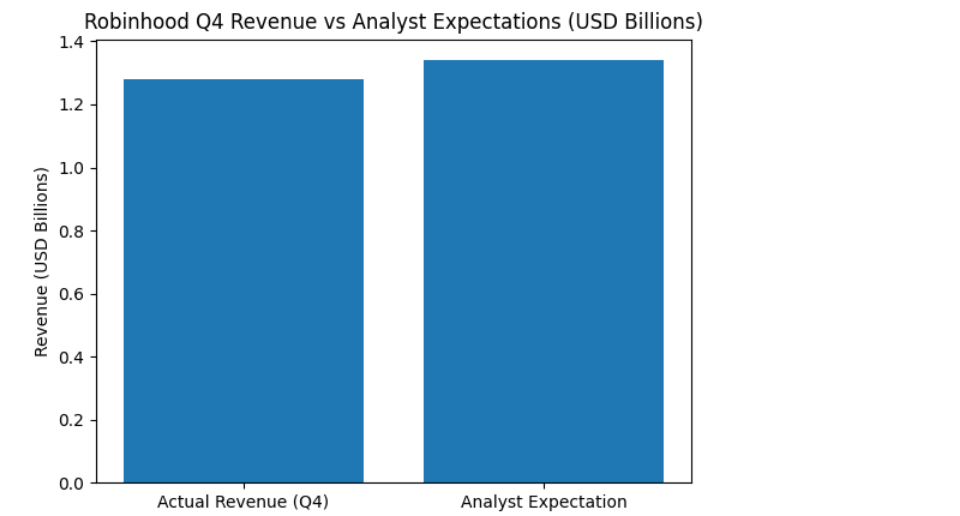
- Robinhood Markets reported record quarterly revenue of $1.28B but missed analyst expectations of $1.34B.
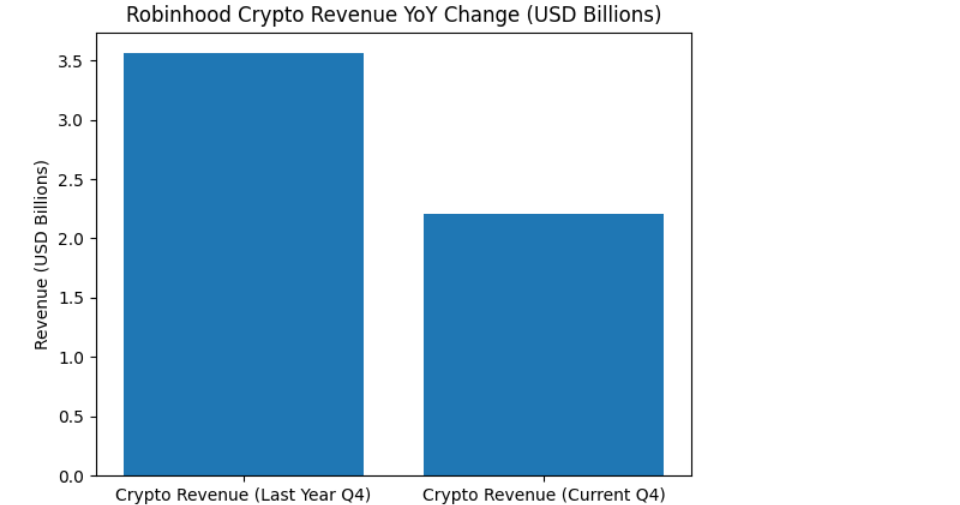
- Crypto-related revenue declined 38% year-over-year to $221M as digital asset markets softened.
- Stock trading and options activity outpaced crypto growth, highlighting business diversification.
- “Other” transaction-based revenue surged 375% year-over-year, driven by prediction markets and futures.
- Full-year 2025 revenue reached $4.5B (+52%), with net income of $1.9B (+35%).
- CEO Brad Tenev reaffirmed the vision of building a “financial super app.”
- The earnings reflect broader structural shifts in retail trading, digital asset adoption, and fintech monetization.
1. Earnings Overview: Growth With Friction
Robinhood’s latest quarterly earnings present a nuanced picture. The company reported record Q4 revenue of $1.28B, representing a 27% year-over-year increase. However, this figure fell short of Wall Street’s expectation of $1.34B. While headline growth remains strong, markets reacted negatively to the miss, sending the stock down over 7% in after-hours trading to approximately $79, far below its October peak of $148.
Net income came in at $605M, down 34% year-over-year, though earnings per share of $0.66 slightly exceeded analyst expectations of $0.63.
For long-term observers, the key issue is not whether Robinhood is growing—it is—but whether its growth mix is shifting in ways that alter its risk profile and future upside.
[Revenue vs Expectation]
2. Crypto Revenue Drops 38% — A Cyclical or Structural Shift?
Crypto-related revenue declined to $221M, a 38% drop year-over-year. This reflects the broader cooling in digital asset markets that began in October, when Bitcoin and altcoins entered a consolidation phase following earlier volatility cycles.
Why the Decline Matters
Crypto trading is historically high-margin for platforms like Robinhood. Retail-driven volatility spikes typically translate into surges in transaction-based revenue. A sustained slowdown in crypto activity therefore compresses a lucrative segment.
However, the decline does not necessarily signal abandonment. Instead, it mirrors:
- Lower speculative retail participation
- Reduced short-term volatility
- Migration of some crypto traders to decentralized platforms
- Increasing regulatory clarity reducing “panic trading”
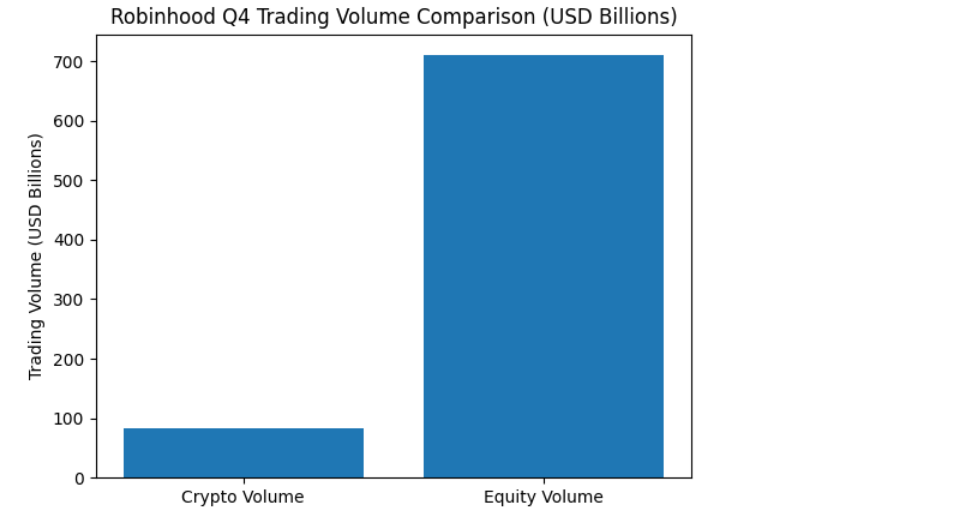
More importantly, crypto nominal trading volume still reached $82.4B in Q4, up 3% sequentially. That suggests activity stabilization rather than collapse.
[Crypto Revenue YoY Change]
3. Equities and Options Outperform Crypto
While crypto struggled, equity trading volume rose 10% quarter-over-quarter to $710B. Options contracts increased 8% to 659M contracts.
This divergence highlights two important dynamics:
- Retail traders are reallocating capital into traditional markets.
- Robinhood’s diversification strategy is working.
The platform is no longer “just a meme stock and crypto app.” It has matured into a multi-asset brokerage with:
- Equities
- Options
- Crypto
- Futures
- Prediction markets
This reduces earnings volatility over time.
[Trading Volume Comparison]
4. The Hidden Growth Engine: “Other” Transaction Revenue
Perhaps the most interesting number in the report is not crypto.
“Other” transaction-based revenue—which includes prediction markets and futures—hit a record $147M in Q4, up 375% year-over-year.
Robinhood’s March partnership with Kalshi enabled regulated prediction markets. Demand for event contracts surged as retail traders sought new forms of speculation.
This reflects a broader macro trend:
- Retail demand for structured risk products
- Financialization of real-world events
- Gamification of derivatives markets
Prediction markets sit at the intersection of fintech and Web3 ideology—decentralized information pricing, but centralized execution.
For blockchain entrepreneurs, this suggests a strong use case for on-chain event derivatives.
5. Full-Year Performance: Record Highs
Despite quarterly volatility, full-year 2025 revenue hit $4.5B, up 52% from 2024. Net income rose 35% to $1.9B.
This is not a shrinking company. It is a scaling fintech platform absorbing crypto cyclicality.
The key strategic takeaway:
Crypto may fluctuate, but Robinhood’s core monetization engine is broadening.
6. The Super App Vision: Strategic Implications
CEO Brad Tenev reiterated the ambition to build a “financial super app.”
In practice, this means:
- Multi-asset custody
- Integrated payments
- Yield products
- Margin and derivatives
- Event contracts
- Cross-border trading
- Potential tokenization services
The super app model mirrors Asia’s fintech ecosystems but adapted to Western regulatory structures.
For crypto builders, this raises important questions:
- Will centralized platforms dominate token distribution?
- Will self-custody wallets remain competitive?
- Can DeFi integrate with regulated brokerage rails?
7. Broader Industry Context
Recent fintech and crypto trends add context:
- Bitcoin ETF inflows stabilized, reducing speculative surges.
- Retail participation cooled after prior bull runs.
- Tokenization of real-world assets is accelerating.
- Major institutions are entering digital asset custody.
- Stablecoins are gaining traction for payments infrastructure.
Robinhood’s crypto revenue decline should therefore be seen within this broader normalization phase.
This is not a collapse of digital assets—it is a maturation cycle.
8. What This Means for Investors Seeking New Crypto Opportunities
For readers seeking the next revenue source or emerging digital asset opportunity:
- Prediction Markets – Strong retail demand suggests opportunity for decentralized alternatives.
- Tokenized Real-World Assets – As brokerage platforms diversify, blockchain-native settlement layers may gain relevance.
- Infrastructure Tokens – Lower volatility environments favor utility-based crypto projects.
- Cross-Asset Platforms – Hybrid CeFi-DeFi integrations may capture value.
- Stablecoin Payment Rails – As super apps evolve, stablecoins become settlement primitives.
Robinhood’s earnings demonstrate a key principle:
Crypto revenue is cyclical. Infrastructure growth is structural.
9. Risk Assessment
Risks include:
- Regulatory tightening
- Further crypto volatility contraction
- Retail disengagement
- Margin compression from competition
However, diversification reduces existential exposure.
10. Conclusion
Robinhood’s earnings are not a story of decline. They are a story of transition.
Crypto revenue fell 38%, but overall revenue rose. Trading diversified. Prediction markets surged. Full-year profits expanded.
The fintech landscape is shifting from speculative crypto spikes toward integrated financial ecosystems.
For blockchain entrepreneurs and investors, the opportunity lies not in chasing volatility—but in building infrastructure that survives it.
Crypto’s explosive growth phase may be cooling, but the integration phase has begun.
The winners of the next cycle will likely combine:
- Compliance
- Multi-asset functionality
- Tokenized infrastructure
- Risk management sophistication
- User-centric design
Robinhood’s numbers reflect this transition in real time.


