
Main Points :
- The European Union is considering a comprehensive prohibition on transactions with all Russia-based crypto service providers.
- The proposal aims to eliminate loopholes created by successor entities such as Garantex’s replacements.
- Russian payment platform A7 and its ruble-pegged stablecoin A7A5—which reportedly surpassed $100 billion in monthly volume—are key targets.
- The ban would include transactions involving Russia’s digital ruble (CBDC).
- The EU’s 20th sanctions package expands pressure to regional Russian banks and third-country intermediaries, notably Kyrgyzstan.
- Oil transport restrictions may shift from price caps to near-total service bans.
- Unanimous approval from all 27 EU member states is required; three reportedly have reservations.
I. Closing the Sanctions Loophole: Why the EU Is Escalating
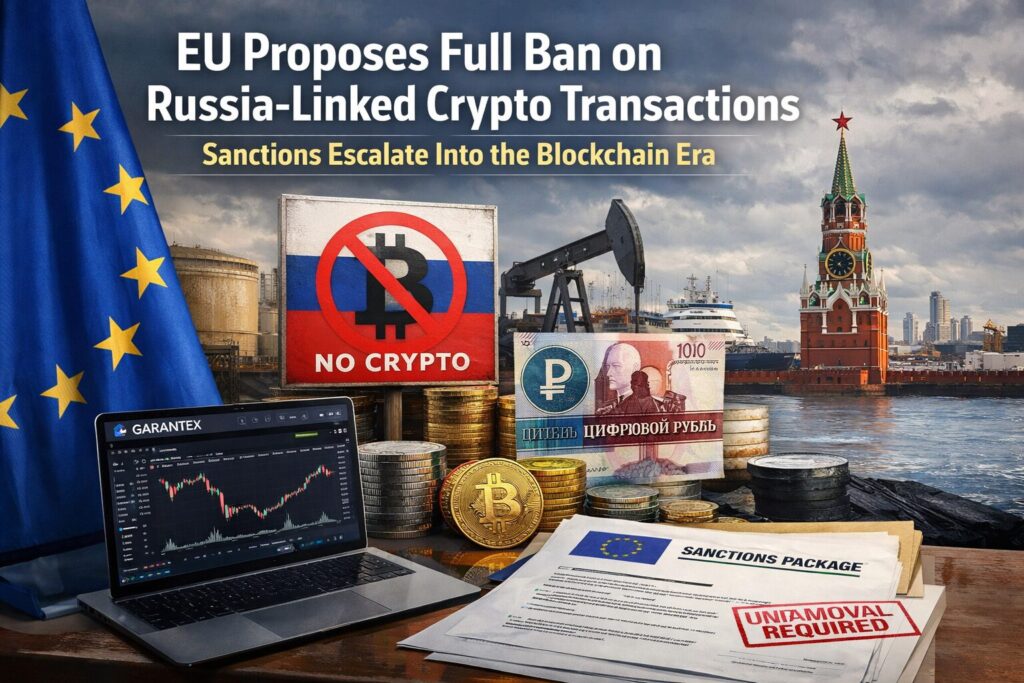
The European Union is preparing what could become one of the most aggressive regulatory actions in the history of cryptocurrency markets. According to internal documents reported by the Financial Times and official EU communications, the European Commission has proposed a sweeping ban on all transactions involving crypto service providers established in Russia.
Until now, EU sanctions have largely targeted specific entities or individuals. However, regulators have increasingly observed that sanctioned firms simply dissolve and reappear under new names or corporate structures, continuing operations in a legal gray zone. This “cat-and-mouse” dynamic has frustrated enforcement authorities and undermined the intended economic pressure on Moscow.
The new proposal seeks to end that cycle entirely by banning interactions with any Russia-based crypto operator, regardless of whether it has been individually listed. In effect, the EU would treat the entire Russian crypto services ecosystem as a sanctioned sector.
For blockchain market participants, this marks a turning point: cryptocurrency is no longer viewed as peripheral to geopolitical strategy—it is now considered a central infrastructure of state-level economic maneuvering.
II. Targeting Garantex Successors and the Rise of A7A5
One of the EU’s primary motivations is to prevent the resurgence of entities connected to Garantex, a Russian-linked exchange previously sanctioned by the United States in 2022 for allegedly facilitating cybercrime activities.
After sanctions were imposed, successor entities reportedly emerged, enabling continued crypto liquidity flows tied to Russian actors. EU officials concluded that targeting individual exchanges was ineffective.
Even more striking is the case of the Russian payments platform A7 and its ruble-linked stablecoin A7A5. Blockchain analytics firm Elliptic reported that A7A5 exceeded $100 billion in transaction volume in January alone—a scale that suggests significant usage beyond domestic retail payments.
If accurate, such figures imply that stablecoins are increasingly functioning as alternative settlement rails for cross-border trade, potentially bypassing traditional correspondent banking systems.
For crypto investors and developers, this development carries two important implications:
- Stablecoins are now geopolitical tools, not just DeFi liquidity instruments.
- Regulatory scrutiny will intensify on fiat-pegged tokens connected to sanctioned jurisdictions.
III. Russia’s Strategic Crypto Pivot
In August 2024, President Vladimir Putin signed legislation formally legalizing the use of cryptocurrencies in international settlements. This move was widely interpreted as a strategic pivot designed to mitigate the impact of Western financial sanctions.
By enabling crypto-based trade settlement, Russia aimed to:
- Reduce reliance on SWIFT-based banking infrastructure.
- Facilitate bilateral trade in energy and commodities.
- Experiment with decentralized or semi-centralized financial rails resistant to seizure.
The EU proposal would also prohibit interactions involving Russia’s central bank digital currency (CBDC), known as the digital ruble. This is significant: the ban would not merely target decentralized assets, but also sovereign digital currency infrastructure.
For blockchain practitioners, this signals a broader regulatory doctrine: CBDCs and decentralized crypto are now treated as components of the same strategic financial architecture.
IV. Sanctions Package No. 20: Expanding Pressure Beyond Crypto
The crypto ban forms part of the EU’s 20th sanctions package against Russia. This package includes:
- Sanctioning 20 additional regional Russian banks.
- Restricting alternative payment mechanisms used for sanctions evasion.
- Targeting third-country intermediaries facilitating restricted goods trade.
A major focus is Kyrgyzstan. EU data indicates that exports of high-priority dual-use goods from the EU to Kyrgyzstan surged approximately 800% since the Ukraine war began, while Kyrgyz exports to Russia reportedly increased by 1,200%.
These figures strongly suggest trade rerouting patterns designed to bypass sanctions.
For blockchain businesses, the lesson is clear: compliance must increasingly incorporate geopolitical supply-chain awareness, not merely wallet screening.
V. Oil Shipping Restrictions: From Price Caps to Service Bans
Another dramatic escalation concerns Russian oil transport. Under current G7 policy, Western services such as insurance and maintenance are restricted only if oil trades above a designated price cap.
The new EU proposal would effectively eliminate this price-cap conditionality, replacing it with a near-total prohibition on providing services to vessels transporting Russian crude oil.
This would significantly constrain Russia’s export revenue streams.
For crypto markets, energy geopolitics matter. Russian energy revenue impacts:
- Global commodity prices
- Inflation expectations
- Central bank policy trajectories
- Bitcoin’s macro correlation profile
As energy volatility increases, so too does crypto’s role as a macro hedge.
VI. Approval Uncertainty and Political Friction
The proposal requires unanimous approval from all 27 EU member states. Reports suggest that three countries have expressed reservations.
Historically, EU sanctions packages have ultimately passed after negotiation, though often diluted.
If approved, this would represent one of the most sweeping crypto-related prohibitions ever implemented by a major economic bloc.
Graph Section (Insert After Section VI)
Below is a conceptual visualization of the geopolitical shift:
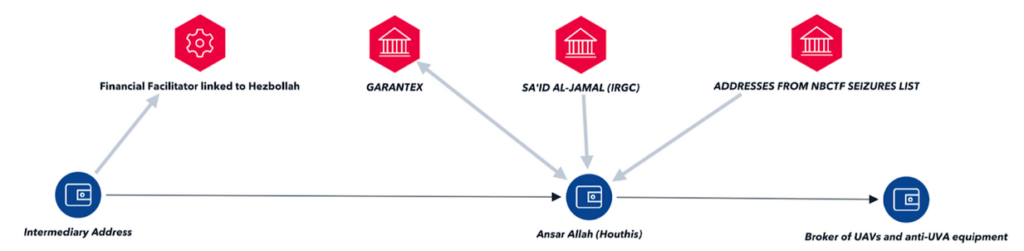
Suggested Placement: Insert here after Section VI to illustrate scale, timeline, and structural impact.
VII. What This Means for Crypto Investors and Builders
For readers searching for new crypto opportunities or practical blockchain applications, the implications are profound.
1. Stablecoin Fragmentation Risk
Jurisdiction-linked stablecoins will face increasing segmentation. Investors should monitor:
- Geographic issuance structures
- Custodial banking relationships
- Regulatory alignment
Neutral, transparent stablecoins may gain market share as politically exposed tokens become restricted.
2. Compliance-First Infrastructure as Alpha
Exchanges, wallets, and DeFi protocols that build sophisticated sanctions screening and jurisdictional intelligence layers may attract institutional capital.
Compliance is no longer a cost center—it is a competitive moat.
3. CBDC vs Decentralization Narrative Intensifies
As sovereign digital currencies become geopolitical tools, decentralized networks like Bitcoin and Ethereum may regain appeal as politically neutral alternatives.
Conclusion: Blockchain Enters the Sanctions Battlefield
The EU’s proposed comprehensive ban on Russia-linked crypto transactions marks a structural evolution in global financial conflict. Cryptocurrency is no longer merely an innovation layer on top of finance—it is now a core battleground of statecraft.
For investors and blockchain builders, this environment presents both risk and opportunity. Jurisdictional fragmentation will increase. Stablecoins will be scrutinized. Compliance architectures will become strategic assets.
Yet amid tightening controls, demand for censorship-resistant, globally interoperable settlement networks may grow stronger than ever.
In the coming years, the intersection of geopolitics and blockchain will likely define not just regulatory outcomes—but capital flows, asset valuations, and the next generation of financial infrastructure.


