
Main Points :
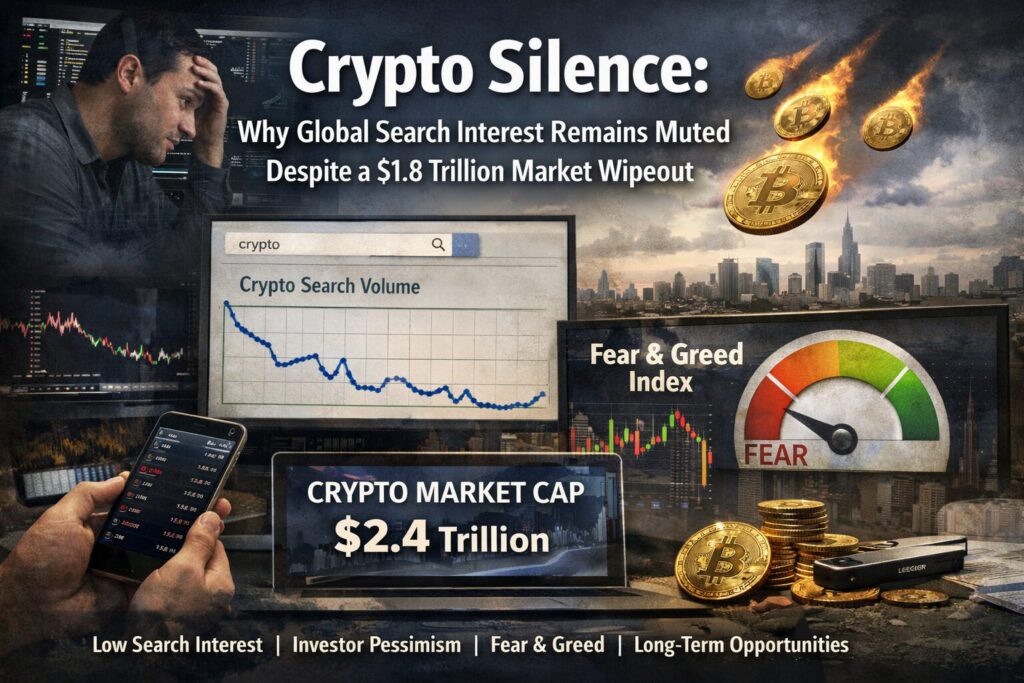
- Global Google search interest for “crypto” remains near yearly lows, even as the total crypto market capitalization has fallen from over $4.2 trillion to around $2.4 trillion.
- Historically, collapsing search volume has coincided with periods of extreme investor pessimism—and, in several past cycles, long-term accumulation opportunities.
- U.S. search behavior shows a partial divergence, hinting at localized speculative rebounds rather than broad-based confidence.
- On-chain data, trading volumes, and sentiment indicators such as the Fear & Greed Index all point to a market dominated by caution rather than capitulation.
- For builders, long-term investors, and yield-seeking participants, periods of low public attention have often been when foundational opportunities quietly emerged.
1. A Quiet Market After the Storm
The global cryptocurrency market has just experienced one of its sharpest contractions in recent history. From a peak capitalization exceeding $4.2 trillion, the total market value has declined to approximately $2.4 trillion, erasing nearly $1.8 trillion in notional value.
Yet, unlike previous downturns, one metric stands out for what it does not show: public attention.
According to Google Trends, worldwide search interest for the term “crypto” remains near its lowest level of the past 12 months. At the time of writing, global search volume registers around 30 on a 0–100 scale, where 100 represents peak interest. For context, that peak was last observed in August 2025, when market capitalization reached its all-time high.
This disconnect—between dramatic market losses and muted public curiosity—raises an important question: what does silence mean in crypto markets?
2. Google Search Volume as a Proxy for Investor Psychology
Search trends have long been used as a soft indicator of investor sentiment. Unlike price charts, which reflect executed decisions, search behavior captures intent, curiosity, and emotional response.
During euphoric phases, retail participants flood search engines with queries like “how to buy crypto” or “next Bitcoin.” During fear-driven collapses, searches often spike again—this time fueled by panic.
What makes the current environment unusual is the absence of either extreme.
Over the past year, the lowest global reading on Google Trends for “crypto” was 24, and current levels hover only slightly above that floor. This suggests not panic—but disengagement.
[Global Google Search Volume for “Crypto” (12 months)]
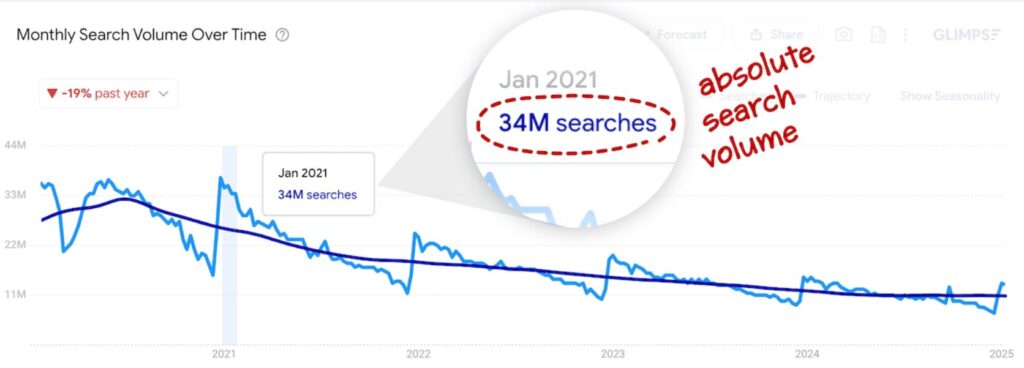
For seasoned market participants, this type of apathy often signals a transition phase: after forced sellers exit, but before new narratives reignite interest.
3. The U.S. Market: A Partial Divergence
While global interest remains subdued, the United States presents a more nuanced picture.
U.S. search volume for “crypto” peaked at 100 in July, before sliding below 37 in January. However, in the first week of February, search interest rebounded sharply to 56, suggesting episodic re-engagement by American investors.
This divergence likely reflects macro-driven speculation rather than a structural return of confidence. The U.S. market has been particularly sensitive to political and trade developments, including renewed tariff uncertainty linked to policies associated with Donald Trump.
Notably, the U.S. year-to-date low of 32 was recorded during the April 2025 market crash, a period directly tied to tariff escalation fears.
[U.S. Google Search Volume for “Crypto”]
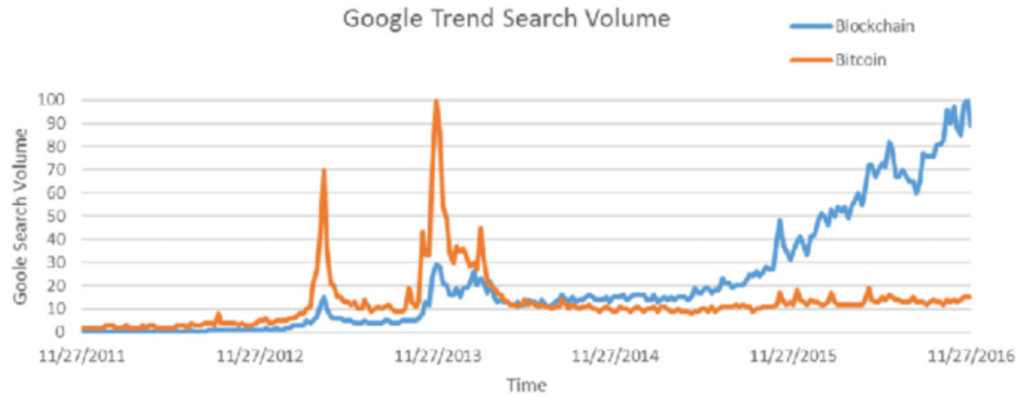
This pattern implies tactical interest rather than strategic conviction—short-term traders responding to volatility, not long-term capital reallocating with confidence.
4. Trading Volume Confirms the Lack of Conviction
Market activity data reinforces the message conveyed by search trends.
According to CoinMarketCap, total daily cryptocurrency trading volume fell from over $153 billion on January 14 to approximately $87.5 billion by Sunday.
In liquid markets, falling volume during price declines usually indicates one of two things:
- Sellers are exhausted, or
- Buyers are unwilling to step in.
At present, evidence points to the latter. Capital is not rushing into crypto; instead, it is waiting.
5. Fear at Historic Extremes
Sentiment indicators paint an even starker picture.
The Crypto Fear & Greed Index, also published by CoinMarketCap, plunged to an all-time low reading of 5 on Thursday, before modestly rebounding to 8 by Sunday. Both readings remain firmly within the “Extreme Fear” zone.
[Crypto Fear & Greed Index at Record Lows]
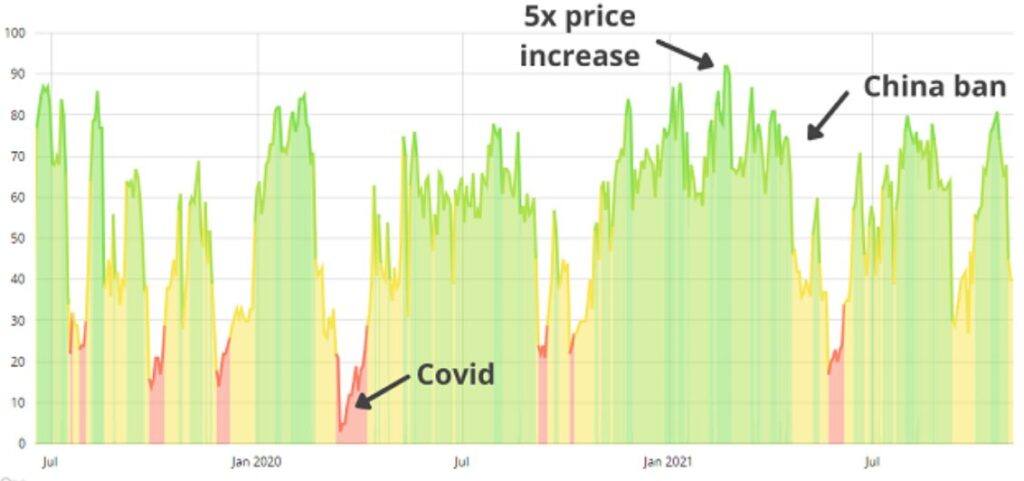
Remarkably, sentiment is now comparable to levels last seen in 2022, immediately following the collapse of the Terra ecosystem and its dollar-pegged stablecoin. That event triggered cascading liquidations across centralized and decentralized platforms, accelerating the previous bear market.
The parallel does not imply identical outcomes—but it underscores how deeply risk appetite has contracted.
6. Social Signals: Waiting for a Bottom
Behavioral analytics firm Santiment reports that crypto-related social media commentary has turned overwhelmingly negative.
In a recent report, Santiment noted that the ratio of positive to negative comments has broken down, with negative sentiment reaching its highest level since December 1. At the same time, many participants appear to be watching closely for early signs of a bottom rather than exiting entirely.
This behavior is consistent with late-stage bearish environments: disbelief, fatigue, and selective attention replace panic.
7. What Low Attention Historically Signals
From a historical perspective, periods of suppressed public interest have often preceded important structural developments:
- In 2015–2016, low search interest followed the Mt. Gox collapse, just before Ethereum and DeFi primitives began gaining traction.
- In 2019, post-ICO fatigue masked early institutional accumulation.
- In 2022, following Terra and FTX, infrastructure investment quietly accelerated while retail attention evaporated.
In each case, builders outpaced speculators.
8. Implications for Investors and Builders
For readers focused on new crypto assets, alternative revenue streams, and practical blockchain applications, the current environment offers a paradox.
Short-term momentum is scarce. Liquidity is cautious. Headlines are pessimistic.
Yet this is precisely when:
- Protocol-level innovation accelerates without hype pressure.
- Valuations normalize relative to utility rather than narrative.
- Regulatory clarity advances quietly.
- Strategic partnerships form away from public scrutiny.
Yield strategies, infrastructure plays, enterprise blockchain use cases, and compliance-aligned digital asset services tend to mature in these phases—not during speculative frenzies.
9. Conclusion: Silence as a Signal
The muted global search interest for “crypto” is not merely a reflection of falling prices—it is a mirror of collective exhaustion.
Markets have not forgotten crypto. They are simply no longer shouting about it.
For long-term participants, this silence may be the most important signal of all. Historically, crypto’s most consequential developments have occurred not when everyone was watching—but when almost no one was.


