
Main Points :
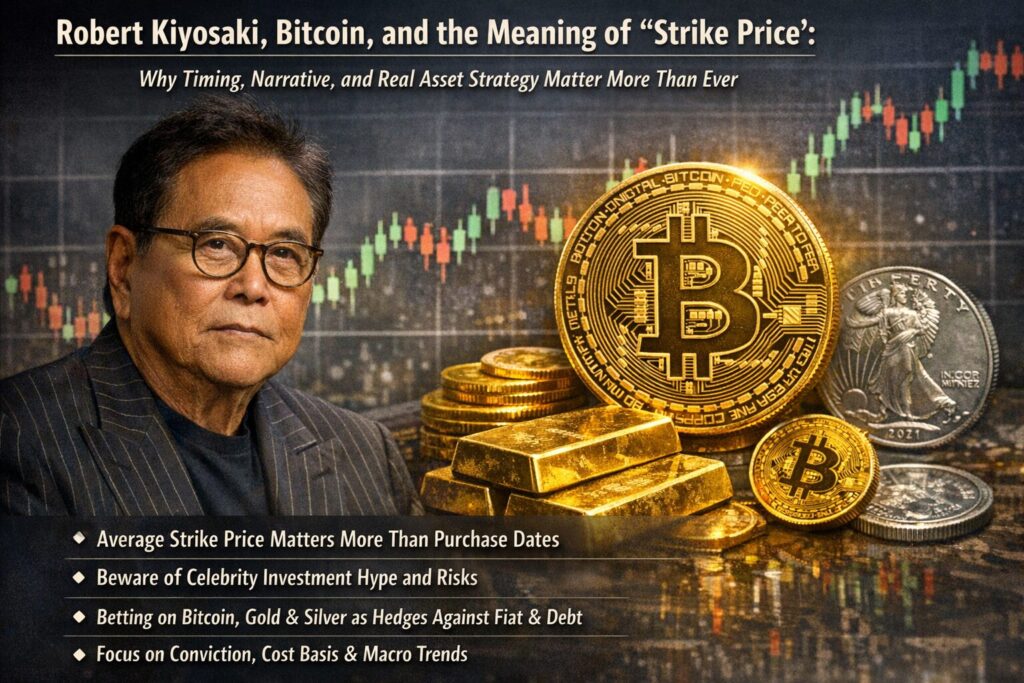
- Robert Kiyosaki pushed back against criticism over when he bought Bitcoin, arguing that average acquisition price (“strike price”) matters more than purchase dates.
- The controversy highlights a core risk in following celebrity investment narratives without independent verification.
- Kiyosaki remains aggressively bullish on Bitcoin, gold, and silver, positioning them as hedges against fiat currency debasement and U.S. debt expansion.
- His price forecasts are extremely optimistic, yet historical accuracy has been limited, reinforcing the need for disciplined analysis.
- For readers seeking new crypto assets, revenue opportunities, and practical blockchain use, the lesson is not about Kiyosaki—but about how to evaluate conviction, cost basis, and macro narratives correctly.
1. The Spark of the Controversy: “I Bought Bitcoin at $6,000”
On February 8, Robert Kiyosaki reignited debate within the crypto community after responding on X to critics who questioned his long-standing claim that he bought Bitcoin at $6,000. His rebuttal was direct and combative: he argued that critics misunderstood his point because he was referring not to the date of purchase, but to his average acquisition price, which he described as his “strike price.”
According to Kiyosaki, focusing on the exact timing of buys misses the essence of investing. What matters, he insisted, is whether the asset itself grows in value over time. He challenged detractors by asking how much Bitcoin, gold, or silver they personally hold—implying that ownership and long-term conviction outweigh semantic disputes.
Yet the controversy did not emerge in a vacuum. Just days earlier, on February 6, Kiyosaki had posted that he “stopped buying Bitcoin at $6,000.” That statement collided head-on with past posts showing him actively buying Bitcoin at far higher prices—above $90,000 in January 2026 and even expressing intent to buy more when prices exceeded $117,000 in mid-2025.
This inconsistency triggered X’s Community Notes, which rapidly surfaced screenshots and timelines that contradicted a literal reading of his claim.
2. Strike Price vs. Purchase Date: A Financially Valid—but Poorly Communicated—Argument
From a technical standpoint, Kiyosaki’s defense is not inherently wrong. Professional investors often focus on average cost basis, not the chronological order of transactions. Dollar-cost averaging (DCA), for instance, is a widely accepted strategy that smooths volatility and reduces emotional timing errors.
However, the issue lies in communication clarity. Saying “I stopped buying at $6,000” strongly implies a historical cutoff, not an averaged result across many years. In financial markets—especially crypto, where misinformation spreads quickly—language precision matters.
This is where reputational risk arises. Even if the underlying strategy is sound, ambiguous phrasing can erode trust. Financial planner Mark McGrath publicly criticized Kiyosaki, arguing that someone who has promoted Bitcoin daily for years cannot credibly claim not to have bought during long stretches of price appreciation.
Key insight:
Being financially correct is not the same as being credibly persuasive. For investors and builders alike, narrative discipline is as important as strategy.
3. Celebrity Advice and the Structural Risk for Retail Investors
Crypto analysts were quick to remind audiences of a hard truth: celebrity conviction is not a substitute for due diligence.
High-profile figures like Kiyosaki shape sentiment, but they rarely disclose:
- Exact position sizes
- Risk management rules
- Liquidity constraints
- Opportunity costs
For retail investors seeking the next revenue source or practical blockchain deployment, blindly mirroring such figures can be dangerous. A wealthy individual can tolerate volatility and drawdowns that would wipe out smaller portfolios.
This episode reinforces a long-standing principle in crypto markets:
Narratives attract attention, but cash flow, utility, and risk control determine survival.
4. Kiyosaki’s Macro Thesis: Fiat Currency Is the Real Enemy
To understand why Kiyosaki remains undeterred, one must revisit his broader worldview.
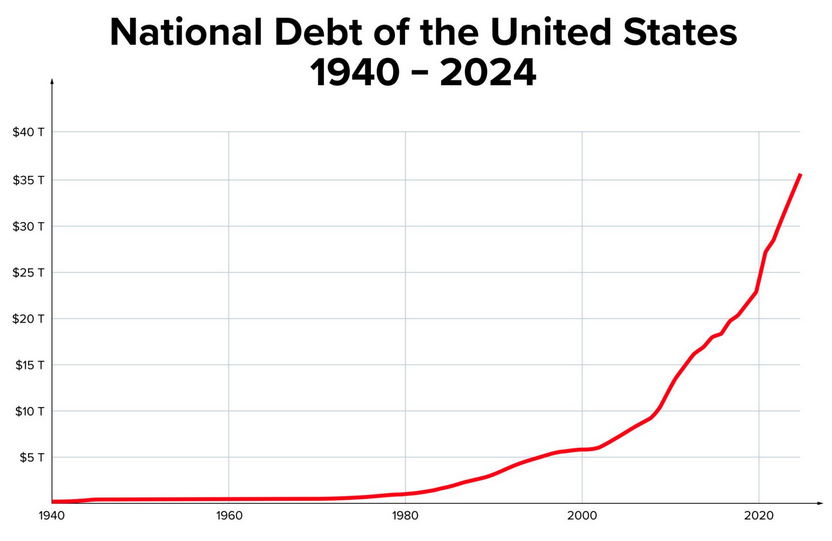
For decades, he has criticized fiat currencies—particularly the U.S. dollar—labeling them “fake money.” His core thesis is that expansionary monetary policy, rising sovereign debt, and persistent deficits inevitably erode purchasing power.
In this framework:
- Bitcoin represents digitally scarce, censorship-resistant value
- Gold serves as historical monetary insurance
- Silver functions as both monetary metal and industrial commodity
He repeatedly frames these assets as lifeboats in a systemic reset scenario rather than short-term trades.
[Comparative performance of Bitcoin, gold, and silver vs. U.S. debt growth (USD-based)]
5. Aggressive Price Targets—and Their Track Record
Kiyosaki’s projections remain among the most bullish in mainstream discourse:
- Bitcoin: $250,000 in 2026; potentially $1,000,000 by 2035
- Gold: $27,000 per ounce
- Silver: $200 per ounce
All figures are expressed here in USD, as requested.
However, third-party analyses indicate that since 2022, only about 10% of his short- to mid-term price predictions have materialized. This does not invalidate his macro thesis—but it does weaken the tactical reliability of his forecasts.
For sophisticated readers, this suggests a distinction:
- Macro direction: Possibly correct
- Timing and magnitude: Highly uncertain
6. What This Means for Crypto Investors and Builders
For those exploring new crypto assets, income opportunities, or enterprise blockchain use, the Kiyosaki debate offers practical lessons:
- Separate narrative from mechanics
Understand whether a claim refers to cost basis, timing, or allocation size. - Design strategies that survive being wrong
Volatility-resistant models—staking, infrastructure, payment rails, or B2B blockchain services—often outperform pure price speculation. - Use macro views as context, not commands
Even if fiat debasement continues, execution still determines outcomes. - Transparency builds credibility
Whether you are a fund manager, founder, or influencer, clarity around assumptions is non-negotiable.
7. Conclusion: The Real Lesson Is Not About $6,000
In the end, the controversy surrounding Robert Kiyosaki is less about whether he bought Bitcoin at $6,000 and more about how investment stories are told—and believed.
His emphasis on long-term asset value over purchase dates reflects a legitimate investment philosophy. Yet the backlash underscores how quickly credibility can erode when messaging is unclear or appears inconsistent.
For today’s crypto audience—especially those seeking sustainable revenue and real-world blockchain applications—the takeaway is clear:
Conviction without clarity is noise.
Strategy without verification is risk.
Bitcoin, gold, and silver may or may not reach Kiyosaki’s lofty targets. But disciplined analysis, transparent assumptions, and practical use cases will remain valuable—regardless of who tweets next.


