

Key Takeaways :
- The unexpected nomination of a hawkish Federal Reserve Chair revived fears of prolonged monetary tightening, triggering broad risk-off behavior.
- A liquidity crisis at a major Chinese gold trading platform forced deleveraging across metals and crypto derivatives markets.
- Political uncertainty linked to newly released Epstein-related documents weighed on Trump-linked assets and spilled into crypto sentiment.
- Combined, these forces erased most of Bitcoin’s post-election rally and pushed prices to multi-year lows.
- Derivatives data suggest $76,600 as a critical near-term support, with asymmetric risks on either side.
1. Bitcoin’s Sharp Reversal: From Post-Election Optimism to Macro Reality
Bitcoin’s decline below the $80,000 level marks a decisive shift in market psychology. After ending January in negative territory, BTC slid to around $77,000—its lowest level in more than two years—wiping out nearly all of the gains accumulated since the U.S. presidential election.
In the weeks following the election victory of Donald Trump, markets had priced in a continuation of loose financial conditions. Traders broadly assumed that Trump, having repeatedly criticized tight monetary policy, would appoint a dovish Federal Reserve Chair inclined toward rate cuts and a weaker dollar. That assumption proved fragile.
The broader context matters. Bitcoin had already been underperforming traditional safe havens such as gold and silver earlier in the week, even as geopolitical tensions pushed precious metals to record highs. This divergence hinted that crypto markets were vulnerable to a sudden repricing once macro assumptions were challenged.
That challenge arrived on January 30.
2. The Federal Reserve Shock: A Hawkish Nomination Reprices Risk
The most immediate catalyst for Bitcoin’s sell-off was Trump’s announcement of his nominee to replace Jerome Powell as Chair of the Federal Reserve when Powell’s term ends in May. Contrary to expectations, Trump nominated Kevin Warsh, a figure widely regarded as prioritizing inflation control and dollar strength.
This decision stunned leveraged traders. Rather than signaling a pivot toward aggressive rate cuts, the nomination suggested continuity—or even intensification—of tight monetary conditions. Risk assets across the board repriced rapidly.
Bitcoin fell more than 4% within 24 hours, breaking below $77,300 for the first time since December 11. Weekly losses exceeded 10%, and sentiment flipped decisively bearish.
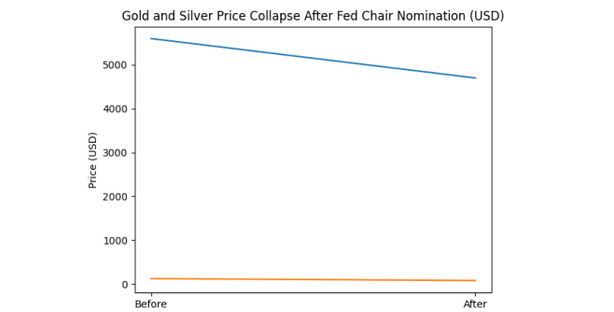
The shock was not confined to crypto. Precious metals, which had rallied strongly on expectations of easier monetary policy, experienced violent reversals. Gold dropped from roughly $5,600 to $4,700, while silver collapsed from $121 to $77. Platinum and palladium followed suit. Analysts estimate that global precious metals markets shed close to $7 trillion in value in a matter of days.
[“Gold and Silver Price Collapse After Fed Chair Nomination”]
Simultaneously, the U.S. dollar surged. The Dollar Index rose about 2%, from a weekly low near 95.25 to above 97. This strengthening dollar added further pressure on dollar-denominated risk assets, including Bitcoin.
3. China’s Gold Crisis: Liquidity Stress Spills Into Crypto
While U.S. monetary policy drove the initial shock, a second and less expected factor amplified the sell-off: a crisis in China’s gold market.
A Shenzhen-based gold trading platform, Jiewurui (JWR), reportedly froze approximately $19 billion in customer assets, preventing thousands of investors from withdrawing funds. According to reporting by Bloomberg and regional media, the platform collapsed under the weight of massive redemption requests triggered by surging gold prices.
Founded in 2014, JWR had built credibility through physical storefronts, aggressive social media marketing, and competitive pricing. However, when liquidity dried up, the firm was forced to halt withdrawals and later offered compensation of only around 20% of initial investments. Protests reportedly followed, prompting police intervention.
This episode had consequences far beyond China’s gold market. Investors facing losses and margin calls were forced to liquidate positions elsewhere, accelerating deleveraging across global derivatives markets.
Crypto markets, heavily intertwined with leveraged trading, felt the impact immediately.
According to data from Coinglass, more than $1.49 billion in crypto positions were liquidated within 24 hours. Bitcoin alone accounted for approximately $483 million in liquidations, while Ethereum saw an even larger $784 million wiped out.
[“Crypto Market Liquidations by Asset (24h)”]
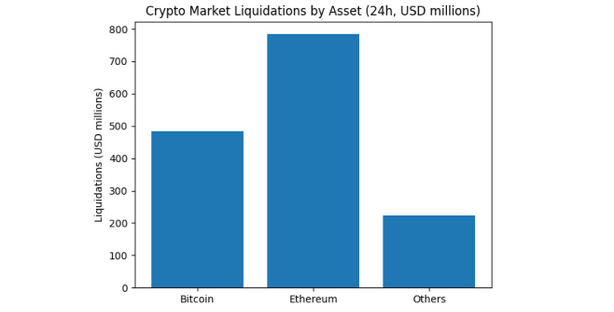
Such patterns are common during macro-driven shocks: assets with higher volatility and deeper leverage, like ETH and altcoins, tend to suffer disproportionate liquidations, reinforcing downside momentum across the market.
4. Political Risk Returns: Epstein Documents and Anti-Trump Trades
A third layer of pressure emerged from U.S. politics. The release of new Epstein-related documents reignited speculation around impeachment risks and political instability, weighing heavily on Trump-linked assets.
Shares of Trump Media & Technology Group fell roughly 5.4%, while a basket of Trump-associated cryptocurrencies declined sharply. Data from CoinGecko show that the combined market capitalization of major Trump-related tokens dropped below $9.5 billion, losing more than $750 million—or about 8%—in a single day.
Specific tokens fared even worse. WLFI plunged 16%, Trump Coin fell over 5% to just above $4, and its market capitalization slipped below $1 billion for the first time. The Melania token recorded a weekly decline of nearly 19%.
Interestingly, early social media reactions to the Epstein documents were comparatively favorable toward Elon Musk, who publicly called for prosecutions while emphasizing minimal personal contact with Epstein. Tesla’s stock rose about 3% to $430, lifting its market capitalization to roughly $1.6 trillion—overtaking Bitcoin’s total market value, which dipped below $1.54 trillion.
This divergence underscored how political narratives can rapidly reshape capital flows, even within the broader “risk asset” category.
5. Derivatives and Technical Outlook: Where the Market May Stabilize
With macro, liquidity, and political pressures converging, Bitcoin’s price structure deteriorated quickly. Yet derivatives data provide clues about where the market may attempt to stabilize.
Futures positioning shows approximately $1.35 billion in short positions versus $1.05 billion in longs, indicating a net bearish bias. However, liquidation heatmaps reveal a significant concentration of long positions around $76,600—roughly $316 million worth.
[“Bitcoin Liquidation Heatmap Highlighting $76,600 Support”]
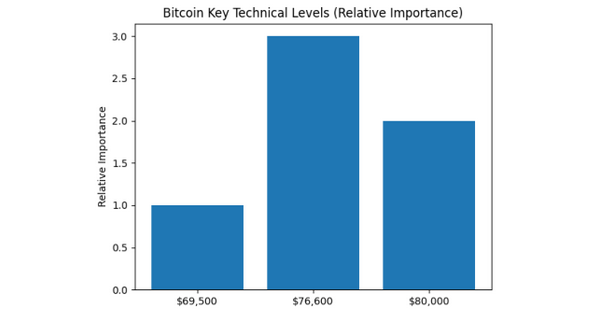
This level now represents a critical battleground. If bulls can defend it through spot buying or short-term short squeezes, Bitcoin could stage a reflexive rebound toward the $80,000 area. Such moves are often driven not by renewed optimism, but by tactical positioning and risk management.
Conversely, a decisive break below $76,600 could open the door to a deeper correction, with the next major downside target around $69,500. Prediction markets currently assign only about a 10% probability that Bitcoin will reclaim $100,000 within February, reflecting widespread caution.
6. Strategic Implications for Crypto Investors and Builders
For readers seeking new crypto assets, revenue opportunities, or practical blockchain applications, the current environment carries important lessons.
First, Bitcoin’s behavior reinforces its sensitivity to global liquidity and dollar dynamics. Despite narratives of “digital gold,” BTC remains tightly linked to macro conditions, especially during periods of stress.
Second, cross-market contagion is real. A liquidity crisis in Chinese gold trading can cascade into crypto derivatives within days. Builders and treasury managers should factor such correlations into risk models and capital allocation strategies.
Third, political risk is no longer peripheral. Tokens associated with political figures or narratives may experience amplified volatility during periods of controversy, offering speculative opportunities—but also outsized downside risk.
Finally, periods of deleveraging often create long-term opportunities. Historically, forced liquidations clear excess leverage and lay the groundwork for more sustainable advances, particularly for projects with real-world utility and strong balance sheets.
Conclusion: A Perfect Storm, Not a Structural Collapse
Bitcoin’s fall below $80,000 was not driven by a single failure within crypto itself. Rather, it reflected a rare convergence of forces: a hawkish monetary surprise, a major liquidity shock in China’s gold market, and renewed political uncertainty in the United States.
Together, these factors erased months of speculative gains and reminded investors that crypto does not exist in isolation from global finance. Yet nothing in the current episode fundamentally undermines Bitcoin’s long-term role as a scarce digital asset or the broader blockchain ecosystem’s capacity for innovation.
For disciplined investors and builders, the coming weeks may prove less about chasing price rebounds and more about identifying resilient projects, sustainable yield models, and practical use cases that can endure beyond the next macro cycle.


