Main Points :
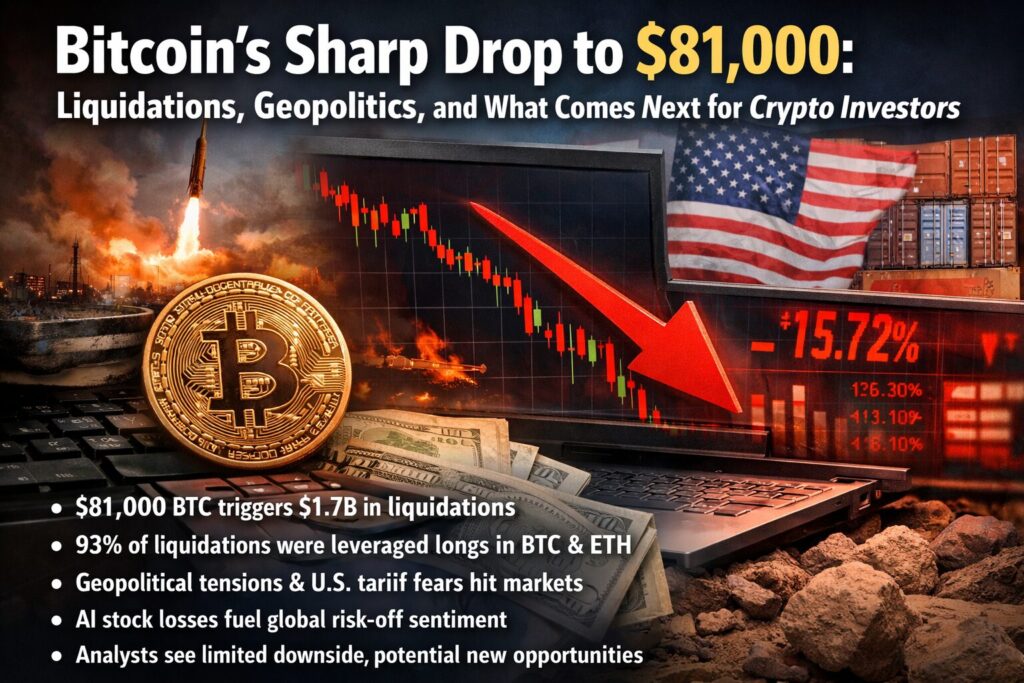
- Bitcoin briefly fell to around $81,000, its lowest level in roughly nine months, triggering over $1.7 billion in liquidations
- About 93% of liquidations were leveraged long positions, mainly in BTC and ETH
- Rising Middle East geopolitical tensions and new U.S. tariff concerns acted as immediate catalysts
- Weak U.S. tech earnings, especially in AI-related stocks, intensified global risk-off sentiment
- Despite the sharp correction, many analysts argue that downside risk may now be limited
- For investors seeking new crypto assets, yield opportunities, or practical blockchain use cases, this correction may reset entry points rather than end the cycle
1. Bitcoin’s Sudden Fall: What Happened?
Bitcoin (BTC) experienced a sharp and rapid decline on Friday, briefly touching $81,058 on Coinbase, marking its lowest price in approximately nine months. According to TradingView data, this drop represents a 35% correction from the all-time high of around $126,000 recorded in October.
This move was not an isolated crypto-specific event. Instead, it occurred alongside heightened volatility across global markets, driven by a combination of geopolitical risk, macroeconomic uncertainty, and deteriorating sentiment in technology equities.
From a market-structure perspective, Bitcoin had been hovering near a key monthly support zone. Once that level was breached, selling pressure accelerated, triggering stop-losses and forced liquidations across major derivatives platforms.
[Insert Figure 1 here: Bitcoin price decline from ATH to recent low]
Download image:
Figure 1 – Illustrative Bitcoin Price Decline
2. $1.7 Billion in Liquidations: Leverage Unwinds Fast
The most striking feature of this sell-off was the scale of liquidations. Data from CoinGlass shows that approximately 270,000 traders were liquidated within 24 hours, with total liquidations reaching $1.68 billion.
Crucially, 93% of these liquidations came from leveraged long positions, primarily concentrated in Bitcoin and Ethereum (ETH). This indicates that the market was heavily skewed toward bullish positioning, leaving it vulnerable to sudden downside moves.
In leveraged crypto markets, even modest spot price declines can cascade into forced selling. As margin thresholds are breached, exchanges automatically close positions, pushing prices down further and creating a feedback loop.
[Insert Figure 2 here: Liquidation composition]
Download image:
Figure 2 – Liquidation Composition
This event serves as another reminder that leverage, while attractive for yield-seeking traders, remains one of the largest structural risks in crypto markets.
3. Geopolitical Shock: Middle East Tensions and Tariff Anxiety
One of the primary external catalysts was rising geopolitical tension in the Middle East. Reports indicated that the United States had dispatched additional naval forces to the region, amid escalating friction with Iran.
Former U.S. President Donald Trump commented publicly that “very large and powerful ships” were heading toward Iran, adding that he hoped they would not need to be used. Such statements, even when framed as deterrence, tend to amplify market uncertainty.
At the same time, Trump signed an executive order declaring a national emergency, imposing tariffs on imports from countries that sell or supply oil to Cuba. While the direct economic impact of this policy may be limited, markets interpreted it as a signal of renewed trade friction and protectionism.
Historically, Bitcoin has sometimes been framed as a hedge against geopolitical instability. However, in periods of acute risk-off sentiment, crypto often behaves like a high-beta risk asset, selling off alongside equities rather than acting as a safe haven.
4. Broader Market Impact: Crypto, Gold, and Silver All Slide
The sell-off was not confined to digital assets. The total cryptocurrency market capitalization fell by approximately $200 billion within 24 hours, reflecting broad-based weakness across altcoins.
Traditional safe-haven assets also showed surprising volatility. Gold, after reaching a record high near $5,600 per ounce, declined by about 9%, while silver corrected by roughly 11.5%.
This simultaneous decline across risk assets and traditional hedges suggests that investors were prioritizing liquidity and capital preservation, rather than rotating into alternative stores of value.
5. Tech Earnings and AI Concerns Add Fuel to the Fire
Another important factor was weakness in U.S. technology stocks. According to Jeff Mei, CEO of BTSE Exchange, the crypto market’s decline showed a clear correlation with disappointing earnings from major tech firms, particularly Microsoft.
Microsoft shares fell around 10% in a single session, marking their largest drop since March 2020. Investors reacted negatively to record-high capital expenditures and signs of slowing cloud revenue growth, raising concerns about the sustainability of AI-driven expansion.
As AI-related equities corrected, fears spread that a broader technology-sector revaluation was underway. Given the increasing overlap between crypto investors and tech-focused portfolios, risk reduction in one sector spilled over into the other.
6. Is This an Overreaction? The Bull Case After the Drop
Despite the severity of the move, several market participants argue that the sell-off may have been excessive.
Mei noted that cryptocurrencies have already been trending downward since October, suggesting that much of the bad news may now be priced in. From a valuation standpoint, Bitcoin at around $80,000–$85,000 is increasingly viewed as attractive by long-term investors.
On-chain data from other sources (such as long-term holder supply metrics and exchange outflows) also suggests that structural selling pressure remains limited, with much of the recent volume driven by derivatives rather than spot selling.
For investors focused on medium- to long-term horizons, this environment may represent a reset rather than a breakdown.
7. Implications for Yield Seekers and Blockchain Practitioners
For readers interested in new crypto assets, alternative revenue streams, and practical blockchain applications, this correction carries several implications:
First, lower prices reduce entry barriers for infrastructure plays, such as staking, validator operations, and liquidity provision. Yields denominated in crypto often become more attractive after sharp corrections.
Second, speculative excess tends to clear out weaker projects, refocusing attention on protocols with real-world usage, sustainable token economics, and enterprise adoption.
Finally, volatility underscores the importance of risk management and capital efficiency, especially for businesses building on or integrating blockchain systems.
8. What to Watch Next
Key factors to monitor going forward include:
- Developments in Middle East geopolitics
- U.S. trade and tariff policy signals
- Upcoming inflation and interest-rate data
- Stability in U.S. tech and AI-related equities
- Changes in leverage and open interest in crypto derivatives
A stabilization in these areas could quickly restore confidence, while further shocks may extend volatility.
Conclusion: Correction, Not Capitulation
Bitcoin’s brief drop to around $81,000 and the resulting $1.7 billion liquidation event highlight how interconnected crypto markets have become with global macro forces. Geopolitical tension, trade uncertainty, and tech-sector weakness converged to trigger a sharp but arguably mechanical sell-off.
For long-term participants, especially those seeking new opportunities in digital assets and blockchain-based business models, this episode may ultimately be remembered as a resetting moment rather than a structural top.
As always in crypto, risk remains high—but so does the potential for those who understand the cycles, manage leverage carefully, and focus on fundamentals.