Main Points :
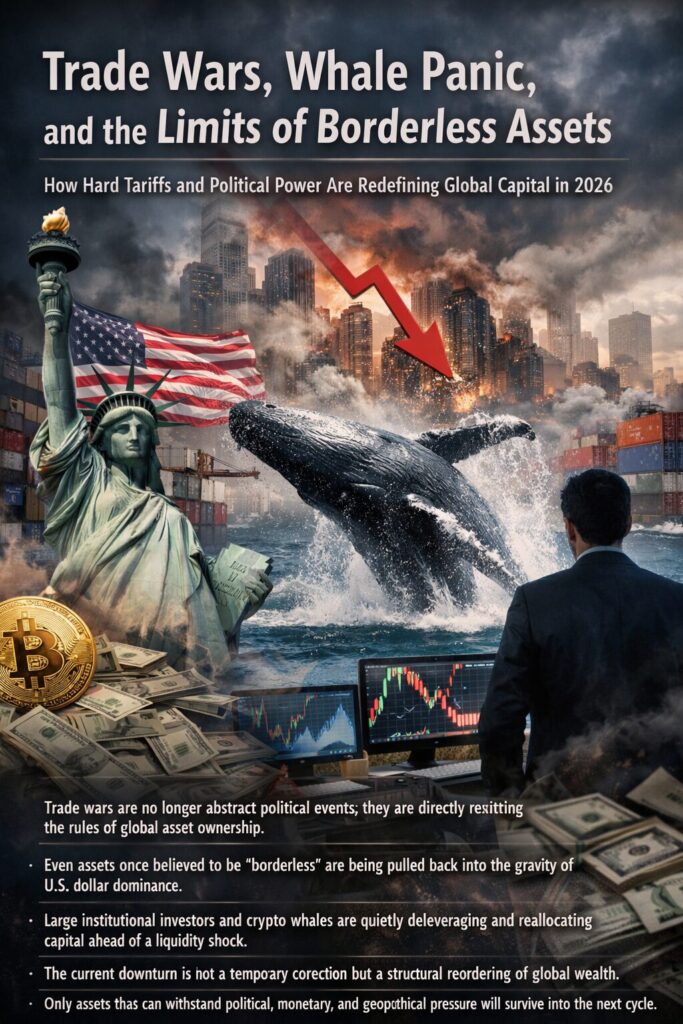
- Trade wars are no longer abstract political events; they are directly rewriting the rules of global asset ownership.
- Even assets once believed to be “borderless” are being pulled back into the gravity of U.S. dollar dominance.
- Large institutional investors and crypto whales are quietly deleveraging and reallocating capital ahead of a liquidity shock.
- The current downturn is not a temporary correction but a structural reordering of global wealth.
- Only assets that can withstand political, monetary, and geopolitical pressure will survive into the next cycle.
The Collapse of the Borderless Ideal: When Physical Power Rewrites Asset Rules
For decades, global markets were built on a seductive assumption: capital could move freely across borders, largely immune to the political frictions of nation-states. Digital assets, in particular, were celebrated as the ultimate expression of this ideal—a realm where code replaced sovereignty and algorithms overpowered diplomacy.
That assumption is now breaking down.
The hardline tariff policies promoted under Donald Trump’s renewed political influence have begun erecting invisible but formidable walls around assets that were once considered global by nature. Trade is being weaponized, and with it, the flow of capital is being redirected not by market efficiency, but by national interest.
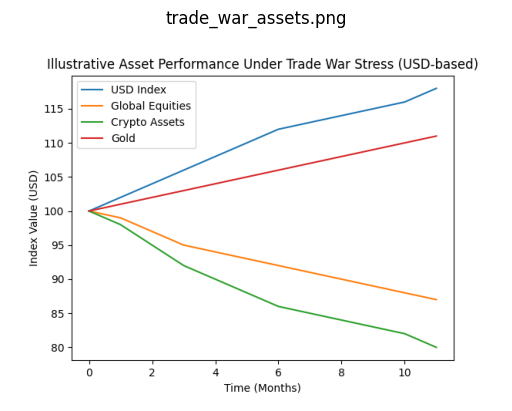
As geopolitical tension intensifies, even traditional “safe haven” assets have struggled to preserve value in the face of a surging U.S. dollar. What was once considered a refuge in times of crisis is now vulnerable to the overwhelming gravitational pull of dollar supremacy.
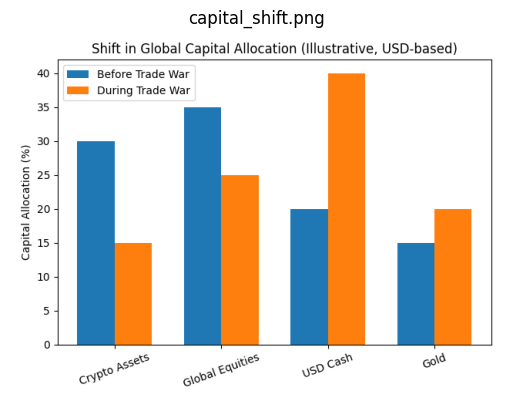
The dream of frictionless global capital has collided with physical reality. Tariffs raise import costs, reignite inflationary pressures, and undermine the Federal Reserve’s long-anticipated interest rate cut scenarios. In doing so, they expose a harsh truth: monetary policy does not exist in a vacuum, and political decisions can override even the most sophisticated financial models.
The belief that certain assets—particularly digital ones—exist outside the legacy financial system has proven dangerously naive. No matter how decentralized the code may be, pricing, liquidity, and risk perception remain anchored to the dollar-based global system.
Those unwilling to confront this reality are being swept away by market volatility. Wealth defense is no longer engineered inside algorithms or smart contracts alone; it is being redrawn in diplomatic negotiations and executive offices.
We are witnessing history running in reverse. Strategies that once guaranteed success no longer function. Protectionism has erected physical barriers that suppress speculative fervor and plunge markets into a winter-like silence. In this environment, clinging to yesterday’s narratives has become one of the greatest financial risks of all.
Whale Behavior and the Silent Signal of an Approaching Storm
Market analysts have observed a clear and unsettling pattern: large wallets are moving funds onto exchanges at an accelerating pace. These transfers, often followed by discreet selling, are not random. They represent the instinctive defense mechanisms of investors who sense structural danger ahead.
What makes this shift especially significant is the participation of institutions once regarded as unshakeable pillars of market confidence. Even giants such as BlackRock and other major asset managers are recalibrating risk exposure in response to macroeconomic upheaval.
Unlike retail investors, whales do not wait for headlines. They read political signals, policy drafts, and diplomatic tensions long before they become mainstream news. Their actions are anticipatory, not reactive.
This wave of selling is not merely profit-taking. It is a deliberate effort to raise liquidity ahead of what many expect to be a renewed global liquidity crunch. Trade friction slows growth, compresses margins, and erodes risk tolerance across asset classes.
Speculative positions that thrived in an era of cheap capital are now being dismantled with ruthless efficiency. Leverage is unwound, narratives collapse, and assets dependent on perpetual inflows are exposed.
Capital is retreating from intangible promises toward assets backed by overwhelming force or deep historical trust: the U.S. dollar and gold. This migration is not ideological; it is survival-driven.
The silent exit of whales strips markets of unfounded optimism. The price declines unfolding today resemble not a routine correction, but the labor pains of a profound transformation in global wealth distribution.
When massive capital moves, devastation follows. Only those who adopt the same cold realism as these whales stand a chance of emerging intact. Emotion has lost its utility; numbers and political realism now govern the market.
Tracking whale behavior is no longer optional—it is the closest thing to a map in a market that has abandoned its old rules.
The New Order of 2026: Survival, Selection, and Enduring Value
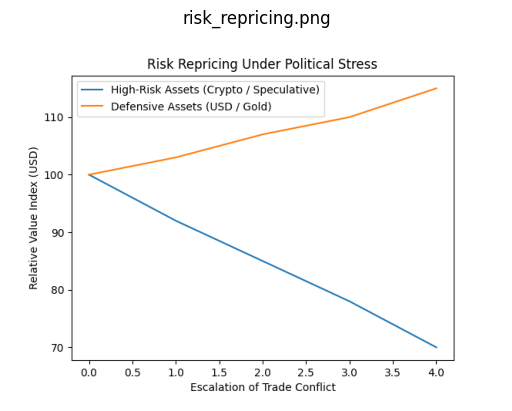
Each policy announcement tied to trade and tariffs injects unpredictable noise into markets, distorting asset prices and obscuring intrinsic value. This is no temporary anomaly; it is the defining condition of the era.
Only assets that endure this brutal selection process will earn the right to lead the next bull market. The path is unforgiving, and the casualties will be numerous.
Investors now face a critical choice: interpret the current downturn as a transient drawdown, or recognize it as the end of a structural cycle. The difference between those interpretations will determine who survives.
Political power has reasserted dominance over economic autonomy. Even whales are being forced into defensive retreat, highlighting the scale of the shift underway.
Digital freedom—once the ideological foundation of crypto—now stands trial against the blunt force of closed borders and national policy. Its value must be proven under pressure, not assumed.
Beyond the chaos lies the possibility of a more resilient financial system—one less dependent on speculative excess and more grounded in political and monetary reality. But reaching that future requires extraordinary patience.
History offers a clear parallel. After every gold rush, only assets with genuine utility and resilience remain. Fads fade; fundamentals endure.
As trade war embers spread through the crypto landscape, investors must examine whether the ground beneath their portfolios is stable or already eroding.
In this environment, protecting wealth transcends investment strategy. It becomes a fight to preserve future autonomy.
In 2026, the ultimate refuge is not an asset that promises freedom, but one that can demonstrate it—without permission, even under pressure.
Only assets with sufficient hardness to absorb repeated geopolitical shocks will ascend in the new era. We are both witnesses to this transformation and participants in its unforgiving selection process.
Conclusion: The End of Illusions and the Return of Reality
The trade wars of 2026 have shattered the illusion of borderless finance. Political power, once underestimated, has reclaimed its role as the ultimate market force.
Whales have already acted. Liquidity is being consolidated, leverage dismantled, and narratives abandoned. What remains is a harsher, colder market—but also a more honest one.
For investors seeking new crypto assets, new revenue streams, or practical blockchain applications, the lesson is clear: resilience matters more than ideology. Survival precedes growth.
The next cycle will not reward belief alone. It will reward assets—and investors—that can endure reality.