
Main Points :
- Bitcoin is entering regulated retirement insurance products, not as direct ownership but as managed index exposure.
- Delaware Life integrates Bitcoin exposure via a BlackRock-designed index, using the iShares Bitcoin Trust ETF.
- Volatility is capped at approximately 12%, aligning Bitcoin with insurance-grade risk profiles.
- This marks a structural shift: Bitcoin is moving from speculative asset to portfolio component for long-term capital preservation.
- Similar strategies are emerging globally, signaling a broader convergence of traditional insurance, ETFs, and digital assets.
1. Bitcoin’s Quiet Entry into Insurance-Based Retirement Products
Bitcoin’s integration into mainstream finance has often been associated with dramatic headlines—spot ETFs, institutional trading desks, and sovereign-level discussions. Yet one of the most structurally significant developments is happening quietly: inside insurance-based retirement products.
In early 2026, Delaware Life Insurance, a U.S.-based life insurance and annuity provider, announced that it would add limited Bitcoin-linked exposure to its annuity portfolios. This exposure is not achieved through direct Bitcoin custody, but via an index developed by BlackRock, the world’s largest asset manager.
The move represents more than product innovation. It reflects a deeper transformation in how Bitcoin is perceived: no longer merely a high-volatility speculative instrument, but a risk-managed component suitable for conservative, regulated financial products.
2. Structure Matters: How the Bitcoin Exposure Is Implemented
Indirect Exposure via an ETF-Based Index
Delaware Life’s approach is deliberately conservative. Policyholders do not own Bitcoin directly. Instead, the annuity products reference an index that combines:
- U.S. equities
- A small, risk-managed allocation to Bitcoin, obtained through iShares Bitcoin Trust ETF
This design ensures compliance with insurance regulations while avoiding custody, private key management, and direct crypto accounting complexities.
Volatility Control at Approximately 12%
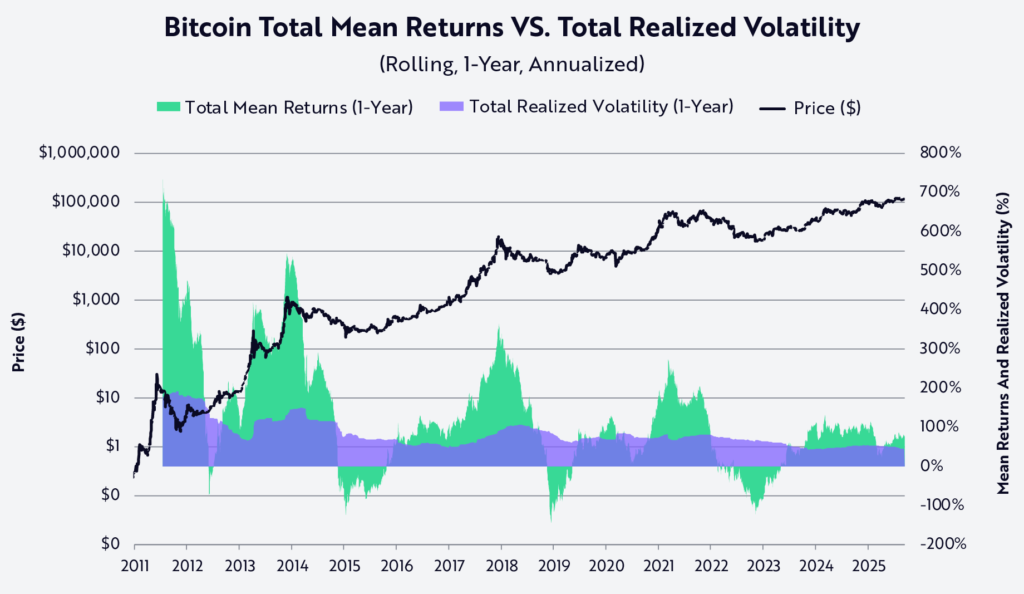
One of the most critical elements of the index is volatility targeting. Bitcoin’s historical annualized volatility has frequently exceeded 60–80%. In contrast, the BlackRock-designed index dynamically adjusts Bitcoin exposure so that overall portfolio volatility remains near 12%, a level compatible with fixed indexed annuity structures.
This mechanism effectively transforms Bitcoin from a “price-driven asset” into a risk-budgeted signal inside a broader portfolio.
【“Conceptual Structure of a Volatility-Controlled Bitcoin Index”】
Diagram showing U.S. equities + capped Bitcoin allocation with volatility band
3. Why Fixed Indexed Annuities Are the Perfect Trojan Horse
What Is a Fixed Indexed Annuity?
Fixed indexed annuities (FIAs) are insurance-based retirement products that:
- Protect principal under contract terms
- Offer ta-deferred growth
- Provide returns linked to a reference index rather than direct asset ownership
Historically, these indices tracked equity benchmarks like the S&P 500. Bitcoin’s inclusion signals that it has crossed an institutional threshold.
Delaware Life’s Scale Makes This Meaningful
Delaware Life focuses exclusively on retirement-oriented products. As of November 2025, the company reported over $40 billion in cumulative annuity sales. Even a small Bitcoin-linked allocation at this scale represents systemic validation, not experimentation.
4. BlackRock’s Bitcoin Strategy: From ETF to Infrastructure
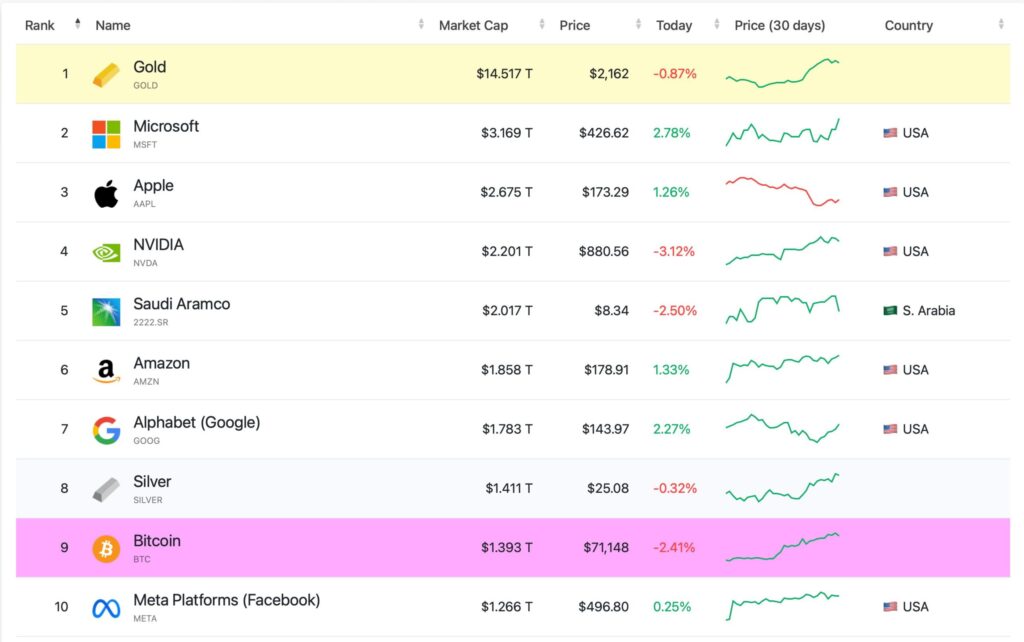
BlackRock launched its spot Bitcoin ETF in January 2024. According to CoinMarketCap, the fund’s market capitalization has since exceeded $70 billion, making it the largest spot Bitcoin ETF globally.
By December 2025, BlackRock publicly stated that the Bitcoin ETF ranked among its top three investment themes for the year. The Delaware Life index is therefore not an isolated product, but part of a broader strategy to embed Bitcoin across traditional financial rails.
【“Top Spot Bitcoin ETFs by Market Capitalization (USD)”】
Bar chart comparison (conceptual)
5. Insurance Companies Are Exploring Multiple Bitcoin Pathways
Delaware Life is not alone. The insurance sector is experimenting with three distinct Bitcoin strategies:
1. Bitcoin-Linked Indices (Delaware Life Model)
- No direct custody
- Volatility-managed exposure
- Ideal for conservative retirement products
2. Bitcoin-Denominated Insurance (Meanwhile Group)
The Meanwhile Group, launched in 2023, offers Bitcoin-denominated life insurance and retirement products. Backed by prominent investors, the company raised $82 million in October 2025 to meet rising demand for Bitcoin-native savings instruments.
3. Bitcoin as Balance Sheet Capital (Tabit)
Barbados-based insurer Tabit holds $40 million worth of Bitcoin to fully back its regulatory reserves for USD-denominated property and casualty insurance. In this model, Bitcoin is not a reference asset—it is the core capital base.
6. Regulatory Winds Are Shifting in Favor of Crypto Exposure
Beyond private insurers, public policy is also evolving. In August 2025, U.S. President Donald Trump signed an executive order instructing regulators to expand access to cryptocurrencies within 401(k) retirement plans.
This directive does not mandate Bitcoin allocation, but it removes a long-standing psychological and regulatory barrier. Together with annuity-based exposure, it suggests that crypto-linked retirement products are moving from exception to option.
7. What This Means for Investors and Builders
For Investors
- Bitcoin exposure no longer requires full volatility risk
- Insurance wrappers provide tax efficiency and downside protection
- Institutional validation reduces counterparty and regulatory uncertainty
For Product Builders
- Index engineering is becoming as important as token design
- Volatility control, not yield maximization, is the key to adoption
- The future lies in financial abstraction, not raw asset access
Conclusion: Bitcoin’s Most Important Adoption May Be Its Least Visible
The integration of Bitcoin into Delaware Life’s annuity products is not about headlines or price speculation. It is about infrastructure acceptance.
When Bitcoin becomes suitable for retirement insurance—arguably the most conservative corner of finance—it signals a fundamental redefinition of the asset. The question is no longer whether Bitcoin belongs in institutional portfolios, but how it is engineered to fit.
For those seeking new crypto assets, revenue models, or practical blockchain applications, this development offers a clear lesson:
The next wave of adoption will be quiet, regulated, and structural.