Key Takeaways :
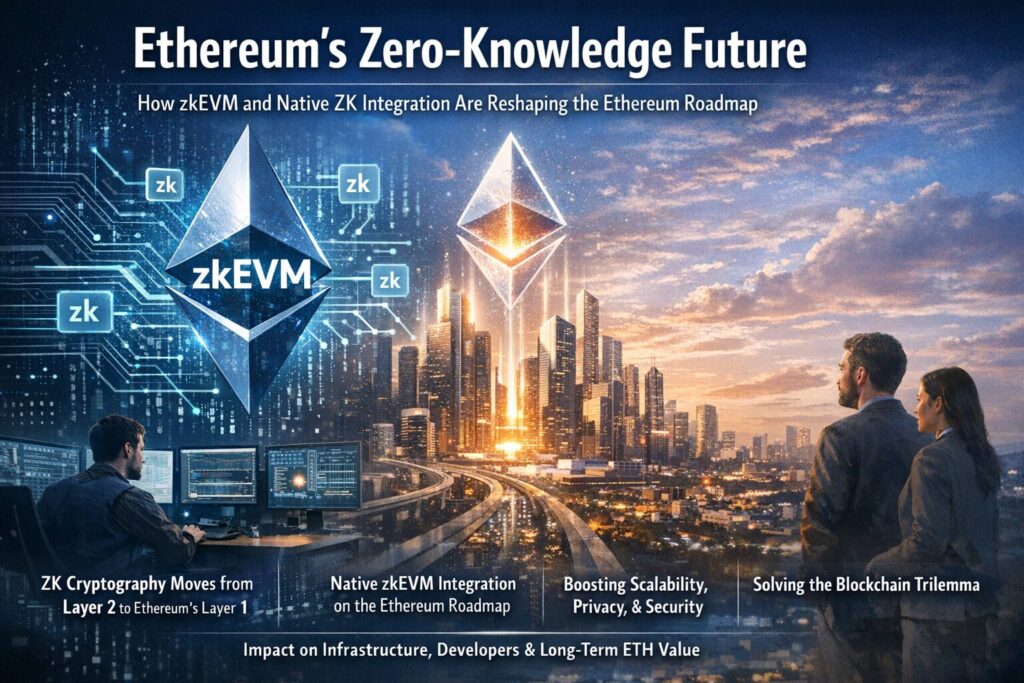
- Ethereum is moving zero-knowledge (ZK) cryptography from Layer 2 into the Layer 1 protocol itself
- Native zkEVM integration is positioned as a medium-term milestone on Ethereum’s roadmap
- ZK proofs significantly reduce validator workload while improving scalability, privacy, and censorship resistance
- Ethereum Foundation leaders argue that ZK technology is essential to resolving the blockchain trilemma
- The shift has major implications for infrastructure providers, application developers, and long-term ETH value capture
Introduction: Ethereum’s Strategic Turn Toward Zero Knowledge
Ethereum is entering a decisive phase in its long-term evolution. What began as an experimental scaling technique on Layer 2 is now being elevated to the very core of the protocol. According to Hsiao-Wei Wang, Co-Executive Director of the Ethereum Foundation, zero-knowledge (ZK) cryptography is no longer a peripheral innovation. It is becoming a foundational pillar of Ethereum’s future.
In an interview with CoinDesk, Wang emphasized that the past one to two years have seen “a remarkable series of breakthroughs” in ZK technology. These advances have pushed ZK from academic theory into practical, protocol-level implementation. Ethereum, she argued, is steadily advancing toward a future where zero-knowledge proofs form the backbone of the network.
This transition is not merely technical. It represents a strategic redefinition of how Ethereum balances scalability, security, decentralization, and neutrality—values that have guided the network since its inception.
What Zero-Knowledge Proofs Really Mean for Blockchains
Zero-knowledge proofs are a class of cryptographic protocols that allow one party to prove that a statement is true without revealing any additional information beyond the validity of the statement itself.
In practical blockchain terms, this means a transaction can be proven valid without exposing sensitive details such as the sender, recipient, or transferred amount. The verifier gains mathematical certainty, not trust-based assurance.
Historically, ZK technology was computationally expensive and impractical for large-scale public blockchains. That reality has changed. Advances in proof systems, hardware acceleration, and cryptographic design have dramatically reduced proof generation and verification costs, opening the door to protocol-level adoption.
From Layer 2 Optimization to Layer 1 Transformation
Until recently, ZK proofs were primarily deployed in Layer 2 solutions, particularly ZK rollups. These systems bundle transactions off-chain, generate cryptographic proofs, and submit them to Ethereum’s mainnet for verification. This approach preserved Ethereum’s security guarantees while significantly lowering fees and increasing throughput.
However, embedding ZK directly into Ethereum’s Layer 1 represents a far more profound shift. It changes not only how transactions scale, but how the network itself is validated.
Last July, the Ethereum Foundation announced its intention to integrate ZK technology across all layers of the Ethereum protocol. The first step in this plan is the introduction of a native zkEVM—an Ethereum Virtual Machine compatible environment that generates zero-knowledge proofs at the base layer.
What Native zkEVM Changes at the Protocol Level
The introduction of zkEVM to Ethereum’s mainnet fundamentally alters the validation process. Instead of re-executing every transaction in a block, validators can simply verify a compact cryptographic proof that attests to the correctness of the entire computation.
This has several profound effects:
- Validator resource requirements drop significantly
- Network scalability improves without sacrificing decentralization
- Verification becomes more accessible, strengthening censorship resistance
- Security guarantees remain anchored in cryptographic certainty rather than computation repetition
In essence, Ethereum shifts from “trust through re-execution” to “trust through proof.”
[After this section – Diagram showing traditional validation vs zk-based validation]
Strengthening Ethereum’s Core Values
Hsiao-Wei Wang emphasized that ZK integration is not about sacrificing Ethereum’s principles for performance. On the contrary, it reinforces long-standing priorities: resilience, security, censorship resistance, and neutrality.
Lower validation costs make it easier for individuals to run nodes. Reduced hardware requirements prevent validator centralization. Cryptographic verification minimizes reliance on trust or privileged actors.
In this sense, ZK technology does not merely scale Ethereum—it hardens it.
Developer Roadmap: From Optional ZK Clients to Network-Wide Adoption
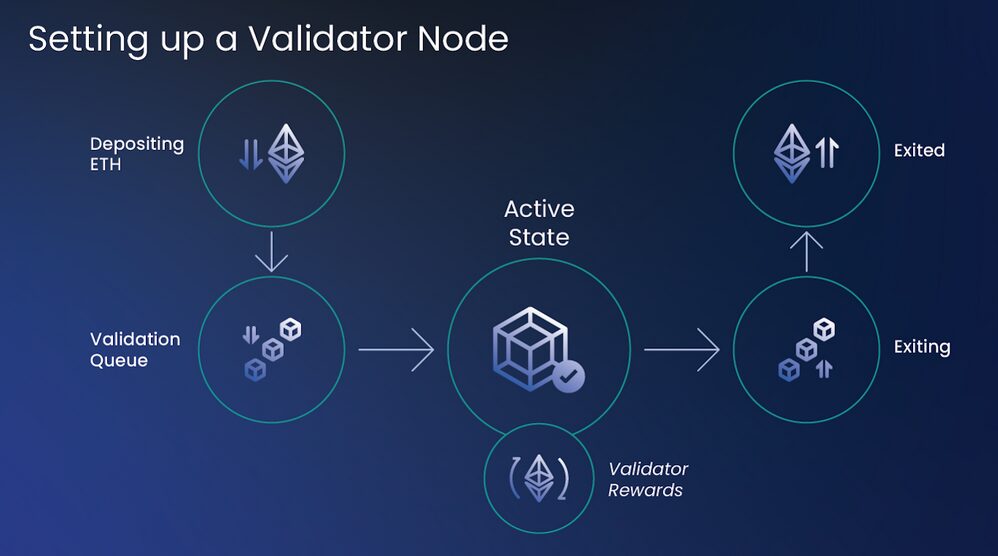
Ethereum Foundation developer Sophia Gold outlined a phased approach to zkEVM adoption. Initially, validators will be given the option to run a “ZK client” that verifies proofs generated from EVM execution. This parallel system allows gradual adoption without disrupting the existing validator ecosystem.
Simultaneously, the Foundation is investing heavily in:
- Formal specifications for zkEVM behavior
- Extensive auditing and security review
- Bug bounty programs to incentivize external validation
- Tooling and documentation to accelerate developer adoption
This approach reflects Ethereum’s characteristic conservatism when it comes to protocol changes—favoring robustness and community alignment over rapid deployment.
Real-World Demonstrations: zk Verification in Action
At Devconnect in Argentina, the verifiable computing platform Brevis demonstrated a new block verification process using the zkLighthouse client. This live demonstration showcased how ZK-based validation could operate in practice, rather than theory.
What once existed primarily in academic papers is now running code. This transition from concept to implementation is a critical inflection point for Ethereum’s roadmap.
[After this section – Photo-style image of developer conference and ZK demo]

Solving the Blockchain Trilemma: Vitalik’s Perspective
Ethereum co-founder Vitalik Buterin has repeatedly argued that the blockchain trilemma—security, decentralization, scalability—can be resolved through engineering, not compromise.
According to Buterin, two technologies are key: PeerDAS (data availability sampling) and zkEVM.
PeerDAS, partially deployed in Ethereum’s recent Fusaka upgrade, addresses data availability and throughput by allowing nodes to verify data existence without storing it in full. zkEVM addresses the computational side by compressing execution into succinct proofs.
Together, these systems redefine what is possible at Layer 1.
Fusaka Upgrade and Blob Expansion
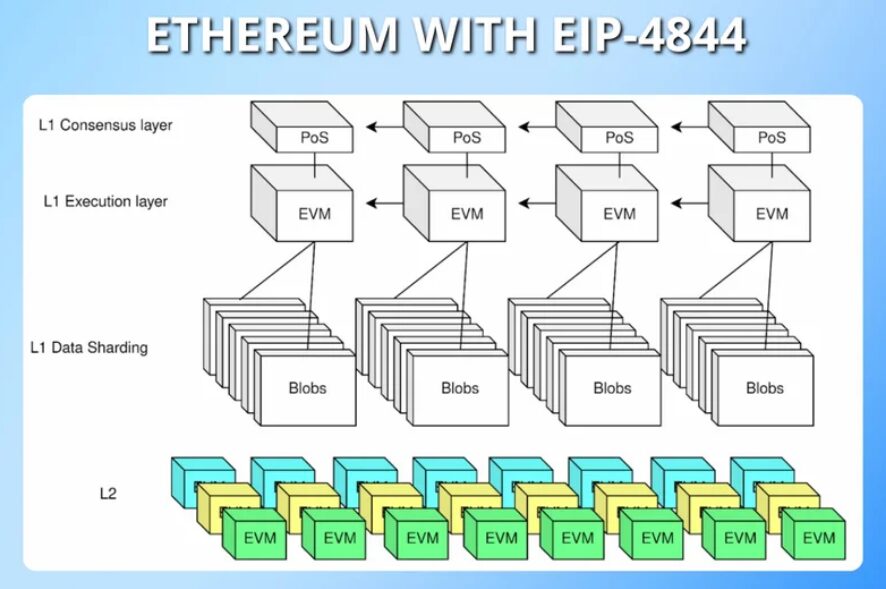
On January 7, Ethereum completed the second BPO (Blob Parameters Only) fork, the final phase of the Fusaka upgrade. This upgrade expands temporary high-capacity data storage known as “blobs” without requiring a disruptive hard fork.
Blob expansion directly supports rollups and ZK-based systems by increasing data throughput while maintaining predictable costs—measured consistently in U.S. dollars.
[After this section – Diagram showing blob-based data availability]
Implications for Investors and Builders
For investors, Ethereum’s ZK-centric roadmap strengthens ETH’s role as a settlement and security layer rather than a high-fee execution bottleneck. This increases long-term value capture while pushing experimentation to scalable environments.
For developers and enterprises, native ZK integration unlocks new application categories:
- Privacy-preserving financial infrastructure
- Verifiable off-chain computation
- Scalable on-chain identity systems
- Compliance-friendly blockchain applications
ZK is not just a scaling solution. It is an architectural shift.
Conclusion: Ethereum’s ZK-Centered Future
Ethereum’s move toward native zero-knowledge integration marks one of the most significant transitions in its history. What began as a workaround for scalability has evolved into a unifying framework for security, privacy, and decentralization.
By embedding ZK proofs directly into the protocol, Ethereum is redefining how trust is established in decentralized systems. The network is no longer scaling despite its principles—it is scaling because of them.
As zkEVM adoption progresses through 2026 and beyond, Ethereum’s role as the world’s most versatile and resilient smart contract platform appears increasingly secure.