
Main Points :
- India’s tax authorities and central bank have formally stated that cryptocurrency transactions are becoming structurally untraceable, pushing the government toward stronger regulation and surveillance.
- India already enforces one of the world’s harshest crypto tax regimes—a flat 30% capital gains tax plus a 1% transaction-level withholding tax—and further tightening is likely in the 2026 federal budget.
- The policy direction is clear: discourage private cryptocurrencies while accelerating adoption of the central bank–issued digital rupee (CBDC).
- These developments carry lessons not only for Indian investors, but also for global market participants, exchanges, and jurisdictions such as Japan that are reassessing their own crypto frameworks.
1. Introduction: India’s Crypto Debate Enters a New Phase
On January 8, 2026, India’s Income Tax Department delivered a striking message to Parliament’s Standing Committee on Finance: cryptocurrency transactions—classified domestically as Virtual Digital Assets (VDAs)—are increasingly undermining the enforceability of tax law. According to the testimony, the combination of pseudonymity, cross-border settlement, decentralized finance (DeFi), and offshore exchanges has made it “practically impossible” to capture the true taxable income of crypto investors.
This position aligns closely with long-standing warnings from the Reserve Bank of India (RBI), reinforcing the sense that India is moving from reluctant tolerance to assertive containment of private crypto activity.
The implications are significant. India is not banning crypto outright, but it is constructing a regulatory and tax environment so restrictive that speculative activity becomes economically unattractive. At the same time, the government is aggressively promoting the digital rupee, a central bank digital currency designed to retain state control over money in a digitized economy.
2. Why Indian Authorities Say Crypto Is a Tax Enforcement Nightmare
Structural Challenges in Tracking Crypto Activity
Indian tax officials emphasized that the difficulty is not merely operational, but structural. Crypto transactions often bypass domestic intermediaries entirely, settling instantly across borders via blockchain networks. Many investors use foreign exchanges, self-custody wallets, or decentralized protocols that fall outside traditional reporting frameworks.
Even when exchanges cooperate, authorities face fragmented data, wallet obfuscation techniques, and rapid asset rotation. The result is a widening gap between declared income and actual trading activity.
RBI’s View: Systemic Risk, Not Just Tax Leakage
The RBI has repeatedly warned that crypto assets lack intrinsic backing, exhibit extreme volatility, and are prone to misuse for money laundering and terror financing. From the central bank’s perspective, large-scale crypto adoption could weaken monetary sovereignty and destabilize the financial system.
These arguments have become the intellectual backbone of India’s regulatory posture.
3. The Strategic Push for the Digital Rupee (CBDC)
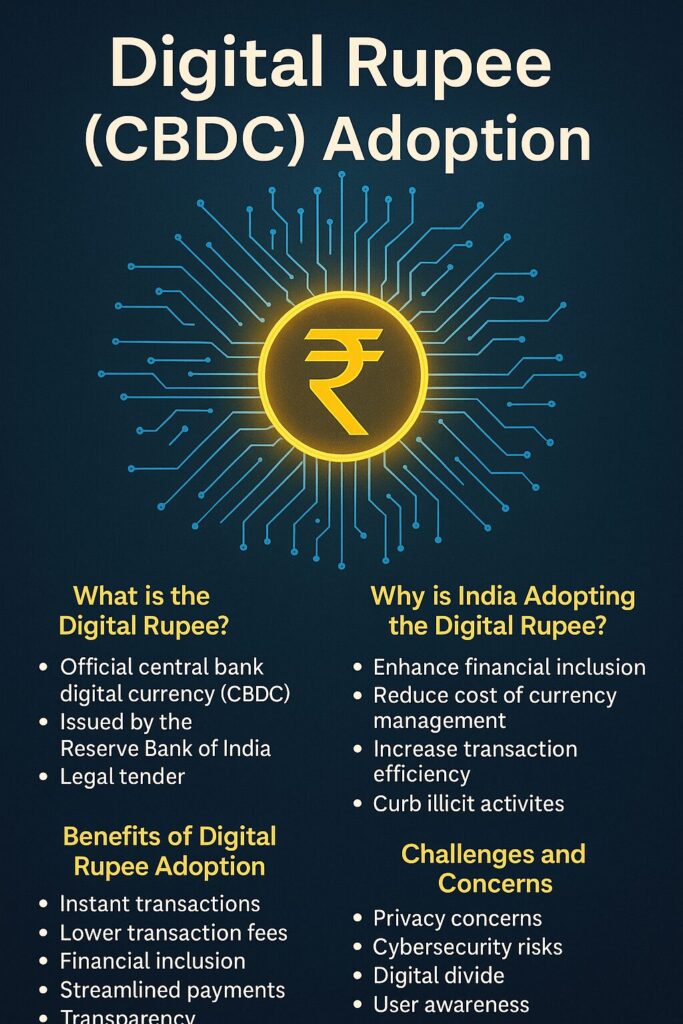
While restricting private crypto, India is simultaneously investing political and institutional capital into its CBDC initiative. The digital rupee pilot began in December 2022 and has expanded rapidly. By August 2024, over 5 million users and 16 major banks were participating.
Government officials have been explicit about the rationale. Commerce Minister Piyush Goyal stated that heavy taxation on private cryptocurrencies is intended to protect investors from “unbacked speculative assets,” while the digital rupee offers a regulated, sovereign alternative.
In other words, regulation is not neutral—it is directional.
4. India’s Crypto Tax Regime: Among the World’s Strictest
Flat 30% Capital Gains Tax
India imposes a uniform 30% tax on all crypto gains, regardless of income bracket. On top of this, high-income earners face surcharges of up to 37%, plus a 4% health and education cess. The effective tax rate can reach 42–43%, placing India among the most punitive jurisdictions globally.
1% Transaction-Level Withholding Tax (TDS)
Since July 2022, every crypto transaction triggers a 1% Tax Deducted at Source (TDS). This applies whether the trade is profitable or not. For active traders, the cumulative effect severely constrains liquidity and capital efficiency.
Crucially, the TDS system links transactions directly to the taxpayer’s PAN (Permanent Account Number), enabling granular surveillance.
No Loss Offsetting, No Expense Deductions
Perhaps the most controversial feature is the outright denial of loss offsets and expense deductions. Losses cannot be carried forward, nor offset against other income. Apart from acquisition cost, all other expenses—mining costs, electricity, personnel—are disallowed.
This design is intentional: the tax code is structured to discourage participation rather than merely collect revenue.
5. FIU Registration and the Binance Case

Under India’s Prevention of Money Laundering Act (PMLA), crypto exchanges are classified as reporting entities and must register with FIU-IND. By fiscal year 2024–25, 49 exchanges had registered, including a small number of foreign platforms.
The most high-profile enforcement action involved Binance, which was fined approximately $22–28 million (converted to USD) for operating without proper registration. Authorities blocked its app and website until compliance was achieved.
The message was clear: global scale offers no immunity from Indian law.
6. AI Surveillance and Tax Probes into High-Net-Worth Investors
India has escalated enforcement by deploying AI-driven analytics. In 2025, tax authorities launched investigations into more than 400 high-net-worth individuals, many suspected of using offshore exchanges or peer-to-peer channels to bypass domestic controls.
By cross-referencing TDS data, exchange disclosures, and international information-sharing frameworks, discrepancies exceeding roughly $1,200 trigger automated alerts. This approach has materially boosted crypto-related tax revenue year over year.
7. The 2026 Federal Budget: What Might Come Next?

Finance Minister Nirmala Sitharaman is expected to present the 2026 federal budget on February 1. Analysts anticipate additional measures, potentially including retroactive audits, expanded reporting obligations, and deeper access to wallet and exchange data.
Industry leaders warn that excessive rigidity could push innovation, capital, and talent offshore—turning India into a tax collector rather than a rule-maker in the global crypto economy.
8. India vs. Japan: A Comparative Perspective
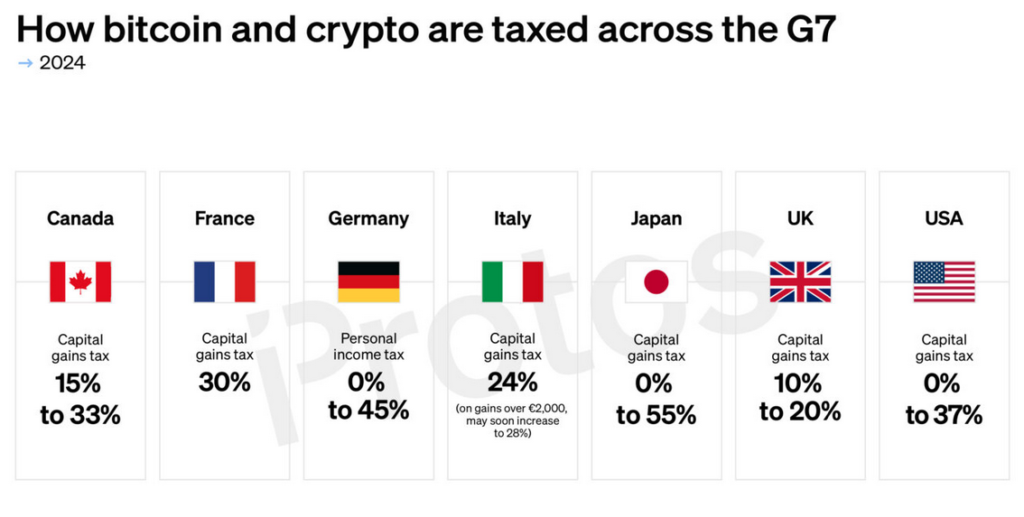
While India tightens controls, Japan is moving in the opposite direction, planning to shift crypto taxation toward a 20% separate tax regime with loss carryforwards by 2028. The contrast illustrates divergent policy philosophies: containment versus integration.
For global investors, this divergence underscores the importance of jurisdictional risk assessment alongside market analysis.
9. What Global and Japanese Investors Should Learn
India’s approach demonstrates how taxation, compliance, and technology can be combined to shape market behavior without outright bans. Even decentralized and offshore strategies are increasingly visible under AI-assisted enforcement.
For investors seeking new crypto assets or revenue opportunities, the lesson is clear: regulatory risk is now as material as price volatility. Markets with unclear or hostile policy trajectories demand higher risk premiums—or avoidance altogether.
10. Conclusion: Regulation as Strategy, Not Reaction
India’s crypto policy is no longer reactive. It is strategic, coordinated, and technologically sophisticated. By imposing severe tax friction, expanding surveillance, and promoting a state-backed digital currency, India is redefining the boundaries of acceptable digital finance.
Whether this approach succeeds in protecting investors and financial stability—or instead drives innovation abroad—remains to be seen. What is certain is that India’s experiment will influence global regulatory debates, including those in Japan and other major economies.
For crypto participants worldwide, India serves as both a warning and a case study: the future of crypto will be shaped not only by code and markets, but by states that are rapidly learning how to govern them.