
Main Points :
- Bitcoin was born from distrust in centralized finance after the 2008 global financial crisis.
- Over 17 years, it evolved from a niche P2P experiment into a globally recognized macro asset.
- Market cycles, regulatory shocks, and technological upgrades shaped Bitcoin’s resilience.
- Institutional adoption, ETFs, and sovereign interest redefined Bitcoin as “digital gold.”
- The next phase focuses on integration with global finance, not ideological isolation.
1. The Genesis of Bitcoin: A Monetary Rebellion (2008–2009)
On January 3, 2009 (Japan time), Bitcoin’s genesis block was mined, marking the birth of a monetary system without a central authority. Two months earlier, an anonymous figure using the name Satoshi Nakamoto published the white paper “Bitcoin: A Peer-to-Peer Electronic Cash System.”
The timing was not accidental. The collapse of Lehman Brothers in September 2008 exposed structural fragility in the global financial system. Governments responded with unprecedented bailouts and quantitative easing, reinforcing public distrust in banks and central authorities.
Embedded in Bitcoin’s genesis block was a symbolic message from The Times:
“Chancellor on brink of second bailout for banks.”
This was not merely a timestamp—it was a declaration. Bitcoin was designed as an alternative monetary system, immune to discretionary monetary policy and centralized control.
2. Early Experiments and the First Market Signals (2010–2012)
Bitcoin’s first real-world transaction occurred in May 2010, when 10,000 BTC were exchanged for two pizzas. At the time, Bitcoin had negligible value—roughly $0.002 per BTC. At today’s valuation, that transaction would exceed $300 million.
This era also saw:
- The launch of early exchanges
- The emergence of mining pools
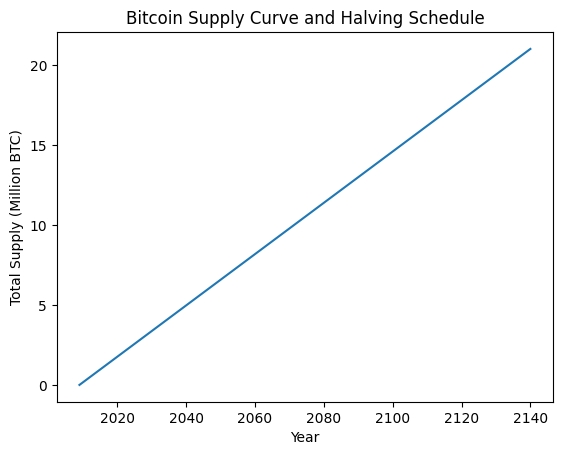
- The first halving in 2012, reducing block rewards from 50 BTC to 25 BTC
The halving introduced Bitcoin’s defining monetary feature: programmatic scarcity. Unlike fiat currencies, Bitcoin’s supply schedule was fixed and transparent.
Bitcoin Supply Curve and Halving Schedule (2009–2140)
3. Crises, Bubbles, and Survival (2013–2016)
Bitcoin’s first major speculative bubble occurred in 2013, driven by:
- The Cyprus banking crisis
- Capital controls in Europe
- Growing distrust in fiat currencies
Bitcoin’s market capitalization surpassed $1 billion, attracting global attention. However, the ecosystem was immature. Exchange hacks, most notably the Mt. Gox collapse in 2014, wiped out trust and liquidity.
Despite these setbacks, Bitcoin did not die. Hash rate recovered. Developers improved protocol security. Importantly, governments—especially Japan—began formal regulatory discussions.
This period proved Bitcoin’s anti-fragility: it weakened under stress but emerged stronger.
4. Institutional Awareness and Regulatory Recognition (2017–2019)
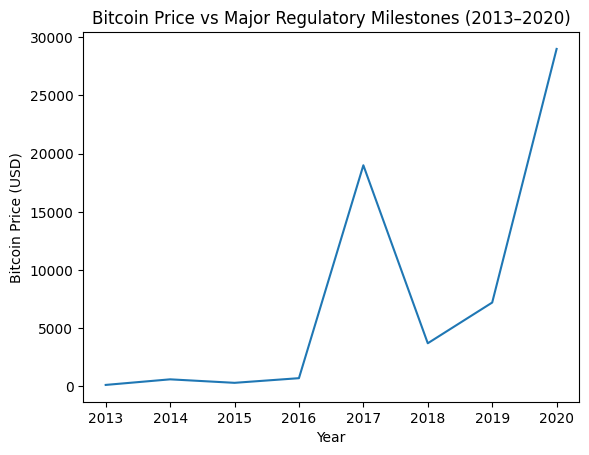
2017 marked Bitcoin’s entry into mainstream consciousness. Prices surged past $10,000, ICOs exploded, and retail participation peaked.
Yet the crash of 2018 was equally dramatic. Overleveraged speculation collapsed, and Bitcoin lost more than 70% of its value.
What changed afterward was not price—but perception.
- Japan legally recognized cryptocurrencies
- The term “crypto assets” replaced “virtual currencies”
- Futures markets matured
- Custody solutions improved
Bitcoin began transitioning from a speculative toy to a regulated financial instrument.
Bitcoin Price vs. Global Regulatory Milestones (2013–2020)
5. Bitcoin as a Corporate and Treasury Asset (2020–2022)
The COVID-19 pandemic triggered massive monetary expansion. In response, corporations sought inflation hedges.
In 2020, publicly listed companies began allocating treasury reserves to Bitcoin. Payment platforms integrated crypto services. Bitcoin reached new all-time highs above $60,000.
However, excessive leverage and weak governance caused systemic failures:
- Algorithmic stablecoin collapse
- Hedge fund bankruptcies
- Major exchange failures
Despite this, Bitcoin’s core protocol remained unaffected. Hash rate reached new highs, reinforcing the distinction between Bitcoin the network and crypto the industry.
6. The ETF Era and Macro Integration (2023–2024)
By 2023, Bitcoin’s narrative shifted decisively toward macro finance.
Key developments included:
- Legal victories against regulatory uncertainty
- Approval of spot Bitcoin ETFs in the United States
- Capital inflows from pension funds and asset managers
Bitcoin’s market capitalization surpassed $1 trillion, ranking among the world’s top financial assets.
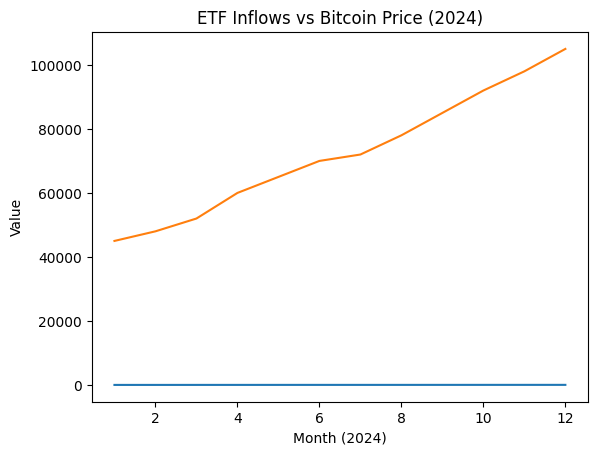
The fourth halving in 2024 further reduced new supply, while ETFs created continuous demand pressure. Bitcoin surpassed $100,000, cementing its role as “digital gold.”
ETF Inflows vs. Bitcoin Price (2024)
7. 2025: Bitcoin as a Strategic Asset
In 2025, price growth slowed, but structural adoption accelerated.
- Governments discussed Bitcoin as a reserve asset
- Regulatory clarity improved
- Institutional portfolios integrated Bitcoin alongside gold and bonds
Bitcoin was no longer an outsider—it became a recognized component of the global financial system.
8. What Comes Next: From Digital Gold to Financial Infrastructure
Bitcoin’s next phase is not about replacing fiat currencies. It is about coexistence.
Key trends include:
- Layer-2 scaling for payments
- Integration with traditional finance
- Sovereign and institutional custody frameworks
- Bitcoin as collateral, not currency
The ideological experiment has matured into a financial primitive.
Conclusion: Seventeen Years of Evolution
Bitcoin’s 17-year journey is not a story of linear success. It is a story of survival through crises, adaptation through innovation, and legitimacy through integration.
What began as a cypherpunk manifesto is now a macroeconomic asset class.
Bitcoin did not destroy the financial system.
It forced the financial system to evolve.