
Main Points :
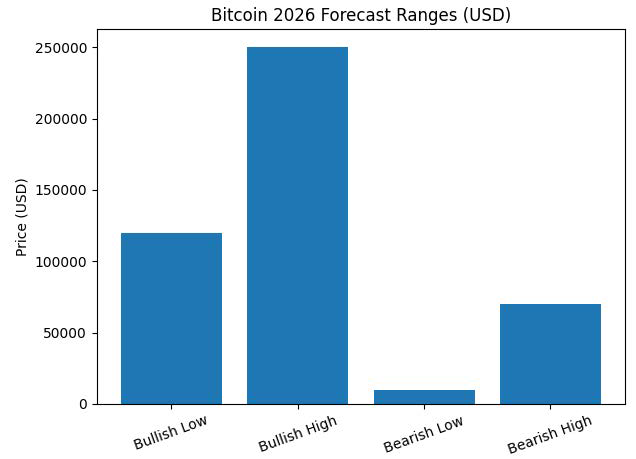
- Major institutions and market leaders project Bitcoin at $150,000–$250,000 by 2026 under bullish scenarios driven by ETFs, institutional allocation, and regulatory clarity.
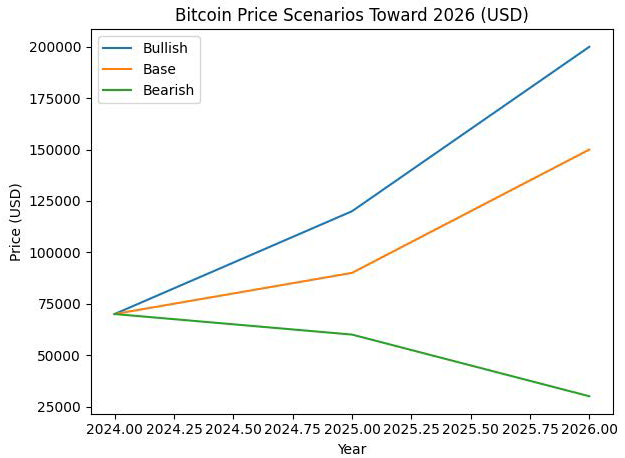
- Bearish analysts warn of deep corrections to $70,000, $50,000, or even below $20,000, citing demand slowdown, liquidity contraction, and technical breakdowns.
- The traditional four-year Bitcoin cycle may be weakening, replaced by structurally driven, institution-led market behavior.
- 2026 is shaping up as a regime-defining year for Bitcoin, not merely another speculative cycle peak or trough.
1. Overview: Why Bitcoin’s 2026 Outlook Is So Polarized
In late December 2025, crypto intelligence outlet Wu Blockchain published a widely circulated report compiling forecasts from major financial institutions, crypto-native firms, and prominent market figures regarding Bitcoin’s 2026 price trajectory. The conclusions could hardly be more divided.
On one side, bullish forecasts envision Bitcoin trading between $150,000 and $250,000 by the end of 2026, powered by institutional inflows, spot Bitcoin ETFs, regulatory progress in the United States, and a structural shift in portfolio allocation strategies. On the other side, bearish projections warn that Bitcoin could face a severe downturn—potentially falling back to $70,000, $50,000, or even as low as $10,000—if liquidity tightens and speculative demand fades.
This sharp divergence reflects a deeper uncertainty: Is Bitcoin evolving into a mature macro asset, or does it remain a highly cyclical, liquidity-dependent risk trade?
2. Macro and Structural Themes Shaping Bitcoin in 2026
Before diving into individual forecasts, it is crucial to understand the structural forces that define the 2026 debate.
Institutional Capital and Spot Bitcoin ETFs
Since the approval of U.S. spot Bitcoin ETFs, institutional access to BTC has changed fundamentally. Pension funds, asset managers, and private banks can now gain exposure without custody or operational risk. Many bullish analysts argue that even a 1–5% allocation from global institutional portfolios would dramatically exceed Bitcoin’s annual new supply.
Regulation as a Catalyst, Not a Constraint
Contrary to earlier cycles, regulation is increasingly viewed as a demand enabler. Proposed U.S. legislation on stablecoins and crypto market structure is expected to reduce legal uncertainty and unlock participation from conservative capital pools.
Monetary Policy and Liquidity Cycles
Expectations of U.S. rate cuts in 2026—and unconventional liquidity tools introduced by the Federal Reserve—are another key variable. For some analysts, these policies resemble a quiet return to quantitative easing, historically a powerful tailwind for scarce assets like Bitcoin.
3. Bullish Scenarios: Bitcoin at $150,000–$250,000
Tom Lee (Fundstrat): Structural Demand Breaks the Cycle
Tom Lee, co-founder of Fundstrat, has repeatedly stated that Bitcoin could reach $200,000–$250,000 by the end of 2026. His thesis rests on institutional allocation math: if large asset managers shift even a small fraction of portfolios into BTC, demand could overwhelm supply.
Lee also argues that the classic four-year halving cycle is losing relevance, replaced by structural demand driven by ETFs and long-term holders.
Brad Garlinghouse (Ripple): Bitcoin as Digital Reserve Asset
Ripple CEO Brad Garlinghouse has projected Bitcoin at $180,000 by late 2026, framing BTC as a neutral reserve asset for the digital economy. At the same conference, leaders from Solana and Binance echoed expectations of prices well above current levels, reinforcing a broadly optimistic industry consensus.
JPMorgan: Bitcoin Still Cheap Relative to Gold
JPMorgan’s strategists estimate Bitcoin’s volatility-adjusted “fair value” at around $170,000, based on comparisons with gold. Importantly, JPMorgan frames this not as a guaranteed target but as a theoretical valuation ceiling under current market structures.
Standard Chartered and Bernstein: A Moderated Bull Case
Standard Chartered revised earlier ultra-bullish forecasts downward, now projecting $150,000 by the end of 2026. Bernstein aligns closely with this view, emphasizing that institutional participation could extend bull markets beyond historical norms—even if upside is more measured than earlier predictions.
Bitcoin 2026 Forecast Ranges (USD)
4. Policy-Driven Optimism: Hayes, Grayscale, and Bitwise
Arthur Hayes (BitMEX): Liquidity Is Destiny
Arthur Hayes argues that new Federal Reserve liquidity mechanisms amount to stealth quantitative easing. In this environment, he believes Bitcoin could break above $200,000, as expanding money supply pushes capital into scarce assets.
Grayscale and Bitwise: The End of the Four-Year Cycle
Both Grayscale and Bitwise predict new all-time highs in 2026, asserting that Bitcoin is transitioning from a speculative asset into financial infrastructure. Bitwise, in particular, highlights ETF demand potentially exceeding annual Bitcoin issuance—a structural imbalance favoring higher prices.
5. Bearish Scenarios: Corrections, Crashes, and Capitulation
CryptoQuant: Demand Is Already Slowing
On-chain analytics firm CryptoQuant warns that Bitcoin may already be in a bearish regime. Their base case projects a decline toward $70,000, with a more severe downside scenario near $56,000, aligned with realized price levels from prior bear markets.
Peter Brandt: Technical Structure Breakdown
Veteran trader Peter Brandt highlights the breakdown of Bitcoin’s long-term parabolic trend. Historically, such breakdowns have preceded drawdowns of 70–80%, implying a potential fall to $25,000 if history repeats.
Bloomberg Intelligence: A Deflationary Shock
Mike McGlone of Bloomberg Intelligence offers the most extreme bearish view, warning that Bitcoin could collapse to $10,000 in a global deflationary downturn. His thesis assumes tightening liquidity, collapsing risk appetite, and mean reversion after speculative excess.
Bitcoin Price Scenarios Toward 2026 (USD)
6. Neutral and Consolidation Views: Stability Over Speculation
VanEck and Barclays: A Year of Digestion
VanEck predicts 2026 will be a year of consolidation rather than extremes, with Bitcoin trading in a broad range as markets absorb prior volatility. Barclays echoes this view, suggesting that without a major catalyst, crypto markets may stagnate amid lower retail participation.
These institutions emphasize long-term accumulation strategies, such as dollar-cost averaging, over aggressive speculation.
7. Corporate Accumulation: A Hidden Support Pillar
One often-overlooked factor is continued corporate accumulation. In late December 2025, Strategy (formerly MicroStrategy) disclosed the purchase of over 1,200 BTC, bringing its holdings above 670,000 BTC. This behavior suggests that some corporations now treat Bitcoin as strategic treasury infrastructure, providing a structural price floor.
8. Conclusion: 2026 as a Regime-Defining Year
Bitcoin’s 2026 outlook is not merely a debate over price targets—it is a referendum on Bitcoin’s identity. If institutional adoption, regulatory clarity, and monetary easing persist, Bitcoin may establish itself as a core macro asset, validating bullish forecasts above $150,000. If liquidity contracts and demand weakens, history warns that brutal drawdowns remain possible.
For investors seeking new crypto assets, income opportunities, and practical blockchain applications, the key takeaway is clear: 2026 will likely redefine Bitcoin’s role in global finance, one way or another.