Main Points :
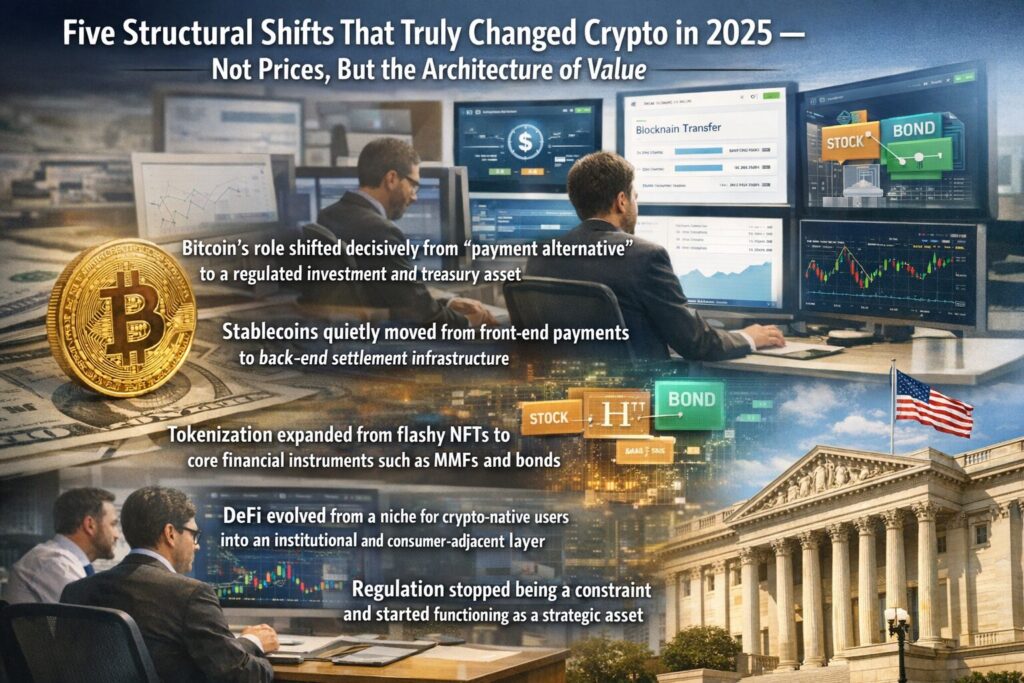
- Bitcoin’s role shifted decisively from “payment alternative” to a regulated investment and treasury asset
- Stablecoins quietly moved from front-end payments to back-end settlement infrastructure
- Tokenization expanded from flashy NFTs to core financial instruments such as MMFs and bonds
- DeFi evolved from a niche for crypto-native users into an institutional and consumer-adjacent layer
- Regulation stopped being a constraint and started functioning as a strategic asset
Introduction: 2025 as the Year Crypto Stopped Chasing Prices
For most of its history, the cryptocurrency industry has been narrated through price charts. Bull runs and crashes, all-time highs and drawdowns, have dominated headlines and shaped public perception. Yet, 2025 will likely be remembered not as a year of spectacular price performance, but as a year of deep structural change.
This shift was subtle. It did not announce itself with meme-fueled rallies or overnight millionaires. Instead, it unfolded quietly in boardrooms, regulatory discussions, treasury strategies, settlement systems, and institutional balance sheets. What changed in 2025 was not how much crypto assets were worth, but what they were for.
The transformation can be summarized in five interlocking developments—each modest in isolation, but together rewriting the architecture of value exchange.
1. Bitcoin’s Identity Shift: From Payment Tool to Treasury Asset
In October 2025, Bitcoin briefly surpassed $126,000, setting a new all-time high. By year-end, however, prices had retreated, leaving Bitcoin down on a year-to-date basis. Superficially, this looked like another example of crypto volatility.
Structurally, however, something far more important occurred.
Regulatory Repositioning
Japan advanced discussions to reclassify crypto assets under the Financial Instruments and Exchange Act, moving them away from payment-law frameworks. This shift formalized what markets had already internalized: Bitcoin was no longer primarily a medium of exchange. It was an investment asset, subject to capital market logic.
Corporate Treasury Adoption
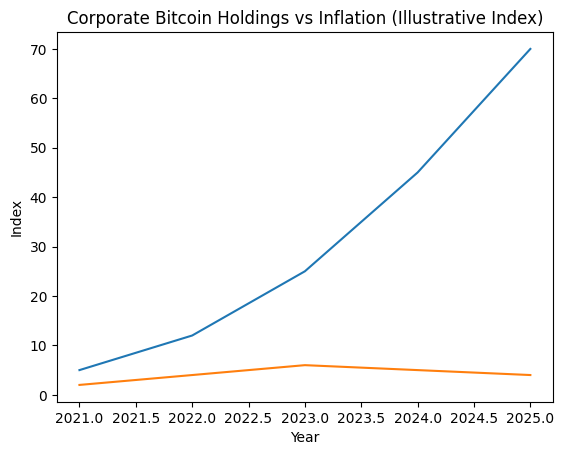
Following the path pioneered by Strategy in the U.S., Japanese-listed companies adopted Digital Asset Treasury (DAT) strategies, holding Bitcoin and Ethereum as balance-sheet assets. These moves were not speculative in the traditional sense; they were responses to inflation risk, currency depreciation, and capital efficiency considerations.
While critics questioned short-term valuation impacts during market downturns, Bitcoin’s position as a macro hedge and long-duration asset solidified.
[Corporate Bitcoin Holdings vs Inflation Indicators (USD-based)]
2. Stablecoins: From Payments to Settlement Infrastructure
At the retail level, stablecoins are often discussed as payment tools. In Japan, the introduction of USDC and yen-linked stablecoins revived conversations around everyday crypto payments.
But the more consequential shift in 2025 occurred behind the scenes.
Understanding Settlement vs Payment
Payment is the moment a consumer initiates a transaction. Settlement is the process by which accounts are reconciled and obligations finalized. While visible payments attract attention, settlement determines speed, cost, and capital efficiency for institutions.
Institutional Adoption
Banks, payment processors, and multinational firms increasingly experimented with stablecoins as 24/7 settlement rails, enabling:
- Near-instant finality
- Reduced reliance on batch processing
- Improved liquidity management
This layer is invisible to end users, yet strategically critical. It is where stablecoins quietly outperform legacy systems.
[Payment Layer vs Settlement Layer Using Stablecoins]

3. Tokenization: The Quiet Expansion of On-Chain Finance
Tokenization once meant NFTs and digital art. By 2025, that narrative had matured.
Financial Instruments Go On-Chain
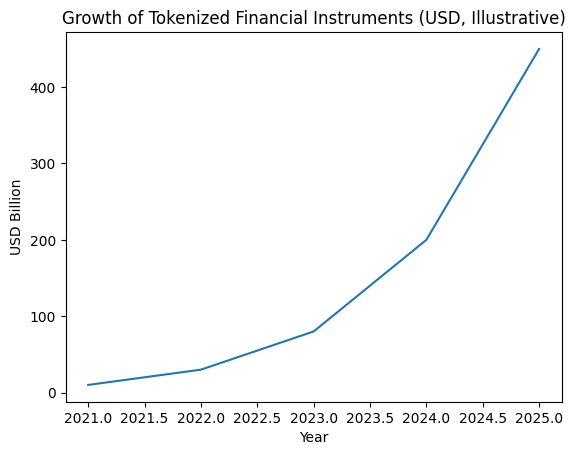
Government bonds, money market funds, and even equities began appearing in tokenized form. Crucially, these were not new financial products, but existing instruments migrating onto blockchain rails.
This development gave rise to what can best be described as on-chain finance—a system where issuance, ownership, and settlement occur natively on distributed ledgers.
The implications are profound:
- Fractional ownership becomes trivial
- Settlement cycles shrink from days to minutes
- Transparency and auditability improve
[Growth of Tokenized Financial Instruments (USD Value)]
4. DeFi Grows Up: From Crypto-Native to Institutional and Consumer-Adjacent
For many, DeFi still evokes memories of yield farming and experimental protocols. In 2025, that image became outdated.
With stablecoins available domestically and tokenized assets entering mainstream finance, DeFi transformed into financial infrastructure rather than speculative playground.
Broadening Participation
Institutions began viewing DeFi protocols as:
- Liquidity venues
- Yield instruments
- Risk management tools
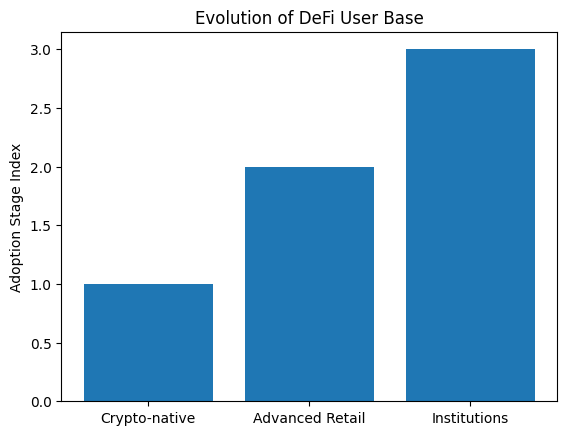
Meanwhile, consumers encountered DeFi indirectly—through apps, wallets, and financial products that abstracted complexity away.
In this sense, DeFi and on-chain finance converged. The distinction became semantic rather than functional.
[Evolution of DeFi User Base (Retail → Institutional)]
5. Regulation as a Strategic Asset
Perhaps the most underestimated shift of 2025 was regulatory.
Japan’s move toward clearer classification under financial law was not merely restrictive. It increased predictability, enabling long-term planning and cross-border collaboration.
Globally, jurisdictions that offered regulatory clarity attracted capital, talent, and infrastructure. Regulation ceased to be a brake and became a design blueprint.
For businesses, this meant:
- Reduced legal ambiguity
- Easier institutional onboarding
- Greater investor confidence
Conclusion: The Architecture of Value Has Changed
None of these five shifts were dramatic on their own. Yet together, they signal something profound: crypto is no longer an experiment on the fringes of finance.
In 2025, the industry began rewriting the infrastructure of value exchange itself. Payments, settlement, asset issuance, treasury management, and regulation all moved closer to a blockchain-native paradigm.
Bitcoin, first introduced in 2008 as an alternative vision of value exchange, reached a kind of maturity. Not adulthood in the sense of stability—but in responsibility.
2025 may well be remembered as the year crypto stopped asking “How high can prices go?” and started answering “What should this system actually do?”