
Main Points :
- Bitcoin is widely forecast to reach $250,000 by the end of 2027, driven by institutional adoption and macroeconomic hedging.
- 2026 is expected to be a highly volatile and “chaotic” year, marked by post-cycle corrections and structural shifts in global finance.
- Short liquidations above $90,000 revealed over $853 million in short clusters, signaling structural fragility among bearish traders.
- Corporate accumulation strategies, including aggressive purchases by Strategy, are reshaping supply dynamics.
- Rising gold and silver prices reinforce Bitcoin’s role as a hard asset hedge, not merely a speculative instrument.
- Long-term models project even more extreme outcomes, with forecasts exceeding $1.4 million per BTC by 2035.
1. A $250,000 Bitcoin Thesis: Galaxy Digital’s Long-Term Conviction
Galaxy Digital’s Head of Research Alex Thorn recently reaffirmed a bold but increasingly mainstream view: Bitcoin could reach $250,000 by the end of 2027. This forecast is not rooted in speculative enthusiasm alone, but in structural transformations unfolding across global capital markets.
According to Thorn, Bitcoin’s long-term trajectory is supported by two converging forces. First is institutional adoption, which has moved decisively beyond experimentation. Pension funds, sovereign allocators, family offices, and public corporations are now treating Bitcoin as a strategic asset rather than a fringe hedge. Second is the growing demand for non-dollar-denominated stores of value, as fiscal expansion and geopolitical fragmentation weaken confidence in traditional reserve currencies.
Importantly, Thorn tempers his optimism with caution. The path to $250,000 will not be linear. In fact, he explicitly warns that 2026 may be one of the most unpredictable years in Bitcoin’s modern history—a necessary turbulence within a broader secular uptrend.
2. 2026: The “Chaos Year” in the Bitcoin Cycle
The expectation of chaos in 2026 is not arbitrary. Bitcoin has historically followed a four-year cycle, anchored by its halving mechanism, which reduces new supply approximately every 210,000 blocks. These cycles tend to produce a familiar rhythm: rapid appreciation, euphoric peaks, followed by sharp corrections and extended consolidation phases.
From this perspective, 2026 aligns with what many analysts—including Fidelity Digital Assets—describe as a potential “crypto winter” phase. However, this winter may look fundamentally different from previous downturns.
Unlike earlier cycles dominated by retail speculation, the next correction will occur in a market shaped by:
- Spot Bitcoin ETFs with daily inflows and outflows,
- Corporate treasuries holding BTC as a balance-sheet asset,
- Derivatives markets with unprecedented leverage and liquidity.
This structural complexity increases the probability of violent price swings, sudden liquidity events, and narrative confusion—hence the characterization of 2026 as a year of chaos rather than simple decline.
3. The $90,000 Breakout and the $853 Million Short Cluster
(“Bitcoin Short Liquidation Clusters Above $90,000”)
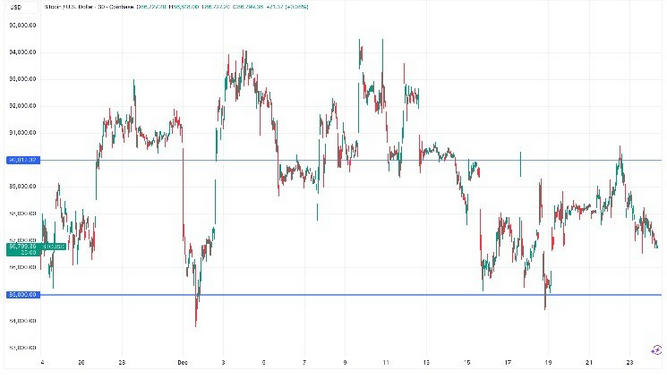
In December, Bitcoin reclaimed the $90,500 level after rebounding from lows near $82,000. This move triggered the liquidation of approximately $853 million worth of short positions, revealing a dense short cluster that had accumulated just above the $90,000 threshold.
Such clusters form when traders collectively bet against a price level perceived as strong resistance. When that resistance breaks, forced liquidations amplify upward momentum. This dynamic underscores a key reality of the current market: price discovery is increasingly driven by derivatives positioning rather than spot demand alone.
The episode also highlights how fragile bearish consensus has become in a structurally bullish environment. As institutional players accumulate Bitcoin on dips, downside narratives struggle to gain traction.
4. Corporate Accumulation and the Strategy Effect
One of the most underappreciated forces in Bitcoin’s supply-demand equation is corporate accumulation. Strategy, widely recognized as the largest corporate holder of Bitcoin, continues to add BTC aggressively, treating it as a long-duration treasury reserve rather than a trade.
This approach has two important implications. First, it removes supply from circulation for extended periods, reducing effective float. Second, it signals to other corporations that Bitcoin can function as a balance-sheet asset comparable to gold, but with superior portability and verifiability.
As more firms adopt similar strategies—particularly in regions facing currency depreciation—the cumulative impact on Bitcoin’s scarcity narrative becomes profound.
5. Gold, Silver, and Bitcoin: A Unified Hard Asset Rally
(“Gold, Silver, and Bitcoin Price Performance Comparison”)
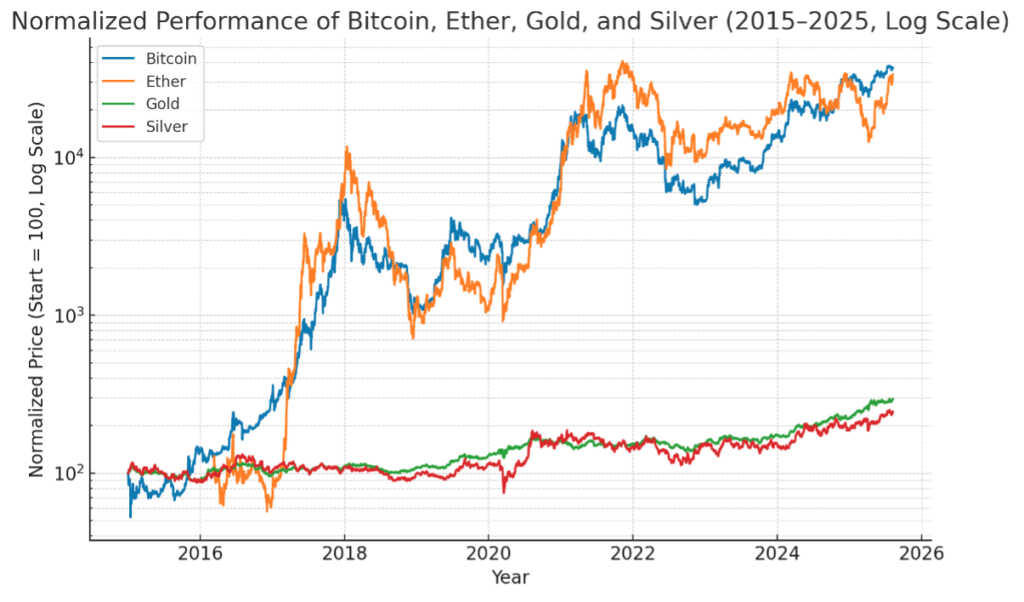
Recent months have seen gold rise to approximately $4,450 and silver to $68.50, marking their strongest annual performance since 1979. Bitcoin’s rebound has closely tracked this move, reinforcing its positioning as a digital hard asset rather than a risk-on tech proxy.
This correlation matters. It suggests that Bitcoin is increasingly responding to the same macroeconomic signals as precious metals: inflation hedging, currency debasement fears, and geopolitical uncertainty. For investors, this convergence strengthens the case for Bitcoin as part of a diversified hard-asset allocation.
6. Diverging Forecasts, Converging Confidence
While short-term outlooks vary, long-term projections for Bitcoin remain remarkably optimistic across institutions. CF Benchmarks, a leading crypto index provider, recently modeled scenarios in which Bitcoin reaches over $1.4 million by 2035.
Such projections assume gradual monetization of Bitcoin as a global reserve asset—an assumption that no longer appears implausible given:
- Regulatory normalization,
- ETF-driven accessibility,
- Integration into institutional risk models.
Even more conservative voices, such as VanEck’s leadership, describe Bitcoin as a potential top-performing asset in the years following 2026, once post-cycle volatility subsides.
7. Beyond Speculation: Practical Use and Capital Strategy
For readers interested not only in price appreciation but in practical blockchain utilization, these developments carry important lessons. Bitcoin’s maturation is enabling new financial architectures:
- Treasury management using BTC as collateral,
- Cross-border settlement without correspondent banks,
- Hybrid strategies combining ETFs, spot holdings, and on-chain custody.
The chaotic phases of the market are often when such innovations are born. Those who build during uncertainty tend to define the next expansion.
8. Conclusion: Chaos as a Prelude to Transformation
The idea that Bitcoin could reach $250,000 by 2027 may sound extreme, yet it is increasingly grounded in observable trends rather than speculation. If 2026 becomes a year of chaos, it will not be a sign of failure—but a necessary recalibration within a rapidly institutionalizing asset class.
For investors, builders, and strategists, the message is clear: volatility is not the enemy of long-term value creation. In Bitcoin’s case, it may be the very mechanism through which the next phase of global financial transformation unfolds.