Main Points :
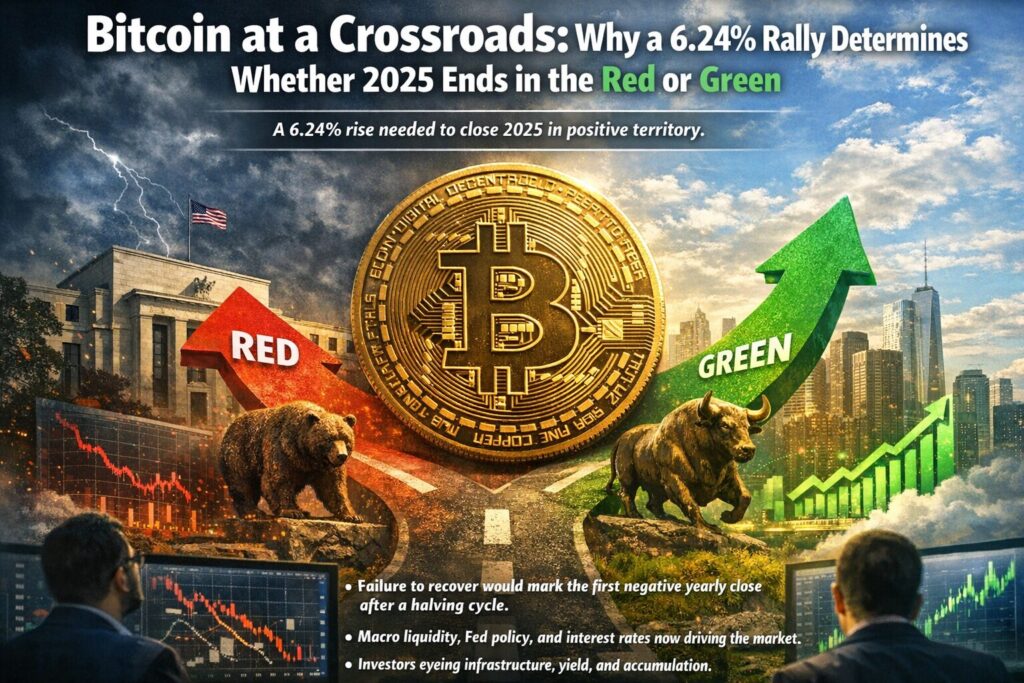
- Bitcoin needs a 6.24% rise from its current level to close 2025 in positive territory.
- Failure to recover would mark the first negative yearly close after a halving cycle.
- A ~30% drawdown from the $125,000 all-time high has reignited debate over whether the bull market has ended.
- Macro liquidity, Federal Reserve policy, and interest rate expectations are now the dominant price drivers.
- For investors and builders, the current phase may be more about infrastructure, yield design, and accumulation than pure speculation.
1. Bitcoin’s 2025 Candle: A Rare Moment of Uncertainty
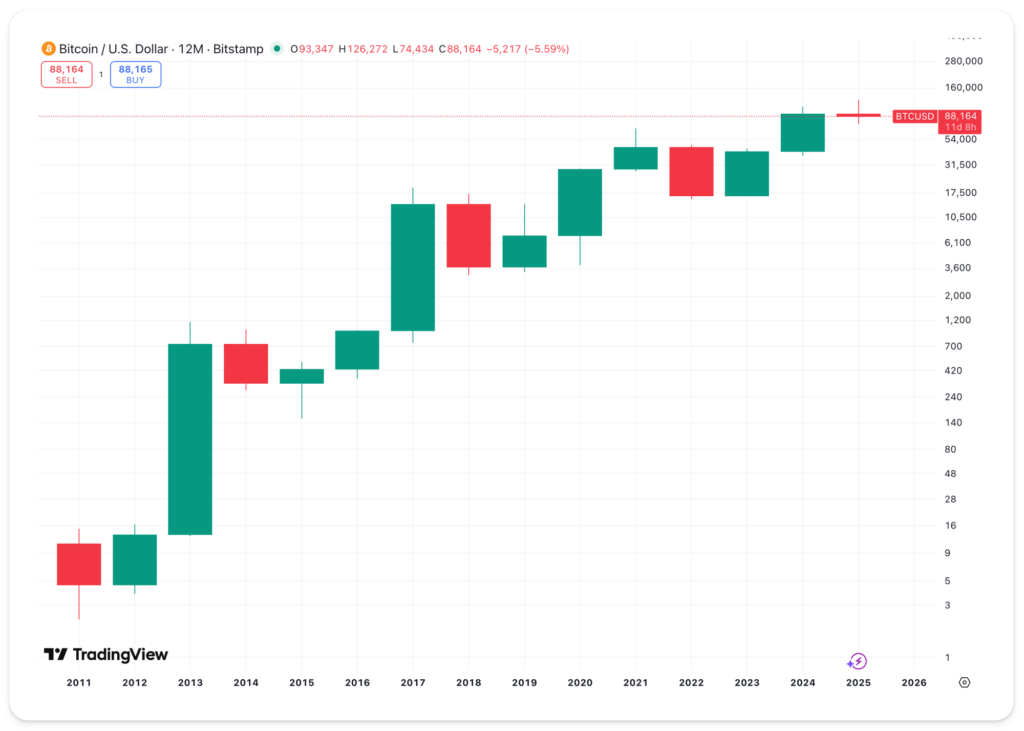
As 2025 draws to a close, Bitcoin finds itself in an unusually delicate position. Despite reaching a new all-time high above $125,000 earlier in the year, Bitcoin is on track to finish the year below its opening level of approximately $93,374, unless it manages a 6.24% rally in the final days.
Market commentator Nic Puckrin summarized the situation bluntly: with only a few days left in the year, Bitcoin must recover quickly or face a historically uncomfortable outcome. If it fails, 2025 would become the first post-halving year in which Bitcoin closes in negative territory.
This is not merely a cosmetic statistic. Annual candles play an outsized role in shaping long-term investor psychology, institutional narratives, and capital allocation decisions—especially as Bitcoin becomes increasingly intertwined with traditional financial markets.
Bitcoin yearly candle (2025) vs opening price
2. From Euphoria to Shock: The $125,000 Peak and the 30% Drawdown
October 2025 was marked by euphoria. Bitcoin surged past $125,000, driven by strong ETF inflows, improving regulatory clarity, and renewed institutional interest. However, optimism proved fragile.
Just days after setting a new record, the broader financial market experienced a sharp and sudden sell-off. Risk assets across the board declined, and cryptocurrencies were no exception. Bitcoin retraced nearly 30%, eventually finding a local bottom around $80,000 in November.
This violent reversal disrupted what many believed to be a structurally sound bull market that began in 2023. Since then, analysts have been divided into two camps:
- Bullish view: The correction is a healthy reset within a larger cycle.
- Bearish view: The post-halving rally has already peaked, and a prolonged downtrend may follow into 2026.
The answer may depend less on crypto-native narratives and more on global liquidity conditions.
3. Breaking the Trend: The 365-Day Moving Average Matters
Since November, Bitcoin has consistently traded below its 365-day moving average, a level widely regarded as a proxy for long-term trend health. This breakdown is significant because it marks the first sustained violation of the structural uptrend that began in 2023.
Bitcoin price vs 365-day moving average

Historically, prolonged periods below long-term moving averages tend to coincide with:
- Reduced speculative leverage
- Lower on-chain activity
- A shift from momentum trading to accumulation
For long-term participants, this is often when fundamentals, yield mechanics, and real utility regain importance.
4. The Macro Lens: Federal Reserve Policy Takes Center Stage
At this stage of the cycle, Bitcoin is behaving less like a niche crypto asset and more like a high-beta macro instrument. The primary external driver is monetary policy, particularly decisions made by the Federal Reserve.
Low interest rates historically favor risk assets, including equities and cryptocurrencies, by increasing liquidity and reducing the opportunity cost of holding non-yielding assets like Bitcoin.
In 2025, the Federal Reserve implemented three 25-basis-point rate cuts, raising hopes that a renewed easing cycle could reignite risk appetite. However, optimism was tempered during the December Federal Open Market Committee meeting, where Chair Jerome Powell delivered mixed guidance.
“There is no risk-free path for policy,” Powell stated, emphasizing uncertainty around inflation persistence and economic resilience.
5. Market Expectations: Why January Rate Cuts Look Unlikely
Interest rate futures markets provide a real-time glimpse into investor expectations. According to the CME Group FedWatch Tool, only 18.8% of market participants currently expect a rate cut at the January FOMC meeting.
This skepticism reflects broader concerns:
- Inflation remains sticky in certain sectors
- Labor markets are cooling, but not collapsing
- The Fed wants to avoid reigniting asset bubbles too quickly
As a result, Bitcoin traders are increasingly cautious, waiting for clearer signals before committing fresh capital.
6. What This Means for Crypto Investors Seeking New Opportunities
For readers interested in new crypto assets and next-generation revenue models, this environment may actually be constructive.
Historically, periods of price stagnation or mild drawdowns have coincided with:
- Growth in decentralized finance infrastructure
- Innovation in yield-bearing crypto instruments
- Expansion of real-world asset (RWA) tokenization
- Increased focus on compliance-ready blockchain services
Rather than chasing short-term price appreciation, sophisticated participants often shift toward cash-flow-generating strategies, such as:
- On-chain lending with conservative collateralization
- Stablecoin yield mechanisms
- Infrastructure tokens linked to actual network usage
7. Practical Blockchain Use Cases Gain Relevance
As speculative excess cools, practical blockchain applications regain center stage. These include:
- Cross-border payments and remittance rails
- Tokenized treasury management
- On-chain settlement for regulated financial institutions
- Non-custodial wallet infrastructure with transparent fee models
Bitcoin’s temporary weakness does not negate its role as the monetary anchor of the crypto ecosystem. Instead, it often encourages builders to focus on robustness, security, and regulatory alignment.
8. Looking Ahead: Recovery or Consolidation into 2026?
Whether Bitcoin manages to reclaim its yearly opening price in the final days of 2025 may ultimately matter less than what follows. Even if the year closes marginally negative, the broader structural picture remains intact:
- Supply issuance remains constrained post-halving
- Institutional custody and ETF infrastructure continues to expand
- Global demand for neutral, borderless assets persists
The key variable is liquidity. If monetary conditions ease further in 2026, Bitcoin’s current consolidation could serve as the foundation for the next expansion phase.
Conclusion: A Yearly Close Is a Signal—Not a Verdict
Bitcoin’s need for a 6.24% rally to end 2025 in positive territory has become a symbolic focal point for the market. While headlines may frame this as a make-or-break moment, experienced participants understand that annual closes are signals, not verdicts.
For investors and operators focused on long-term value creation, the current environment offers something arguably more valuable than price euphoria: time to build, accumulate, and design sustainable crypto-native business models.