

Main Takeaways :
- Bitcoin remains locked in a narrow range around $87,000 amid low holiday liquidity
- Volatility has compressed significantly, signaling a potential energy buildup phase
- A breakout above $87,760–$88,000 could open the path toward $90,000
- Failure to hold short-term support may trigger a pullback toward $86,000
- Market structure suggests indecision rather than trend reversal
1. A Silent Market: Bitcoin During the Christmas Lull
As global financial markets enter the Christmas holiday period, trading activity across risk assets has declined sharply—and Bitcoin is no exception. With institutional desks understaffed and retail participation muted, Bitcoin has been hovering quietly around the $87,000 level, showing little inclination to break higher or lower.
This type of market behavior is not unusual during major global holidays. Historically, Bitcoin often enters a consolidation phase when liquidity dries up, particularly in late December. However, what makes the current situation noteworthy is how compressed volatility has become, even by holiday standards.
Rather than reflecting weakness or strength outright, the current price action suggests hesitation. Bitcoin is not being aggressively sold, but neither is it being confidently accumulated. For traders and long-term investors alike, such moments often precede decisive moves.
2. Technical Overview: The 4-Hour Chart Tells a Story of Compression
[BTC/USD 4-hour chart with EMA(7) and EMA(28)]

On the 4-hour BTC/USD chart, price action paints a clear picture of contraction. Bitcoin is trading almost exactly on top of the 7-period Exponential Moving Average (EMA) while remaining below the 28-period EMA.
The two EMAs are currently in a death cross configuration, with the short-term EMA below the mid-term EMA. Importantly, however, the slope of both lines is shallow, and the distance between them is narrowing. This indicates that bearish momentum is weak rather than dominant.
From a market mechanics perspective, this setup is often described as an “energy compression” phase—a period where opposing forces neutralize each other, storing potential energy for a future breakout.
Volatility indicators confirm this view. Price swings have become increasingly muted, suggesting that traders are waiting for a catalyst rather than actively positioning.
3. Why Low Volatility Matters More Than Direction
Low volatility is often misunderstood as a sign of irrelevance. In reality, it frequently marks the most important phase of a market cycle.
When volatility contracts:
- Stop-loss levels cluster
- Leverage builds quietly
- Breakouts tend to be sharp and directional
<Shows the sharp contraction in Bitcoin’s short-term volatility, a pattern that historically precedes decisive breakouts.>
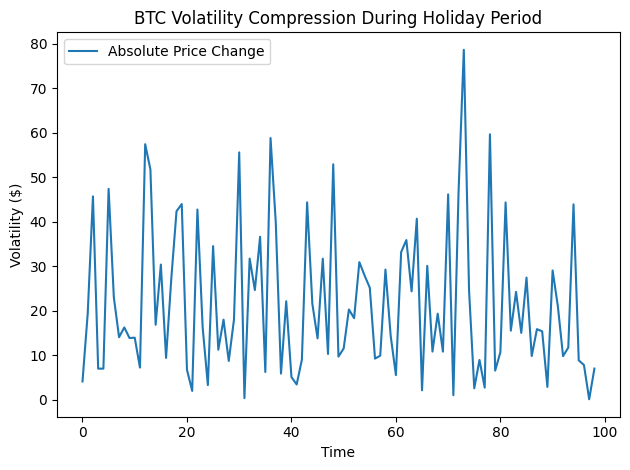
In Bitcoin’s case, this compression is occurring near historically significant price levels. The $85,000–$90,000 range has repeatedly acted as a psychological battleground in recent months, making the current stalemate particularly meaningful.
For investors exploring new crypto assets or yield strategies, this environment also affects altcoins. Capital rotation tends to slow during Bitcoin consolidation, delaying broader market momentum until BTC establishes direction.
4. Bearish Scenario: A Breakdown Toward $86,000
Key Trigger: Loss of Short-Term Support
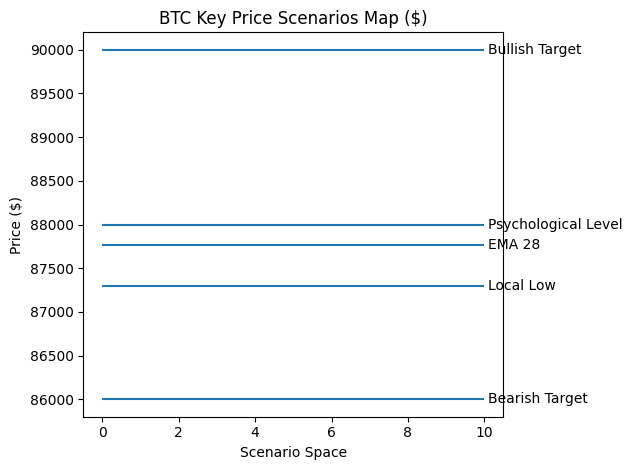
The bearish case hinges on Bitcoin losing its immediate support structure. If price decisively breaks below the 7-period EMA and falls through the recent local low near $87,300, selling pressure could intensify.
In such a scenario, the next logical downside target lies around $86,000, which corresponds to a prior consolidation zone and visible liquidity pocket.
This would not necessarily invalidate the broader bullish trend. Instead, it would likely represent a liquidity sweep—a move designed to flush out weak hands before a renewed attempt higher.
For practical operators in the blockchain space—such as treasury managers or payment platforms—this downside risk reinforces the importance of short-term hedging and liquidity planning during thin markets.
<Summarizes the key price levels that define the current bearish and bullish scenarios for Bitcoin.>
5. Bullish Scenario: Reclaiming EMA 28 and Targeting $90,000
Key Trigger: Break Above $87,760–$88,000
To break free from the current stalemate, Bitcoin must reclaim the 28-period EMA, currently acting as dynamic resistance around $87,760.
A sustained move above this level, followed by acceptance above $88,000, would significantly alter short-term market structure. Such a breakout would signal that buyers have regained control, potentially opening the path toward $90,000 and beyond.
Importantly, a bullish resolution during a low-liquidity period often results in outsized follow-through once full market participation returns. This makes year-end breakouts particularly influential for early Q1 positioning.
6. Broader Market Context: Not Just a Bitcoin Story
While this analysis focuses on Bitcoin, the implications extend across the digital asset ecosystem.
- Altcoins often lag during BTC consolidation but react explosively once direction is set
- DeFi yields tend to stabilize during low volatility phases
- Blockchain payment volumes remain steady, reflecting Bitcoin’s growing role as infrastructure rather than speculation alone
From a practical blockchain adoption perspective, Bitcoin’s stability—even at elevated price levels—supports its use as a settlement and treasury asset. For builders and operators, this reinforces the narrative that Bitcoin is transitioning from a purely speculative vehicle into a core financial primitive.
7. Conclusion: A Market Holding Its Breath
Bitcoin’s current behavior around $87,000 is not a sign of exhaustion, nor is it evidence of renewed weakness. Instead, it reflects a market waiting for participation to return.
As the year-end approaches and liquidity gradually improves, the balance currently holding Bitcoin in place is likely to break. Whether that break occurs upward toward $90,000 or downward toward $86,000 will define the tone for early 2026.
For investors searching for the next opportunity—whether through price appreciation, yield generation, or blockchain-enabled business models—this quiet period should be seen not as a lull, but as preparation.
The silence, as history has shown, rarely lasts long.




