Main Points :
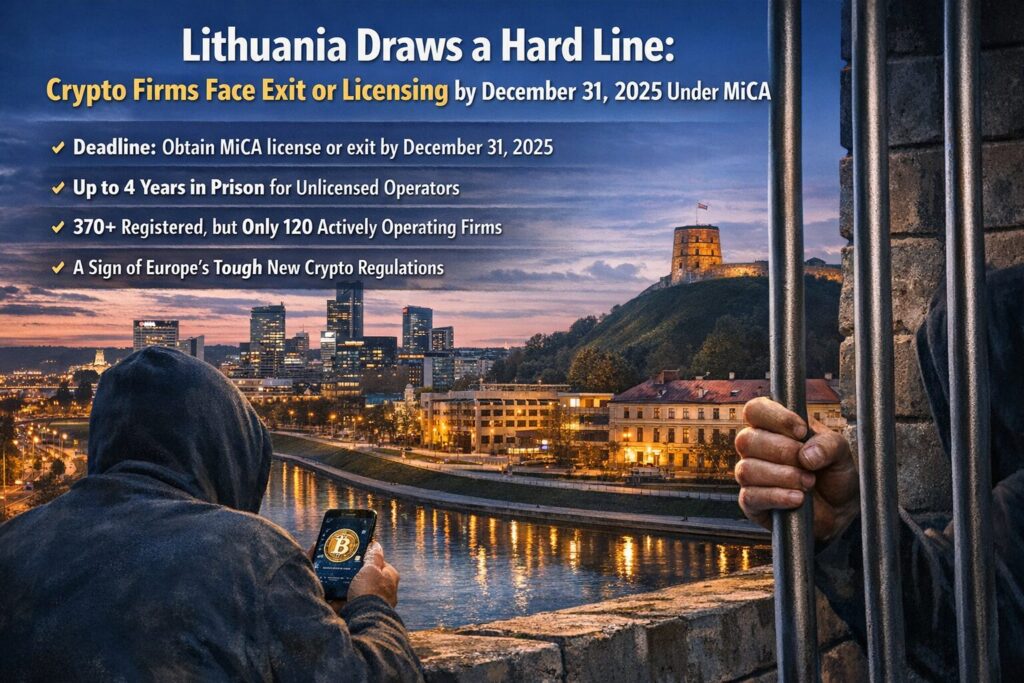
- Lithuania has set December 31, 2025 as the final deadline for crypto service providers to either obtain authorization under the EU’s MiCA framework or exit the market.
- Firms that continue operating without a license after the transition period may face criminal penalties, including up to four years of imprisonment.
- Although more than 370 companies are registered as crypto service providers, only around 120 are actively operating with real revenue and financial reporting.
- The move signals a broader EU-wide shift from registration-based regimes to full prudential licensing, reshaping Europe’s crypto industry.
- For global crypto businesses, Lithuania’s stance provides an early preview of how strict MiCA enforcement will become across Europe.
1. Lithuania’s Regulatory Turning Point for Crypto Businesses
Lithuania has formally entered a decisive phase in its regulation of crypto-asset service providers. The country’s central bank, Lietuvos bankas, announced that crypto exchanges and custodial wallet providers must either secure authorization under the European Union’s Markets in Crypto-Assets Regulation (MiCA) or begin an orderly wind-down of operations by December 31, 2025.
This announcement is not merely administrative. It represents a fundamental shift in how Lithuania—and by extension the European Union—views crypto businesses: no longer as lightly registered entities, but as fully regulated financial institutions with obligations comparable to traditional finance.
For years, Lithuania positioned itself as a crypto-friendly jurisdiction, attracting hundreds of startups due to its relatively straightforward registration regime. That era is now ending.
2. MiCA: From Registration to Full Authorization
The new requirement stems from Regulation (EU) No. 2023/1114, commonly referred to as MiCA. Under MiCA, crypto-asset service providers (CASPs) must meet stringent standards related to:
- Governance and internal controls
- Capital adequacy and financial stability
- AML/CFT compliance
- Consumer protection and transparency
- IT security and operational resilience
Companies that do not intend to offer services under MiCA must exit the market in an orderly manner.
Importantly, Lithuania’s guidance applies to firms listed with the State Enterprise Centre of Registers, which previously served as the primary registry for crypto service providers. Registration alone will no longer suffice.
3. Criminal Liability for Unlicensed Operations
One of the most striking aspects of Lithuania’s approach is the criminal liability attached to non-compliance.
Under the Lithuanian Criminal Code, providing financial services without the required license can result in:
- Public service penalties
- Monetary fines (amounts determined by courts; typically assessed in USD-equivalent)
- Restrictions on liberty
- Imprisonment for up to four years
This is a significant escalation compared to administrative fines commonly seen in other jurisdictions. The central bank also has the authority to block websites, publicly name violators, and refer cases to law enforcement agencies.
For founders and executives, this introduces personal legal risk, not merely corporate penalties.
4. The Reality Behind the Numbers: 370 Registered, 120 Active
Lithuania’s central bank disclosed revealing statistics:
- Over 370 companies are registered as crypto service providers.
- Only around 120 firms are actively generating revenue and submitting financial statements.
- Approximately 30 companies have applied for MiCA licenses.
- Only 10 applications are currently under formal review.
This disparity highlights a core issue MiCA aims to address: regulatory arbitrage and shell registrations that exist on paper but contribute little real economic activity.
Title: “Lithuanian Crypto Providers: Registered vs Active vs Licensed”
Description: Bar chart comparing total registered firms (370+), active firms (120), MiCA applicants (30), and applications under review (10).
5. Why Lithuania Is Acting Early—and Firmly
Lithuania’s proactive stance is strategic. As MiCA becomes fully applicable across the EU, national regulators are expected to enforce it consistently. Lithuania’s central bank is signaling:
- Zero tolerance for regulatory limbo
- Alignment with EU-wide supervisory expectations
- Protection of Lithuania’s financial system reputation
By forcing early exits or compliance, Lithuania reduces systemic risk and avoids becoming a haven for non-compliant crypto firms migrating from stricter jurisdictions.
6. Implications for Crypto Exchanges and Wallet Providers
For crypto exchanges and custodial wallet services, the message is clear:
- Licensing is no longer optional.
- Business models must support compliance costs, governance structures, and regulatory reporting.
- Marginal or undercapitalized firms will struggle to survive.
For many smaller operators, the rational choice may be orderly withdrawal, customer migration, and business closure rather than attempting full MiCA compliance.
7. A Signal to the Global Crypto Industry
Although this development is specific to Lithuania, its implications are global.
The EU represents one of the world’s largest economic blocs. MiCA is becoming a global reference framework, influencing regulators in Asia, the Middle East, and Latin America.
For international crypto businesses, Lithuania’s enforcement shows what to expect:
- Clear deadlines
- Criminal enforcement mechanisms
- No tolerance for “grey-zone” operations
Companies serving EU customers from abroad may also face indirect exposure if regulators coordinate cross-border enforcement.
8. Strategic Considerations for Crypto Entrepreneurs
For founders and investors, several strategic lessons emerge:
- Regulatory arbitrage is ending in mature markets.
- Sustainable crypto businesses must be designed with compliance-by-default architectures.
- Licensing jurisdictions should be chosen based on long-term viability, not speed or cost alone.
In practical terms, this means investing early in legal, compliance, and governance infrastructure—often exceeding $1–3 million in cumulative setup and operating costs over several years (USD equivalent).
9. What Happens Next?
Between now and December 31, 2025:
- Regulators will intensify scrutiny of crypto firms.
- License applications will likely face bottlenecks.
- Market consolidation will accelerate.
Firms that survive this transition may benefit from higher trust, reduced competition, and institutional adoption.
Title: “Expected Crypto Market Consolidation Under MiCA”
Description: Timeline-style diagram showing decline in number of providers and rise in regulatory quality from 2024–2026.
Conclusion: MiCA Is No Longer Theoretical
Lithuania’s decision removes any remaining ambiguity around MiCA enforcement. The era of loosely regulated crypto operations in Europe is ending, replaced by a bank-grade regulatory environment.
For some, this marks the end of the road. For others, it is the foundation for the next phase of crypto’s integration into the global financial system.
The message is unmistakable: comply, consolidate, or exit.