Main Points :
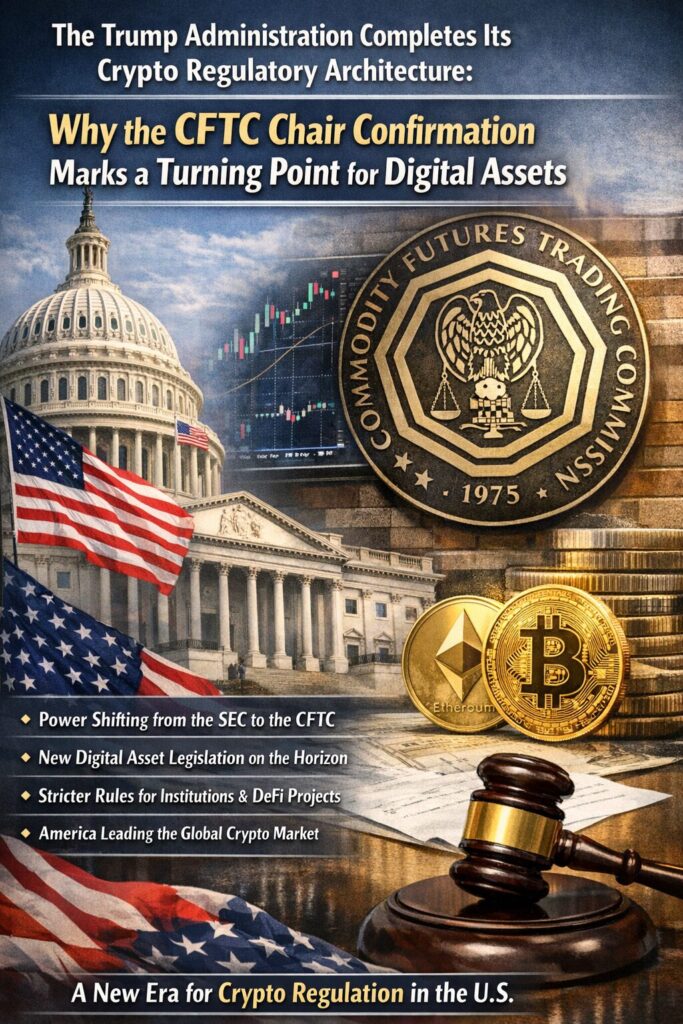
- The confirmation of a new CFTC Chair signals that the U.S. digital asset regulatory framework is nearing completion.
- Power over digital assets is gradually shifting from the SEC toward the CFTC, redefining market structure.
- The upcoming Digital Asset Market Structure legislation could reshape crypto business models globally.
- Institutional capital, DeFi projects, and token issuers are all likely to face a clearer—but stricter—regulatory environment.
- The U.S. is positioning itself strategically as the world’s leading crypto jurisdiction.
1. A Critical Moment for U.S. Crypto Regulation
The United States is entering what many insiders describe as a once-in-a-generation inflection point for digital asset regulation. According to David Sacks, Special Advisor for AI and Crypto in the Trump administration, the confirmation of Michael Selig as Chair of the Commodity Futures Trading Commission (CFTC) means that nearly all institutional components necessary for comprehensive crypto regulation are now in place.
In a widely circulated post on X, Sacks described the current moment as “extremely critical” for the future of crypto in the U.S. He emphasized that regulatory ambiguity—long cited as the greatest obstacle to innovation—may finally be coming to an end.
At the center of this transformation is the emergence of what Sacks called a “dream team”: Selig at the CFTC and Paul Atkins, Chair of the Securities and Exchange Commission (SEC). Together, they are expected to define clear boundaries between securities, commodities, and decentralized digital assets.
2. The Senate Vote That Changed Everything
The U.S. Senate approved Selig’s appointment by a vote of 53–43, bundled with several other nominations. While the margin was not overwhelming, it demonstrated a solid partisan foundation for advancing the Trump administration’s pro-crypto agenda.
Following his confirmation, Selig publicly committed to supporting innovation in digital asset markets. He highlighted several unprecedented conditions now converging:
- Rapid emergence of new blockchain technologies and tokenized products
- Record-high participation of retail investors in commodity and digital markets
- Legislative momentum toward formally designating the U.S. as the “crypto capital of the world”
These statements are not rhetorical. They reflect a strategic recalibration of U.S. financial policy.
3. From SEC Dominance to CFTC Expansion
For years, the SEC has acted as the de facto regulator for much of the crypto industry, often through enforcement rather than rulemaking. This approach created uncertainty, particularly for exchanges, token issuers, and DeFi protocols.
Draft versions of the Senate’s market structure bill—known as the Responsible Financial Innovation Act—indicate a significant expansion of CFTC authority. Under this framework:
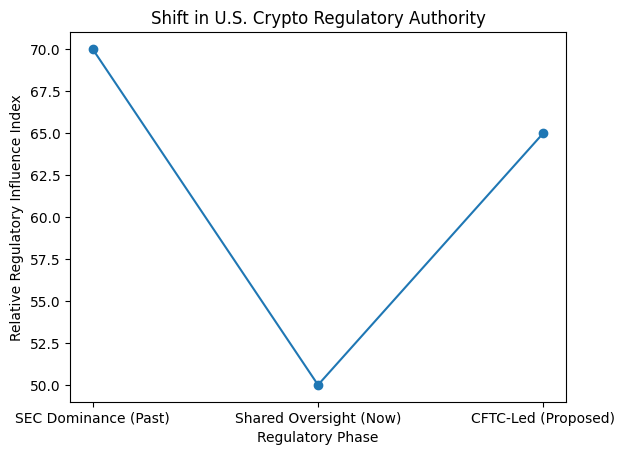
- Most fungible crypto assets would be classified as digital commodities
- Spot markets for crypto would fall primarily under CFTC oversight
- The SEC would retain authority mainly over tokenized securities and investment contracts
This represents a fundamental philosophical shift: from investor-protection-first enforcement to market-structure-first supervision.
4. The CLARITY Act and What Comes Next
The Senate bill builds directly on the CLARITY Act, which passed the House of Representatives in July. Although final language has not yet been settled, the legislative trajectory is clear.
Expected Timeline
- Congressional recess pauses deliberation through year-end
- Senate Banking Committee revisions likely in early January
- Full Senate vote could follow shortly thereafter
Republican leadership has expressed strong support, but resistance remains—particularly around DeFi. Some senators argue that decentralized protocols cannot be regulated using traditional frameworks, potentially delaying passage.
5. Implications for Crypto Businesses and Investors
For Exchanges and Custodians
Clearer rules may lower compliance risk and unlock institutional capital. However, registration, reporting, and surveillance requirements are expected to increase.
For DeFi and Protocol Developers
The debate around DeFi is the most contentious. While open-source code may remain unregulated, front-ends, governance tokens, and revenue-generating structures could face new obligations.
For Token Issuers
A more precise test for whether a token is a security or a commodity could revive U.S.-based token launches—currently suppressed by legal uncertainty.
6. Global Ripple Effects
U.S. regulatory clarity does not stay domestic. Once rules are set, they often become de facto global standards, influencing:
- Asian VASP licensing regimes
- EU MiCA implementation details
- Cross-border stablecoin issuance and settlement
For jurisdictions like Japan, Singapore, and the Philippines, U.S. direction matters immensely.
7. Data Snapshot: Regulatory Capital Inflows (USD)
Institutional Crypto Capital Inflows Under Clear vs. Unclear Regulation
X-axis: Regulatory clarity level
Y-axis: Capital inflow ($ billions)
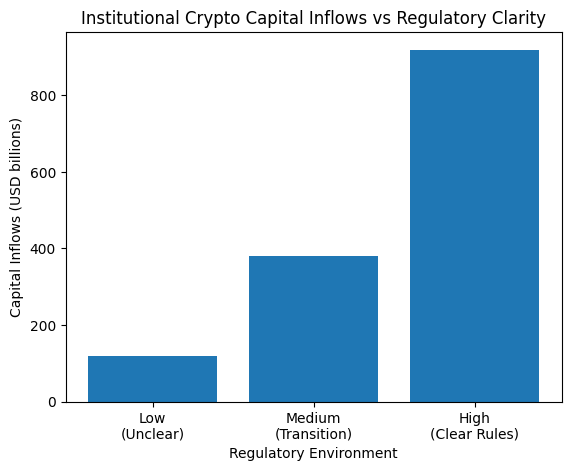
This chart illustrates how capital historically accelerates once regulatory certainty emerges.
8. Strategic Outlook: The U.S. as the World’s Crypto Hub
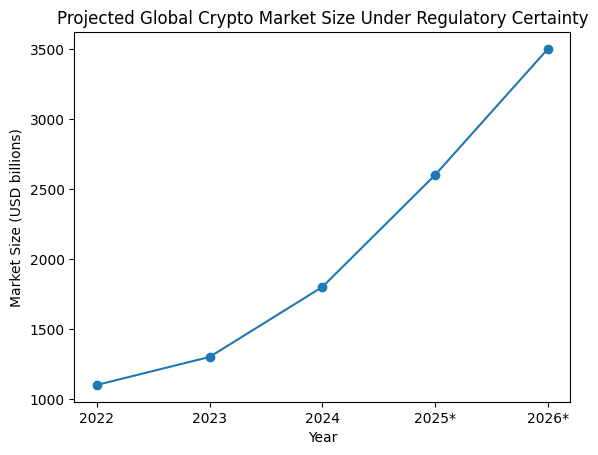
The Trump administration’s approach is pragmatic rather than ideological. By assigning commodities-style oversight to most crypto assets, it aligns digital markets with existing futures and derivatives infrastructure.
If successfully implemented, this framework could:
- Re-shore crypto innovation to the U.S.
- Encourage banks and asset managers to enter the space
- Establish dollar-denominated crypto markets as the global standard
9. Conclusion: Regulation as an Enabler, Not a Constraint
The confirmation of Michael Selig as CFTC Chair is not just a personnel decision—it is a structural milestone. With leadership aligned across the White House, CFTC, and SEC, the U.S. is poised to replace uncertainty with rules.
For builders, investors, and institutions seeking the next wave of opportunity, this may be the clearest signal yet that crypto is entering its regulated—but scalable—era.