
Main Points :
- Bitcoin’s network hashrate declined by approximately 4% over the past month, marking the largest drop since April 2024.
- According to VanEck analysts, prolonged hashrate declines have historically coincided with higher forward returns for Bitcoin.
- Since 2014, periods of declining hashrate have shown a significantly higher probability of positive BTC price performance over 90–180 days.
- Miner capitulation, often viewed negatively, may instead represent a contrarian bullish signal.
- Rising competition for electricity from AI infrastructure could structurally reshape Bitcoin mining economics.
- Lower breakeven electricity costs for miners highlight intensifying pressure but also set the stage for recovery during price rebounds.
1. Why Hashrate Matters More Than Ever
Bitcoin’s hashrate—the total computational power securing the network—is often perceived as a proxy for miner confidence and network health. Conventional wisdom suggests that rising hashrate equals strength, while declining hashrate signals weakness. However, history repeatedly challenges this simplistic interpretation.
In mid-December, Bitcoin’s hashrate fell by roughly 4% over a 30-day period. While this decline raised concerns among some market participants, analysts at VanEck argue that such periods have often preceded significant price appreciation.
VanEck’s Head of Digital Assets Research, Matt Sigel, and Senior Investment Analyst Patrick Bush describe miner exits not as a warning sign, but as a historically “contrarian bullish indicator.”
2. Historical Evidence: When Weakness Breeds Strength
Since 2014, VanEck analyzed Bitcoin price behavior following periods of declining network hashrate. The results are striking.
- When the 30-day hashrate trend turned negative, Bitcoin posted positive returns over the subsequent 90 days in 65% of cases.
- When hashrate was rising, that probability dropped to 54%.
Looking further ahead:
- When the 90-day hashrate growth rate was negative, Bitcoin’s return over the following 180 days was positive 77% of the time, with an average gain of 72%.
- By contrast, rising hashrate environments produced positive returns only 61% of the time.
These statistics suggest that miner capitulation often marks local bottoms rather than sustained downturns.
Bitcoin Forward Returns vs Hashrate Trends (2014–2024)
3. Miner Capitulation: A Classic Contrarian Signal
Miner behavior tends to lag price action. When prices fall or stagnate while costs remain fixed, marginal miners are forced offline. This process—known as miner capitulation—temporarily reduces network hashrate.
Ironically, this often strengthens the remaining mining ecosystem. As inefficient operators exit:
- Network difficulty adjusts downward.
- Surviving miners gain higher block rewards per unit of hash.
- Selling pressure from distressed miners diminishes.
This dynamic mirrors classic commodity cycles, where high-cost producers exit near price bottoms, setting the stage for recovery.
4. Bitcoin Price Context: A Market Reset, Not a Collapse
At the time of analysis, Bitcoin was trading around $88,400, down roughly 30% from its all-time high of $126,080 recorded earlier in October, according to CoinGecko.
While a 30% drawdown may appear severe, such corrections are historically common within Bitcoin bull cycles. Importantly, the current price level still places many miners near or below profitability thresholds.
This tension—price compression combined with rising operational stress—creates the precise conditions under which contrarian signals emerge.
5. Mining Economics Under Pressure: The S19 XP Example
VanEck highlighted the economics of one of the most widely deployed mining rigs: the Bitmain S19 XP, released in 2022.
Key insight:
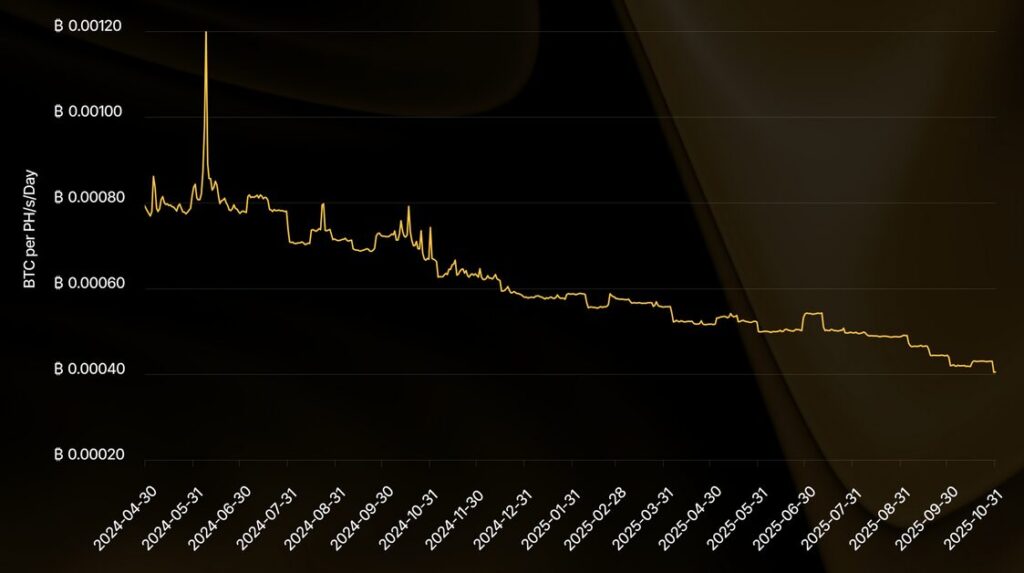
- The electricity cost breakeven for an S19 XP miner dropped from $0.12 per kWh in early 2024 to $0.077 per kWh by mid-December—a 36% decline.
This shift underscores intensifying competition and narrowing margins across the mining sector. Only operators with access to low-cost power or advanced infrastructure can remain viable.
Breakeven Electricity Cost for Bitmain S19 XP (2020–2024)

6. The China Factor and the Rise of AI Power Demand
VanEck estimates that approximately 1.3 gigawatts of Bitcoin mining capacity in China has recently gone offline—contributing significantly to the latest hashrate decline.
Crucially, this power is not disappearing. Instead, it is increasingly being redirected toward AI data centers, which offer higher and more stable returns on electricity usage.
VanEck warns that if this trend accelerates, up to 10% of Bitcoin’s global hashrate could be structurally displaced—not temporarily lost, but permanently reallocated.
This represents a fundamental shift: Bitcoin mining is no longer competing only with itself, but with AI as a dominant buyer of industrial-scale power.
7. Long-Term Implications for Investors and Builders
For investors seeking asymmetric opportunities, declining hashrate periods may offer attractive entry points—particularly when combined with strong long-term fundamentals.
For builders and operators:
- Energy efficiency becomes a strategic moat.
- Vertical integration (power + compute) gains importance.
- Jurisdictional power access increasingly determines competitiveness.
Bitcoin’s proof-of-work system is evolving alongside global energy markets, and those who understand this convergence stand to benefit.
8. Conclusion: Weak Hands Exit, Strong Trends Begin
A falling hashrate may look alarming on the surface, but history suggests otherwise. Miner capitulation has repeatedly preceded powerful Bitcoin recoveries, serving as a cleansing mechanism rather than a death spiral.
As VanEck’s analysis shows, declining hashrate periods are not signals of network failure—but reflections of economic stress that ultimately strengthen Bitcoin’s long-term trajectory.
For investors, entrepreneurs, and infrastructure builders alike, the message is clear:
When miners retreat, opportunity often advances.