Main Points :
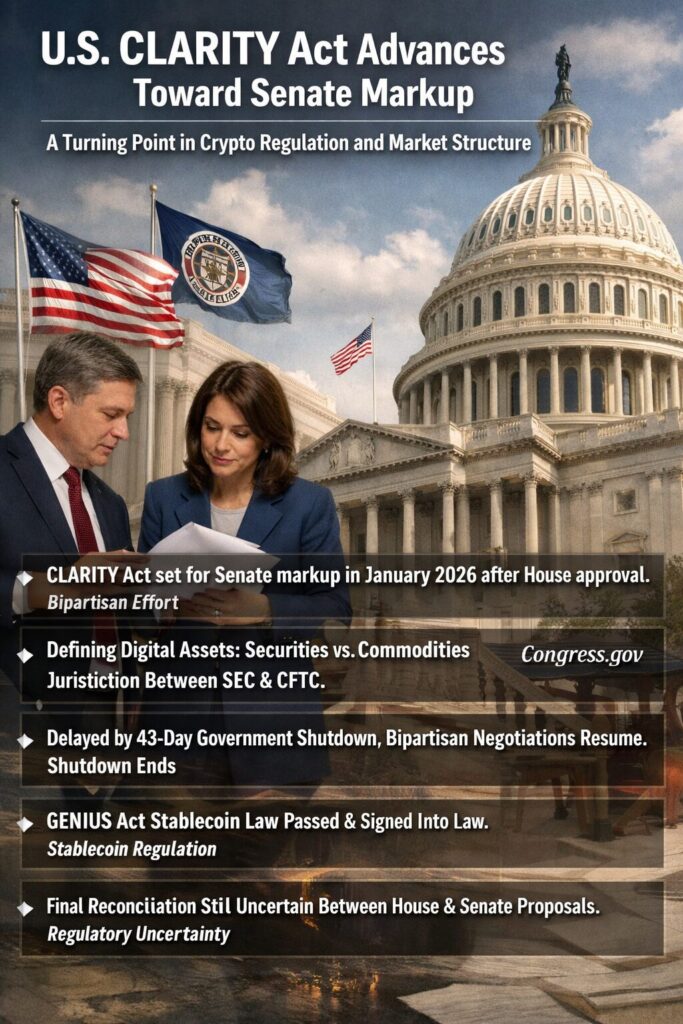
- Bipartisan CLARITY Act is set for Senate markup in January 2026 after House approval. 1
- CLARITY Act aims to define which digital assets are securities vs. commodities and clarify regulatory jurisdiction between SEC and CFTC.
- The bill’s progress was delayed by a 43-day U.S. government shutdown but continues bipartisan negotiations.
- The draft Senate market structure legislation builds on CLARITY with further definitions for digital commodities, consumer protections, and registration regimes.
- Stablecoin regulation under the GENIUS Act has already passed and been signed into law, reshaping stablecoin frameworks in the U.S.
- Regulatory uncertainty remains until final reconciliation between Senate drafts and the House CLARITY Act occurs.
Introduction
In 2025, the trajectory of U.S. cryptocurrency regulation reached a critical inflection point. After years of regulatory ambiguity and enforcement actions that left digital asset firms uncertain about legal treatment, comprehensive legislation like the Digital Asset Market Clarity Act of 2025—commonly known as the CLARITY Act—has finally gained significant momentum. This development comes as the U.S. Senate prepares to begin markup of the bill in January 2026, marking a crucial step towards establishing clear legal definitions for crypto assets, clarifying jurisdiction between major regulatory agencies, and paving the way for broader market structure reforms.
Regulatory clarity has long been a top industry demand. Crypto developers, exchanges, and institutions alike have struggled under a patchwork of regulations and enforcement actions from the U.S. Securities and Exchange Commission (SEC) and the Commodity Futures Trading Commission (CFTC). If enacted, the CLARITY Act could redefine the regulatory landscape, offering legal certainty to innovators while bolstering investor protection.
Background: Why CLARITY Matters
For more than a decade, legislators and regulators grappled with how to categorize digital assets under U.S. law. Historically, the SEC treated many crypto tokens as securities—often based on whether they met the Howey Test for investment contracts—placing them under securities law. Meanwhile, others have argued that assets like Bitcoin and Ether function as commodities best regulated by the CFTC.
This ambiguity created a regulatory environment where businesses and investors faced uncertainty about licensing, disclosure requirements, and enforcement risk. The CLARITY Act seeks to change that by establishing a statutory framework that defines key terms and assigns regulatory authority based on functional characteristics rather than historical precedent.
The House of Representatives passed the CLARITY Act in July 2025, signaling strong bipartisan support. However, the bill encountered delays in the Senate, particularly due to a 43-day government shutdown in late 2025. Despite these setbacks, bipartisan leaders continued negotiations to keep the legislation moving forward.
Core Objectives of the CLARITY Act
1. Defining Digital Assets — Securities vs. Commodities
At the heart of the CLARITY Act is a proposal to clarify which digital assets qualify as securities and which are commodities. Securities would remain under the SEC’s authority, whereas commodities would primarily fall under CFTC oversight.
A broad definition of “digital commodity” includes digital assets that rely on a blockchain for value and can be transferred peer-to-peer without intermediaries—while excluding securities, stablecoins, and derivatives.
This distinction is more than semantic: it determines which regulations apply, the kind of disclosures required, and which regulators oversee trading platforms, custodians, and brokers. Clarity here could significantly reduce compliance costs and legal uncertainty.
Regulatory Jurisdiction: SEC vs. CFTC
One of the most contentious elements of crypto regulation has been the division of authority between the SEC and CFTC. The CLARITY Act proposes that the CFTC have primary oversight for commodities—including major tokens like Bitcoin and Ether—operating in spot markets and other non-security contexts. Securities, on the other hand, would remain under SEC jurisdiction.
This shift could ease the regulatory burden on many digital asset businesses while aligning oversight with the functional nature of the assets. It also aims to prevent overlapping rules that could inhibit innovation or invite conflicting interpretations from regulators.
Senate Market Structure Draft: Building on CLARITY
While CLARITY represents the House’s version of market structure legislation, the Senate has been drafting its own proposals. On November 10, 2025, Senators John Boozman and Cory Booker unveiled a bipartisan discussion draft that expands and refines key definitions and regulatory frameworks.
Consumer Protections and Definitions
The draft clarifies what qualifies as a “digital commodity,” sets out consumer protections, and outlines registration requirements for exchanges, brokers, and dealers. Unlike the House CLARITY Act, the Senate draft adds governance and risk management standards for digital commodity platforms.
Registration and Oversight Enhancements
Under the Senate draft, entities dealing in digital commodities must register with the CFTC and comply with rules designed to minimize conflicts of interest and ensure transparent price discovery. Additional provisions focus on risk management systems and ongoing inspections.
These enhancements signal that lawmakers are seeking not just legal definitions but also operational standards and consumer safeguards for digital asset markets.
Stablecoin Regulation: GENIUS Act Already Law
In parallel with CLARITY, Congress passed the GENIUS Act, which specifically regulates payment stablecoins—cryptocurrencies pegged to assets like the U.S. dollar for payments and settlement purposes. The bill was passed by the Senate and House in mid-2025, and signed into law by President Donald Trump on July 18, 2025.
The GENIUS Act establishes clear requirements for stablecoin issuers, including asset backing and consumer protections. Its enactment represents a landmark shift, providing certainty to an important subset of the crypto ecosystem.
Regulatory Uncertainty and Next Steps
Despite substantial progress, regulatory uncertainty persists. The Senate must reconcile its market structure drafts—including the CLARITY framework and complementary proposals—with the House’s version before a final vote can take place. Progress reports suggest active negotiations are ongoing, but timelines remain fluid.
[Regulatory Timeline for CLARITY Act (House passage → Senate markup → expected final vote)]
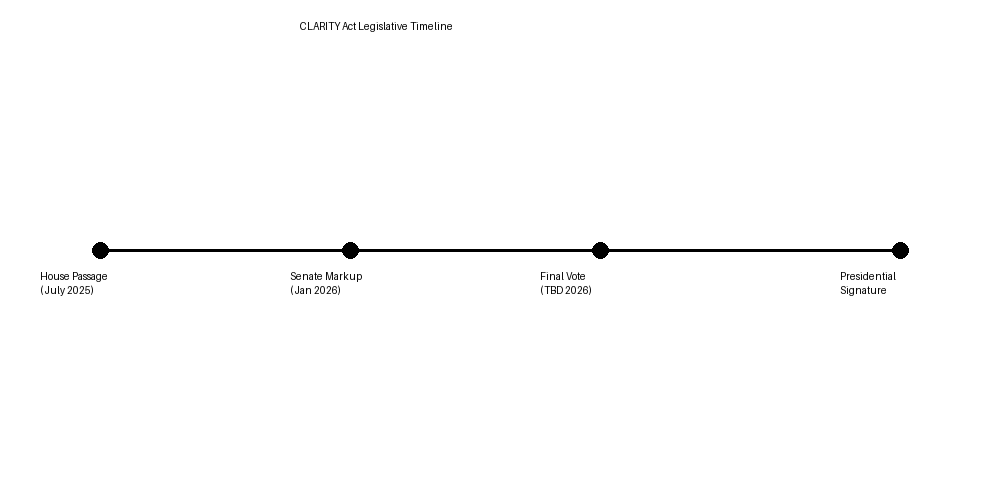
Once committees finalize combined text and negotiate differences, the bill will return to the House for approval before heading to the President’s desk. These procedural steps explain why some analysts predict final passage may stretch into 2026.
What This Means for Crypto Investors and Innovators
1. Clarity Spurs Institutional Participation
Clear legal frameworks reduce risk and attract institutional capital. Investors—especially those deploying large sums or managing institutional funds—thrive in environments with predictable rules. The CLARITY Act could unlock new capital inflows into digital assets.
2. Enhanced Consumer Protection
By defining regulatory responsibilities, lawmakers aim to protect retail investors from fraud and market manipulation. Improved disclosure standards and governance requirements for digital commodity platforms may raise trust in the market.
3. Innovation and New Products
With jurisdiction clarified, companies can innovate with greater confidence—launching new token standards, decentralized finance (DeFi) protocols, and institutional products like tokenized securities or funds.
Conclusion
As 2025 draws to a close, the U.S. crypto regulatory landscape stands on the cusp of historic change. The CLARITY Act’s advancement into Senate markup signifies bipartisan commitment to resolving long-standing ambiguity around digital asset classification, oversight, and market structure. Alongside the already enacted GENIUS Act, which governs stablecoins, these legislative reforms promise to bring much-needed clarity to an industry mired in legal uncertainty.
For investors, developers, and blockchain practitioners, these developments may herald a new era of clearer rules, increased innovation, and broader institutional engagement. Though procedural hurdles remain, the potential of a more definitive legal framework for digital assets is closer than ever—and sets the stage for accelerated growth of crypto markets in the United States.