
Key Takeaways :
- Bitcoin fell below the critical $85,000 support level, accelerating downside pressure across the crypto market.
- Altcoins such as Solana, Cardano, Dogecoin, and Sui experienced steeper losses than Bitcoin.
- Over $550 million in leveraged positions were liquidated, yet market data suggests an orderly deleveraging rather than panic selling.
- Negative funding rates in perpetual futures reflect growing risk aversion among traders.
- The current correction may represent a structural reset rather than the end of the crypto bull cycle.
1. Bitcoin Breaks a Critical Support Level
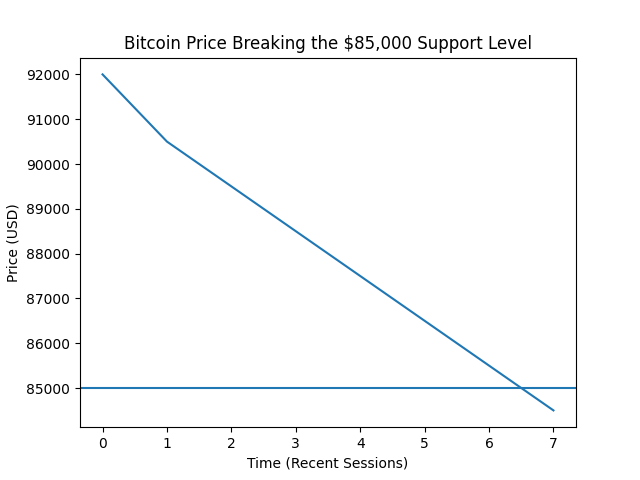
On December 18, Bitcoin (BTC) slipped below the psychologically and technically important $85,000 level, reaching an intraday low near $84,500—its weakest price in nearly three weeks. This move erased an earlier rebound that had briefly lifted BTC to $89,500 earlier in the session.
For weeks, the $85,000 zone had acted as a key support area where buyers consistently stepped in. Its breakdown therefore carried symbolic weight, triggering automated sell orders, margin calls, and a renewed wave of caution across digital asset markets.
While Bitcoin managed a modest bounce after the initial drop, the damage was already done. Market structure weakened, and attention quickly shifted to whether this move would open the door toward the next psychological threshold at $80,000.
2. Altcoins Lead the Downturn
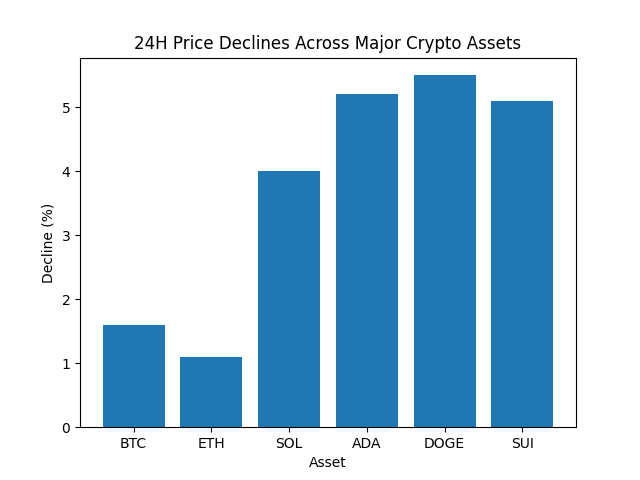
As is often the case during corrective phases, altcoins absorbed the brunt of the selling pressure. Ethereum (ETH) fell below $2,800, while Solana (SOL) declined more than 4%, dropping under $120 and marking its lowest level since April.
Cardano (ADA), Dogecoin (DOGE), and Sui (SUI) each posted losses exceeding 5% over the same period—significantly underperforming Bitcoin’s roughly 1.6% decline.
This divergence underscores a recurring market dynamic: when risk appetite fades, capital tends to rotate out of higher-beta assets and into Bitcoin or stablecoins. Altcoins, particularly those that had rallied aggressively in prior weeks, become the first source of liquidity.
3. $550 Million in Liquidations: Panic or Reset?
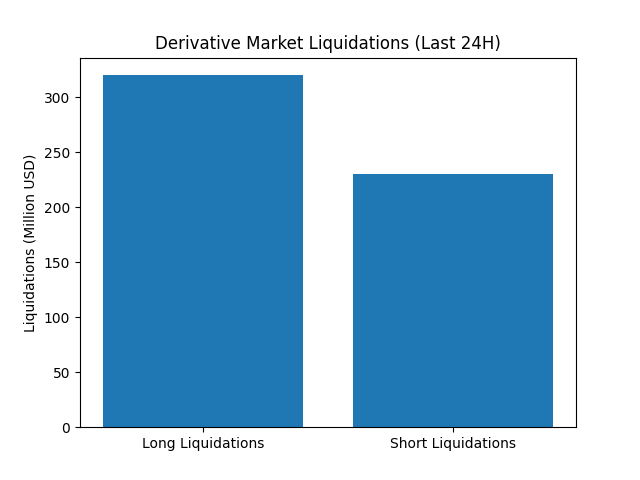
According to CoinGlass data, approximately $550 million worth of leveraged positions were liquidated across crypto derivatives markets in the past 24 hours. Notably, both long and short positions were affected, indicating widespread position adjustment rather than one-sided capitulation.
Despite the headline figure, analysts caution against interpreting these liquidations as a sign of market panic. Trading volumes did not spike dramatically during the sell-off—a key signal that forced selling remained contained.
Amberdata analysts described the move as “orderly deleveraging,” suggesting that traders are reducing exposure in a controlled manner rather than rushing for the exits.
4. Funding Rates Turn Negative: A Shift in Sentiment
Another important signal emerged from perpetual futures markets, where funding rates for many major altcoins turned negative. In simple terms, this means short sellers are paying a premium to maintain their positions—reflecting expectations of further downside or, at minimum, near-term caution.
Negative funding rates often appear during corrective or consolidative phases and do not necessarily imply the start of a prolonged bear market. Instead, they indicate that speculative excess is being flushed out of the system.
Historically, such resets have laid the groundwork for more sustainable advances, provided that spot demand remains intact.
5. Why This Is Not 2022 All Over Again
Comparisons to past market crashes are inevitable, but several structural differences stand out:
First, there is no visible liquidity crisis within the crypto ecosystem. Stablecoin markets remain functional, exchange order books are orderly, and on-chain settlement continues without disruption.
Second, institutional participation—through ETFs, custody services, and regulated derivatives—has diversified market liquidity sources compared to earlier cycles.
Third, macro conditions differ. While interest rates remain elevated, expectations around monetary easing in 2026 continue to support risk assets over the medium term.
Taken together, these factors suggest that the current pullback is more likely a mid-cycle correction than a systemic collapse.
6. Implications for Investors and Builders
For investors, this environment rewards discipline over speculation. Projects with real-world utility, transparent tokenomics, and sustainable revenue models are likely to outperform during periods of volatility.
For builders and operators, particularly those focused on blockchain’s practical applications—payments, settlement, compliance infrastructure, and tokenized assets—market corrections often provide breathing room. Development cycles can continue without the distortions created by excessive hype.
From a strategic perspective, periods of orderly deleveraging tend to separate short-term narratives from long-term value.
7. Conclusion: A Market Reset, Not a Market Collapse
Bitcoin’s drop below $85,000 and the ensuing altcoin sell-off mark a clear shift in short-term market dynamics. However, the absence of panic indicators—such as volume spikes or systemic stress—points toward a controlled reset rather than a breakdown.
For participants seeking new crypto assets, alternative income streams, or practical blockchain use cases, this phase may ultimately prove constructive. Markets are recalibrating expectations, leverage is being reduced, and capital is becoming more selective.
In crypto, such moments often define the next phase of growth.