Main Points :
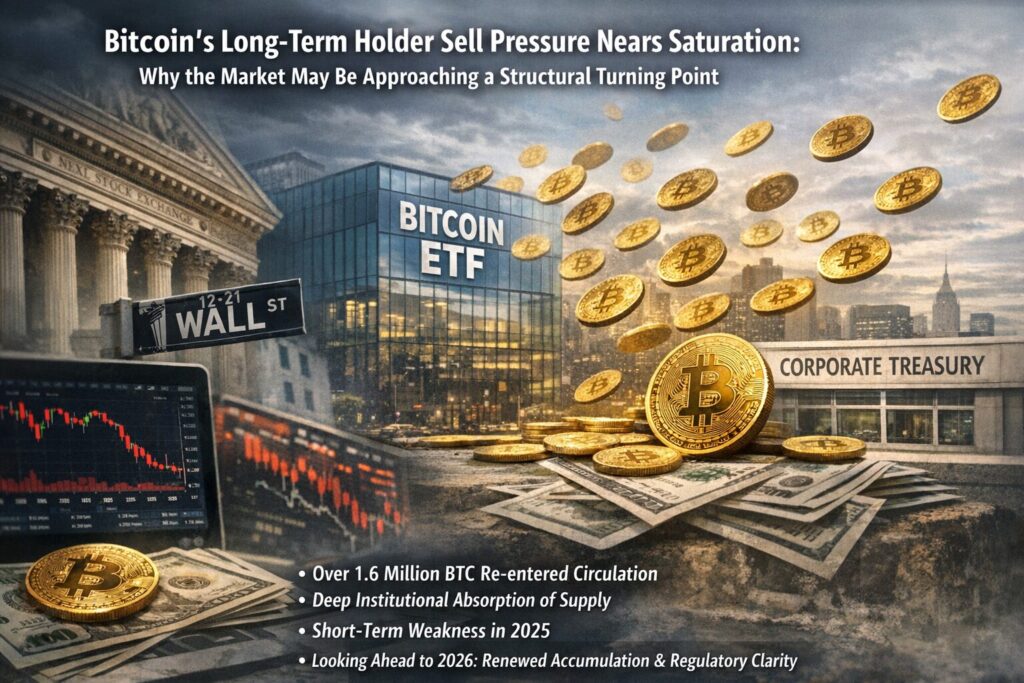
- Bitcoin has experienced one of the largest long-term holder distribution phases in its history, with over 1.6 million BTC re-entering circulation.
- According to K33 Research, this selling pressure is approaching structural saturation, reducing future downside risk.
- Unlike previous cycles, this supply has been absorbed by deep institutional liquidity such as spot Bitcoin ETFs and corporate treasuries.
- Short-term weakness in ETF flows and derivatives activity caused temporary underperformance in 2025.
- Looking ahead to 2026, declining sell pressure, portfolio rebalancing, and regulatory clarity may support renewed accumulation.
- For investors and builders, this phase may represent a long-term accumulation window, not a market failure.
1. Introduction: A Market Exhausted by Selling, Not by Demand
Bitcoin’s recent price stagnation has puzzled many market participants. Despite growing institutional adoption, regulatory clarity, and expanded access via ETFs, Bitcoin has underperformed relative to expectations. According to a detailed analysis by crypto research firm K33, the explanation lies not in collapsing demand, but in exceptionally heavy long-term holder sell pressure—a phenomenon that may now be nearing its natural endpoint.
K33’s latest report suggests that Bitcoin is emerging from a multi-year distribution phase, where early holders steadily sold into rising liquidity. Crucially, the data indicates that this sell pressure is no longer accelerating, but instead approaching saturation. Historically, such conditions have often preceded structural market recoveries.
This article synthesizes K33’s findings, contextualizes them within broader market trends, and explores what this phase means for investors seeking new crypto assets, sustainable yield opportunities, and practical blockchain use cases.
2. Understanding Long-Term Holder Supply Re-Activation
What Is Being Sold—and Why It Matters
K33’s analysis focuses on Bitcoin held for two years or longer, measured via dormant UTXOs (Unspent Transaction Outputs). These coins are typically associated with early adopters, long-term believers, or strategic holders—groups that historically sell only during periods of high confidence and deep liquidity.
Since 2024, the supply of such long-held BTC has been steadily declining, indicating active selling rather than passive technical movements.
- Over 1.6 million BTC from early investors have re-entered circulation.
- In 2025 alone, dormant Bitcoin worth approximately $300 billion (USD equivalent) became active again.
K33 emphasizes that this scale cannot be explained by:
- Wallet consolidation
- Security-related address upgrades
- The conversion of Grayscale’s Bitcoin Trust into an ETF
Instead, the pattern reflects intentional distribution—a strategic exit by long-term holders capitalizing on improved market liquidity.
3. A Unique Cycle: Institutional Liquidity Replaces ICO Mania
How This Cycle Differs from 2017
K33 identifies 2024 and 2025 as the second- and third-largest long-term supply reactivation periods in Bitcoin’s history, surpassed only by the 2017 cycle.
However, the nature of demand is fundamentally different:
| 2017 Cycle | 2024–2025 Cycle |
|---|---|
| ICO participation | Spot Bitcoin ETFs |
| Altcoin speculation | Corporate treasury demand |
| Retail-driven | Institutionally intermediated |
| Shallow liquidity | Deep, regulated liquidity |
Rather than fueling speculative altcoin booms, long-term holders in this cycle sold directly into spot ETF demand and OTC desks, creating a structurally more mature market.
Supporting Evidence: Large OTC Transactions
K33 highlights several notable examples:
- July 2025: An 80,000 BTC OTC trade brokered by Galaxy Digital
- August 2025: A whale swapped 24,000 BTC for ETH
- Oct–Nov 2025: Roughly 11,000 BTC sold in multiple large tranches
These transactions suggest coordinated, widespread distribution rather than isolated selling.
4. Why Bitcoin Underperformed in 2025
When Supply Outpaced Absorption
For much of 2024, ETF inflows and institutional demand absorbed long-term holder selling. However, in 2025, several dynamics shifted simultaneously:
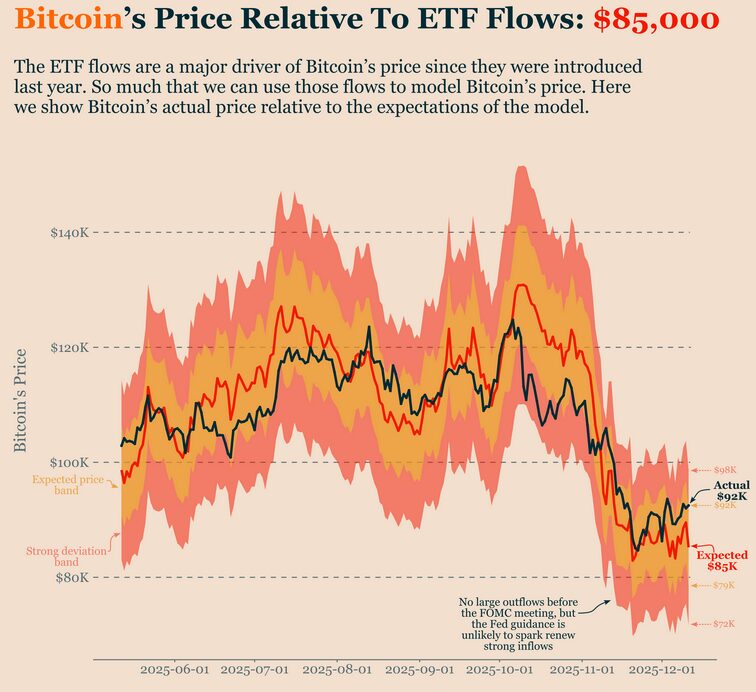
- Spot Bitcoin ETF flows turned net negative
- Derivatives trading volumes declined
- Retail participation weakened significantly
As a result, incremental supply could no longer be fully absorbed, leading to relative price underperformance.
CryptoQuant independently confirmed that the last 30 days of 2025 represented one of the heaviest long-term holder selling periods on record.
Importantly, this underperformance does not imply structural weakness—it reflects a temporary imbalance between supply and demand.
5. Signs of Saturation: Why Sell Pressure May Be Peaking
K33’s central thesis is that sell pressure is nearing exhaustion.
According to research lead Vetle Lunde:
“Roughly 20% of Bitcoin’s total supply has been reactivated over the past two years. On-chain selling pressure is approaching saturation.”
Historically, such large-scale distributions do not repeat indefinitely. Once early holders exit, remaining holders tend to have higher conviction and longer time horizons.
Key Projection
- The supply of BTC held for over two years is expected to stop declining.
- By end-2026, it may exceed the current level of approximately 12.16 million BTC.
This implies a transition from distribution to accumulation.
6. The Role of Portfolio Rebalancing and Market Seasonality
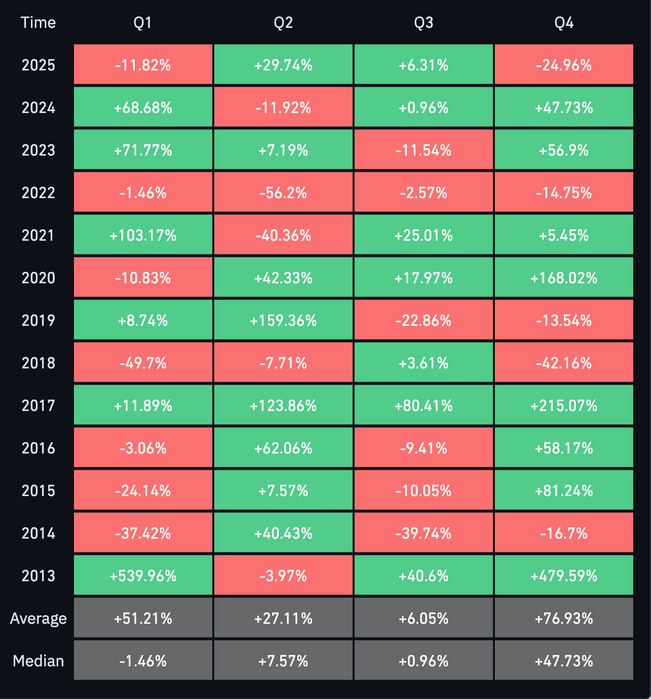
K33 also points to a lesser-known but consistent historical pattern: quarterly mean reversion.
Bitcoin has often moved in the opposite direction of the previous quarter at the start of a new one. Given Bitcoin’s relative underperformance in Q4 compared to other asset classes, portfolio managers with fixed allocation targets may rebalance by increasing BTC exposure.
This dynamic could support inflows from:
- Late December
- Early January
Even modest rebalancing flows can have an outsized impact in a market where sell pressure is declining.
7. Structural Demand Is Stronger Than Ever
Why This Cycle Is Different on the Demand Side
Despite recent ETF outflows, the structural foundation of demand has improved:
- Expanded access via ETFs and advisory platforms
- Clearer regulatory frameworks in major jurisdictions
- Integration with traditional financial infrastructure
- Increased corporate treasury adoption
Lunde cautions that supply reactivation often peaks near market tops, not bottoms. However, he argues that once selling pressure fades, the current cycle’s institutional integration may support more durable demand than in any prior cycle.
8. Strategic Implications for Investors and Builders
For Long-Term Investors
- This phase resembles late-stage distribution, not early-stage collapse.
- Risk-reward dynamics may improve as supply pressure diminishes.
- Bitcoin’s role as a portfolio stabilizer may strengthen post-rebalancing.
For Yield Seekers and Crypto Entrepreneurs
- Lower volatility often precedes innovation cycles.
- Infrastructure, payment rails, custody, and compliance layers become more attractive.
- Bitcoin’s integration into TradFi creates secondary opportunities beyond price appreciation.
9. Visual Analysis and Charts
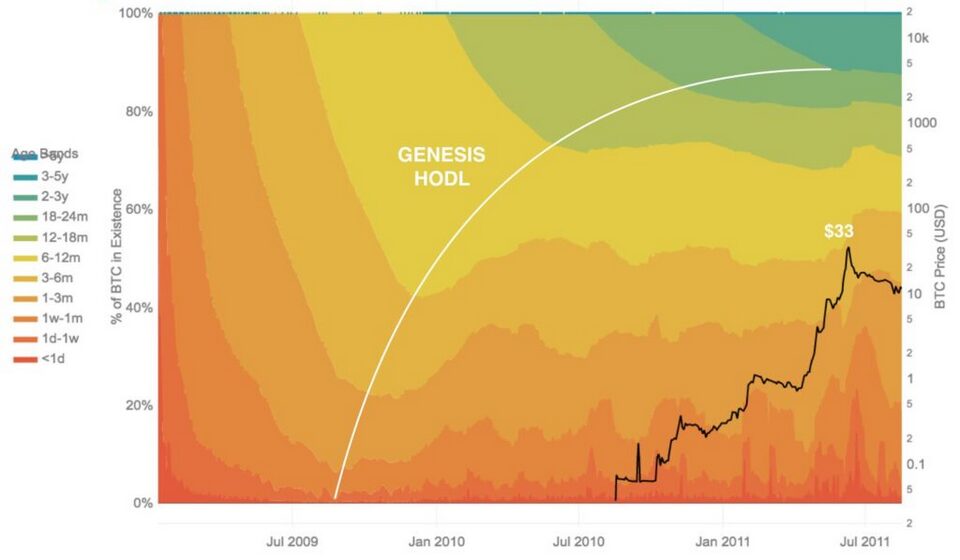
Long-term holder (2+ years) BTC supply trend showing reactivation since 2024.
Spot Bitcoin ETF net flows versus long-term holder selling pressure.
Historical quarterly reversal tendencies in Bitcoin price performance.
10. Conclusion: Not the End of the Cycle—But the End of Forced Selling
Bitcoin’s recent weakness should not be mistaken for declining relevance. On the contrary, the market has been absorbing one of the largest wealth transfers in its history, as early adopters distribute holdings to institutions, corporates, and long-term allocators.
K33’s analysis suggests that this process is nearing completion. As sell pressure fades and structural demand remains intact, Bitcoin may be entering a quieter—but more resilient—phase of its evolution.
For investors seeking new crypto assets, sustainable yield strategies, or real-world blockchain applications, this environment may prove far more fertile than periods dominated by speculative excess.