Key Takeaways :
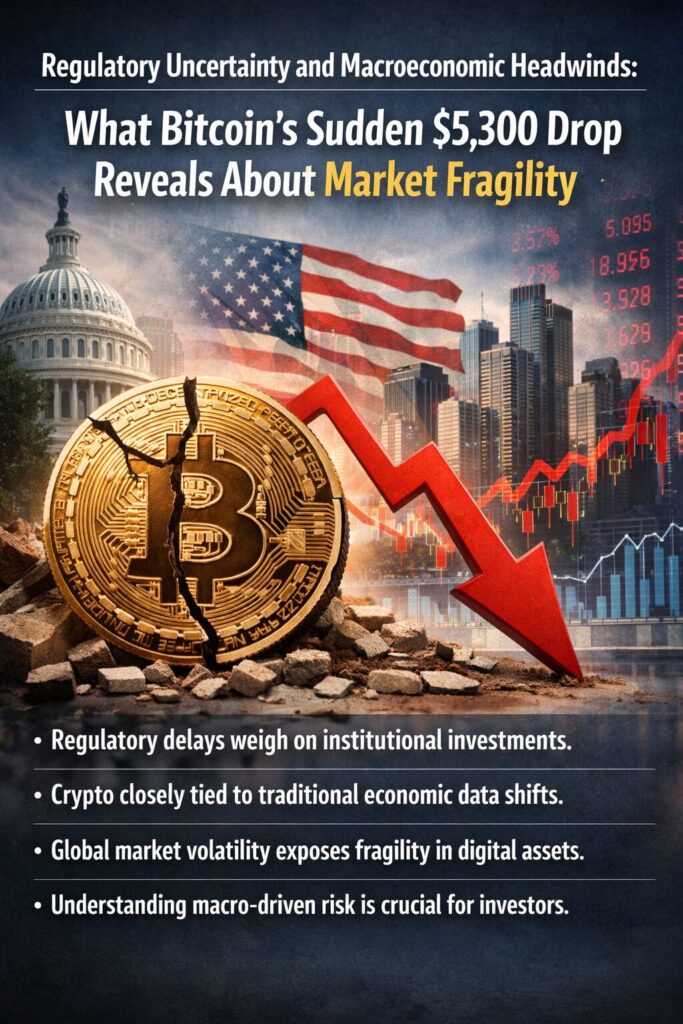
- Bitcoin’s sharp intraday drop of approximately $5,300 exposed the market’s extreme sensitivity to regulatory ambiguity and macroeconomic events.
- The postponement of U.S. crypto regulatory decisions has become a structural drag on institutional capital inflows.
- Crypto markets remain deeply correlated with traditional risk assets, particularly ahead of key U.S. economic data releases.
- For investors seeking new digital assets or revenue opportunities, understanding macro-driven volatility is now essential rather than optional.
1. A Sudden $5,300 Drop Born from Uncertainty
Bitcoin’s sudden decline of roughly $5,300 (converted from approximately ¥800,000) in mid-December 2025 was not merely another episode of routine crypto volatility. Instead, it served as a stress test that revealed how fragile market confidence remains when regulatory clarity and macroeconomic direction are both absent.
At the center of this move were two overlapping uncertainties. First, a highly anticipated U.S. regulatory decision regarding digital assets was postponed yet again. Second, markets were positioning ahead of the U.S. employment report, a data point closely watched for clues about the Federal Reserve’s next monetary policy steps.
When these two factors converged, investors responded in a predictable but powerful way: they reduced risk.
Bitcoin, often described as “digital gold,” once again behaved more like a high-beta risk asset. Short-term traders unwound leveraged positions, while larger investors moved temporarily to the sidelines. The result was a rapid downward move that occurred despite the absence of any major protocol-level issues or crypto-specific scandals.
[Bitcoin Price Movement Around Macro & Regulatory Uncertainty]
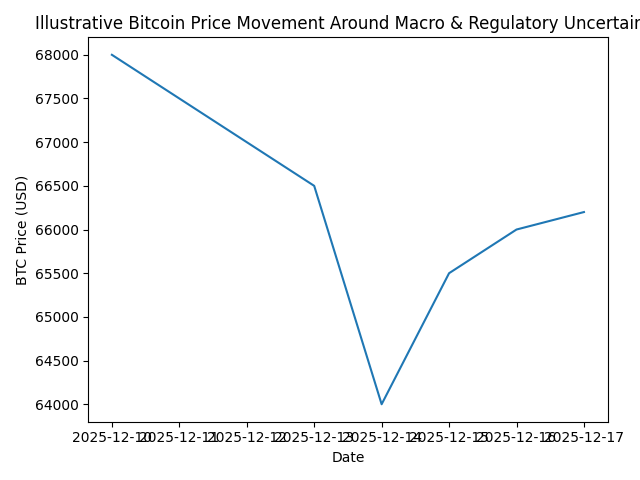
Note: This chart is illustrative and designed to visualize typical volatility patterns around macro events.
2. Why Regulatory Delays Create Real Selling Pressure
Regulatory uncertainty is not a theoretical concern; it has direct market consequences. Each delay in U.S. crypto policy decisions effectively places a ceiling on institutional participation.
Large asset managers, pension funds, and insurance companies operate under strict compliance frameworks. Without clear guidance on custody rules, token classification, and reporting obligations, these institutions cannot deploy capital at scale—even if they believe in Bitcoin’s long-term value proposition.
This creates a paradox. On one hand, market participants widely acknowledge that trillions of dollars in institutional capital are “waiting on the sidelines.” On the other hand, the longer regulators delay, the longer this capital remains inactive, depriving the market of stabilizing inflows.
In December 2025, the postponement of regulatory decisions was interpreted as a signal that clarity would not arrive in the near term. As a result, speculative capital dominated price discovery, amplifying downside volatility.
From a structural perspective, this dependence on regulatory signals represents one of crypto’s most persistent vulnerabilities. Unlike traditional equities, which can rely on earnings and dividends, Bitcoin’s valuation narrative still hinges heavily on adoption trajectories shaped by policy decisions.
3. The Employment Report Effect and Risk-Off Behavior
The timing of the sell-off—just ahead of the U.S. employment report—was no coincidence. Labor market data remains one of the most influential inputs into Federal Reserve decision-making.
Stronger-than-expected employment figures raise the probability of prolonged high interest rates. Higher rates, in turn, increase the opportunity cost of holding non-yielding assets like Bitcoin. Conversely, weaker data can fuel expectations of monetary easing, supporting risk assets.
Ahead of such binary outcomes, investors typically reduce exposure. This “risk-off” behavior is well documented in equities, foreign exchange markets, and increasingly, in digital assets.
Bitcoin’s decline in this context underscores a key reality: despite its decentralized nature, its price is still anchored to global liquidity conditions. Until crypto markets develop deeper internal demand drivers independent of macro liquidity cycles, this pattern is likely to persist.
4. Deepening Correlation with Traditional Financial Markets
One of the most striking aspects of the December move was how closely Bitcoin tracked traditional risk assets. Technology stocks, particularly in the Nasdaq, exhibited similar pre-event weakness as investors braced for macro data.
This correlation challenges the long-standing narrative of Bitcoin as an uncorrelated hedge. While long-term diversification benefits may still exist, short-term price action tells a different story.
[Illustrative Risk Sentiment Correlation]
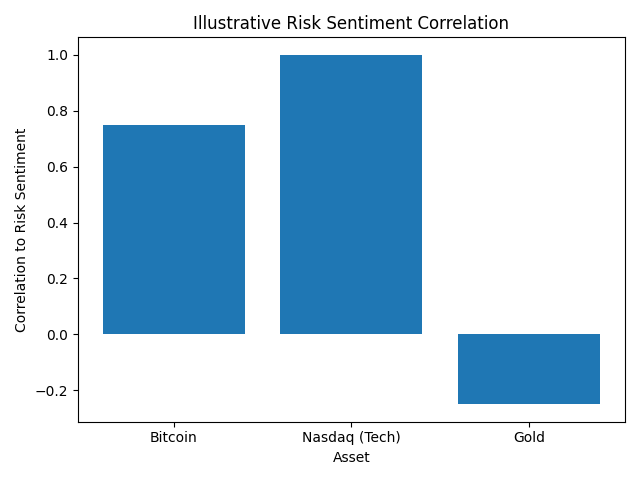
The growing integration of crypto into mainstream portfolios has paradoxically increased its sensitivity to traditional market dynamics. As hedge funds and asset managers trade Bitcoin alongside equities, correlations naturally rise—especially during periods of stress.
5. What This Means for Investors Seeking New Opportunities
For readers searching for new crypto assets or alternative revenue streams, this episode offers several lessons.
First, macro literacy is now a prerequisite for crypto investing. Understanding interest rate policy, employment data, and regulatory calendars is no longer optional.
Second, volatility itself can be an opportunity. Sharp, sentiment-driven sell-offs often create entry points for long-term investors who can tolerate short-term fluctuations.
Third, practical blockchain use cases—such as payments, settlement, and tokenized real-world assets—may prove more resilient over time than purely speculative narratives. Projects that generate cash flow or solve concrete problems are better positioned to weather macro storms.
6. Conclusion: A Market Still in Transition
Bitcoin’s sudden $5,300 decline was not a sign of structural failure, but rather a reminder that the market remains in transition. Regulatory clarity has yet to catch up with innovation, and macroeconomic forces continue to dominate short-term price action.
For serious participants, this environment demands discipline, patience, and a broader analytical framework. The long-term promise of digital assets remains intact, but the path forward will be shaped as much by policymakers and central banks as by developers and entrepreneurs.