Main Points :
- The crypto market entered a correction phase as macroeconomic uncertainty in the U.S. intensified.
- Bitcoin briefly tested the $85,000 level, while Ethereum fell toward $2,900.
- Investors shifted toward risk-off positioning due to concerns over U.S. economic slowdown and speculation surrounding the next Federal Reserve Chair.
- Excessive leverage in crypto derivatives markets amplified downside volatility.
- A stabilizing U.S. dollar reduced Bitcoin’s appeal as a hedge in the short term.
- Structural liquidity issues and declining market depth suggest continued fragility.
1. Market Correction Triggered by Macro Uncertainty
The cryptocurrency market faced a notable correction at the start of the week, driven by a convergence of macroeconomic anxiety and political speculation in the United States. Bitcoin (BTC) declined toward the psychologically significant $85,000 level, while Ethereum (ETH) dropped to approximately $2,900. This move reflected a broader risk-off sentiment among global investors.
Recent surveys and economic indicators have reinforced fears that the U.S. economy may be slowing more rapidly than previously anticipated. At the same time, shifting expectations regarding the next Chair of the Federal Reserve added another layer of uncertainty. Together, these factors encouraged investors to reduce exposure to high-volatility assets such as cryptocurrencies.
2. U.S. Treasury Bonds and Capital Rotation Toward Safety
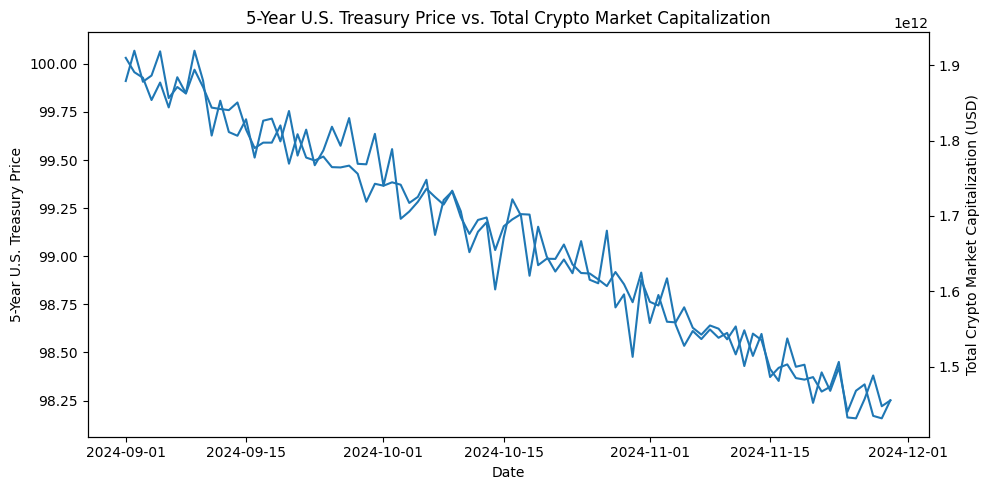
One of the clearest signals of risk aversion emerged in the U.S. Treasury market. The 5-year U.S. Treasury note reached a low price of 98.64 midweek before stabilizing, indicating renewed demand for government bonds despite expectations of further rate cuts.
This behavior suggests that capital is rotating into perceived safe assets rather than flowing into growth or speculative instruments. While lower interest rates typically support risk assets, the current environment shows that fear of economic deterioration can override the usual liquidity-driven optimism.
Title: 5-Year U.S. Treasury Price vs. Total Crypto Market Capitalization
Description: Dual-axis chart showing Treasury price stability against declining crypto market cap.
3. Fiscal Policy, Debt Expansion, and Fed Balance Sheet Growth
Adding to market complexity, U.S. lawmakers approved an extension of tax credits under what has been described as a “large and comprehensive” fiscal bill, simultaneously raising the U.S. debt ceiling by $5 trillion. This expansion comes at a time when the Federal Reserve has also decided to increase its balance sheet by approximately $40 billion per month.
In isolation, such measures might be viewed as supportive for liquidity-sensitive assets like Bitcoin. However, when combined with recession fears, they instead raise concerns about long-term fiscal sustainability and policy credibility. Markets appear increasingly cautious about whether monetary expansion can effectively counteract structural economic weakness.
4. Consumer Weakness Signals a Broader Economic Slowdown
Consumer sentiment data has further undermined confidence. According to a CNBC survey, 41% of U.S. respondents stated they plan to reduce spending during the upcoming holiday season, up from 35% in the previous year. Meanwhile, 61% reported that stagnant wages combined with rising prices have made daily living more difficult.
These trends are especially relevant for crypto markets, which remain highly sensitive to liquidity and discretionary investment flows. Upcoming releases of U.S. retail sales data and non-farm payroll (NFP) figures are expected to play a decisive role in shaping near-term market direction.
5. Excessive Leverage Remains the Crypto Market’s Core Weakness
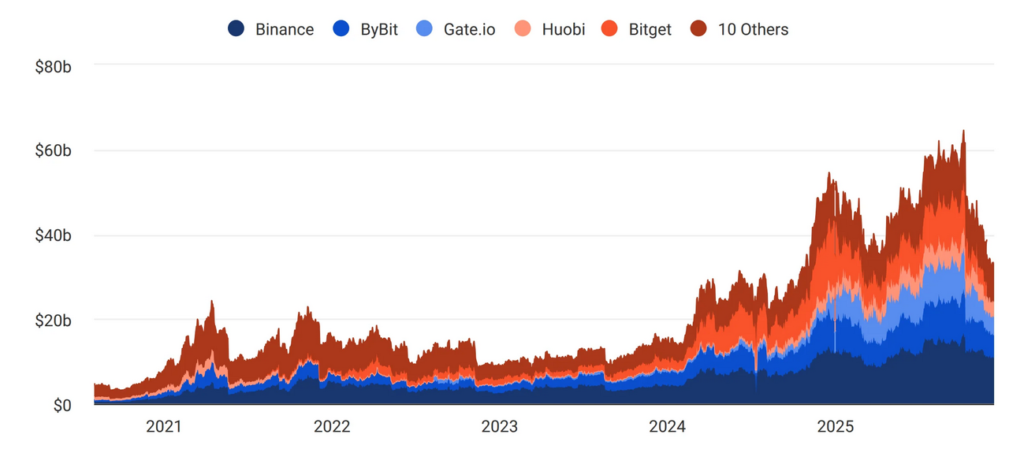
Within the crypto ecosystem itself, excessive leverage continues to pose a systemic risk. Total open interest across derivatives markets has reached approximately $135 billion. Over the past 24 hours alone, more than $527 million in bullish leveraged positions were liquidated.
Such forced liquidations tend to accelerate price declines, creating feedback loops that exacerbate volatility. This dynamic is particularly dangerous in periods of declining liquidity, as relatively small market orders can trigger outsized price movements.
Title: Crypto Futures Open Interest and Liquidations
Description: Visualization of rising open interest alongside liquidation spikes.
6. AI Sector Stress and Spillover Effects on Crypto
Risk aversion has also been reinforced by weakness in the artificial intelligence (AI) sector. Bridgewater Associates, one of the world’s largest hedge funds, warned that heavy reliance on debt financing for AI investments is approaching a dangerous threshold. Co-CIO Greg Jensen cautioned that the sector may be nearing a speculative bubble.
As capital exits AI-related equities, traders are increasingly holding cash rather than reallocating funds into crypto assets. This behavior challenges the narrative that crypto consistently benefits from broader tech-sector enthusiasm.
7. Funding Rate Anomalies and Liquidity Deterioration
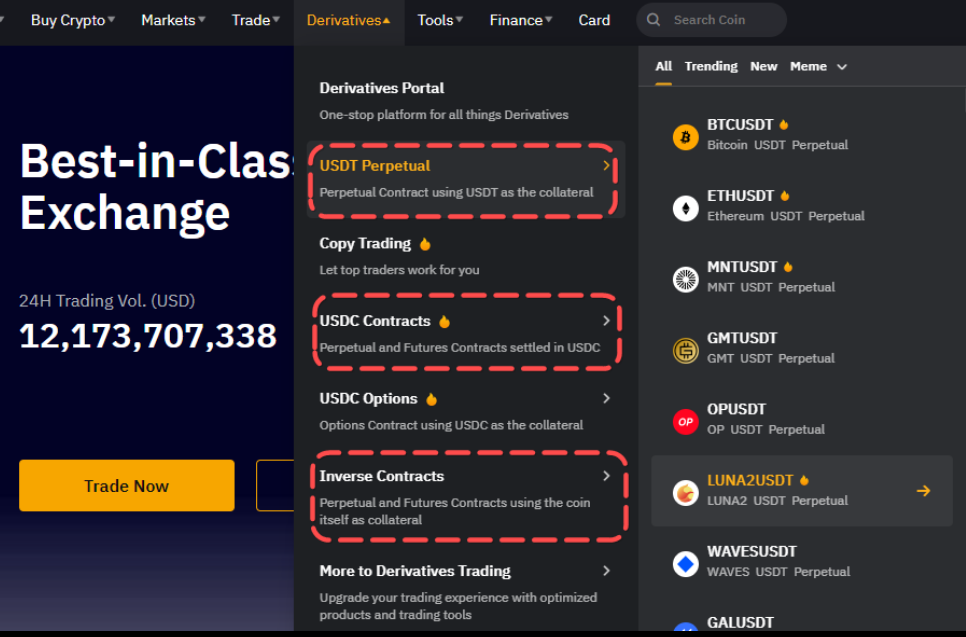
An unusual phenomenon has emerged in crypto derivatives markets. On platforms such as Bybit, demand for short positions surged, pushing annualized funding rates into negative territory. In this scenario, long-position holders receive payments for maintaining leverage—an inversion of normal market conditions.
While such distortions typically attract arbitrage traders and self-correct quickly, current market liquidity is significantly thinner than in previous cycles. Since the sharp sell-off on October 10, overall market depth has deteriorated, and some market makers may be operating at substantial losses.
Title: Crypto Funding Rates Across Major Exchanges
Description: Comparative funding rate chart highlighting negative rates.
8. Fed Chair Speculation and Its Impact on Risk Assets
Political developments also weighed on sentiment. U.S. equities declined after reports suggested that Kevin Hassett’s likelihood of succeeding Jerome Powell as Fed Chair had diminished. Media outlets indicated that the Trump camp may favor a more institutionally independent candidate.
Former President Trump’s comments endorsing Kevin Warsh as a potential candidate slightly eased concerns about extreme dollar weakness. Nevertheless, uncertainty around future monetary leadership remains a destabilizing factor for both traditional and digital asset markets.
9. U.S. Dollar Stabilization Limits Bitcoin’s Hedge Narrative
After four consecutive weeks of decline, the U.S. Dollar Index (DXY) found support around the 98 level. This stabilization reflects renewed confidence that the U.S. government may avoid a severe recession.
For cryptocurrencies, however, a stronger or stable dollar often acts as a headwind. Bitcoin and Ethereum are frequently viewed as components of an alternative financial system, and demand for such alternatives tends to weaken when confidence in fiat systems improves.
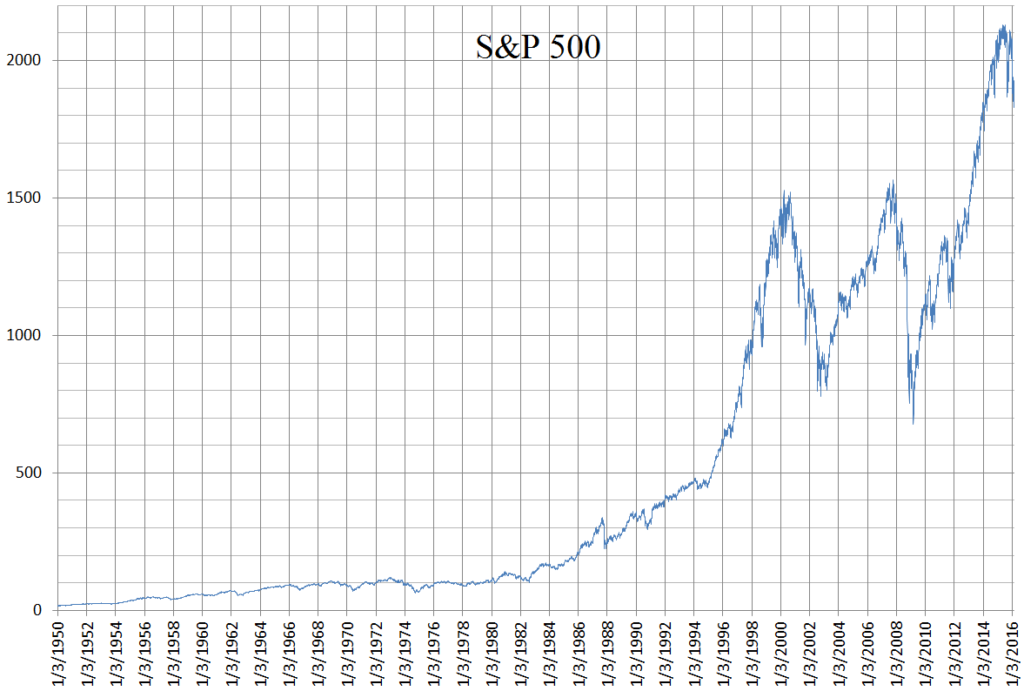
Title: S&P 500 Index vs. U.S. Dollar Index (DXY)
Description: Comparison of equity market movements and dollar strength.
10. Outlook: Structural Pressure and the Path Forward
Taken together, excessive leverage, macroeconomic uncertainty, political ambiguity, and declining liquidity suggest that cryptocurrencies may remain under pressure in the near term. While long-term adoption narratives remain intact—particularly around Bitcoin’s role as a non-sovereign store of value—the short-term environment is dominated by caution.
For investors and builders focused on practical blockchain applications, this phase may represent less an existential threat and more a stress test of market structure. Projects with genuine utility, sustainable revenue models, and prudent risk management are likely to emerge stronger once macro conditions stabilize.
Conclusion
The recent correction in the crypto market is not the result of a single catalyst but rather the convergence of multiple systemic pressures. As Bitcoin tests the $85,000 level, the market is being forced to confront its dependence on leverage, liquidity, and favorable macro conditions.
In the coming months, clarity around U.S. economic resilience, Federal Reserve leadership, and global risk appetite will be critical. Until then, volatility should be viewed not merely as noise, but as a signal—one that separates speculative excess from sustainable innovation within the blockchain ecosystem.