

Key Takeaways :
- Strategy has acquired an additional 10,645 BTC for approximately $983 million, reinforcing its position as the world’s largest corporate Bitcoin holder.
- Despite a sharp downturn in both Bitcoin prices and Strategy’s stock (MSTR), the company continues to execute a high-conviction, long-term Bitcoin treasury strategy.
- The creation of a $1.44 billion USD reserve marks a strategic evolution aimed at stabilizing investor sentiment and mitigating dividend-related risk.
- Strategy’s approach offers important lessons for companies exploring Bitcoin not as a speculative asset, but as a core financial infrastructure.
Introduction: From Business Intelligence to Bitcoin Infrastructure
Strategy’s transformation from a traditional business intelligence firm into what can best be described as a Bitcoin treasury and capital allocation company has few parallels in modern corporate history. While many firms have experimented with holding small amounts of Bitcoin as a hedge or diversification tool, Strategy has pursued a radically different path: it has made Bitcoin the centerpiece of its balance sheet, financing strategy, and long-term corporate identity.
In the past week, amid a broad downturn in the cryptocurrency market and growing pressure on risk assets, Strategy announced that it had acquired 10,645 additional BTC at an average price of $92,098 per Bitcoin, for a total consideration of roughly $983 million. This purchase brings the company’s total holdings to 671,268 BTC, further cementing its position as the largest corporate holder of Bitcoin globally.
Rather than signaling caution during market weakness, Strategy’s actions suggest the opposite: a deepening conviction that Bitcoin represents not merely an investment, but a new monetary base layer.
The Latest Bitcoin Purchase: Details and Strategic Context
Strategy disclosed that the acquisition was completed last week, following a relatively quiet period earlier in the quarter. This renewed acceleration mirrors a similar purchase in early December, when the firm added 10,624 BTC, signaling a deliberate return to aggressive accumulation.
At current market levels, Strategy’s Bitcoin holdings represent tens of billions of dollars in notional value. More importantly, the company tracks its success using a proprietary metric known as “Bitcoin Yield”, which measures the growth rate of Bitcoin holdings relative to the company’s fully diluted share count. As of the latest disclosure, this figure stands at 24.9%, indicating that Strategy has continued to increase Bitcoin exposure per share despite market volatility.
This framing is critical. While traditional investors may focus on short-term price fluctuations, Strategy evaluates performance in terms of Bitcoin accumulation efficiency, not quarterly earnings or share price stability
Strategy Bitcoin Holdings Growth (Illustrative)

Market Downturn and Pressure on MSTR Stock
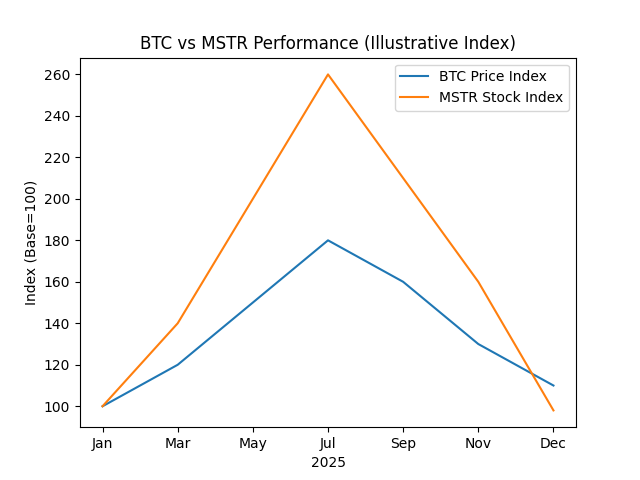
The timing of Strategy’s purchase is particularly striking given the broader market context. Bitcoin, which reached an all-time high of approximately $126,000 in November, has since retraced sharply, briefly falling below $80,000. This decline has weighed heavily on sentiment across the digital asset sector.
Because Strategy’s stock (MSTR) is widely viewed as a leveraged proxy for Bitcoin exposure, its share price has suffered even more severe losses. After peaking above $450 in July, MSTR shares have fallen by nearly 62%, reflecting both Bitcoin’s drawdown and investor concerns over balance sheet leverage.
For many companies, such a backdrop would prompt defensive measures or a pause in risk-taking. Strategy, however, has chosen to respond not by retreating, but by restructuring its financial buffers.
The Creation of a $1.44 Billion USD Reserve
In response to heightened volatility and growing investor anxiety, Strategy announced the establishment of a $1.44 billion USD reserve. This reserve is explicitly designed to cover approximately 12 months of dividend payments, with plans to expand coverage to 24 months in the future.
CEO Phong Le explained in an interview with CNBC that this move was partly intended to counteract FUD—fear, uncertainty, and doubt—which tends to intensify during market downturns. By securing a substantial dollar-denominated reserve, Strategy aims to reassure investors that it can meet near-term obligations without being forced to liquidate Bitcoin holdings at unfavorable prices.
This marks a subtle but important evolution in Strategy’s approach. While Bitcoin remains the core asset, the company is increasingly acknowledging the need for liquidity management and psychological stability in public markets.
BTC Price vs. MSTR Stock Performance (Illustrative Index)
Financing the Bitcoin Strategy: Equity, Debt, and Cash Flow
Strategy’s ability to continue accumulating Bitcoin at scale rests on a multi-pronged financing model. Initially, the company relied heavily on operating cash flow. Over time, it expanded into equity issuance and debt financing, effectively transforming capital markets into a conduit for Bitcoin accumulation.
Critics often argue that this approach introduces systemic risk, especially during prolonged bear markets. Supporters counter that Strategy has, in effect, engineered a Bitcoin-denominated balance sheet, using fiat liabilities to acquire a scarce digital asset with a fixed supply.
The introduction of a USD reserve suggests that Strategy is refining this model rather than abandoning it—acknowledging that while Bitcoin may be the long-term objective, fiat liquidity still plays a critical tactical role.
Implications for Corporate Bitcoin Adoption
Strategy’s actions carry implications far beyond its own balance sheet. For corporate treasurers, CFOs, and founders exploring crypto integration, Strategy represents an extreme but informative case study.
Key lessons include:
- Bitcoin can be treated as a strategic reserve asset, not merely a speculative trade.
- Market volatility does not necessarily invalidate long-term accumulation strategies.
- Transparent metrics and clear communication are essential to managing investor expectations.
- Fiat liquidity buffers remain necessary, even in a Bitcoin-centric model.
As regulatory clarity improves and institutional infrastructure matures, more companies may adopt hybrid strategies inspired—directly or indirectly—by Strategy’s example.
Conclusion: A Stress Test for the Bitcoin Treasury Model
Strategy’s latest $1 billion Bitcoin purchase is not just another headline—it is a stress test of the corporate Bitcoin treasury model under adverse conditions. By continuing to accumulate BTC during a market downturn while simultaneously reinforcing its fiat liquidity position, Strategy is attempting to demonstrate that conviction and prudence are not mutually exclusive.
For readers interested in discovering new crypto assets, identifying future revenue opportunities, or understanding practical blockchain adoption, Strategy’s journey offers a rare, real-world experiment at scale. Whether this model ultimately proves visionary or excessive will depend on Bitcoin’s long-term role in the global financial system—but for now, Strategy is making one thing clear: it intends to find out by staying all in.


