Main Points :
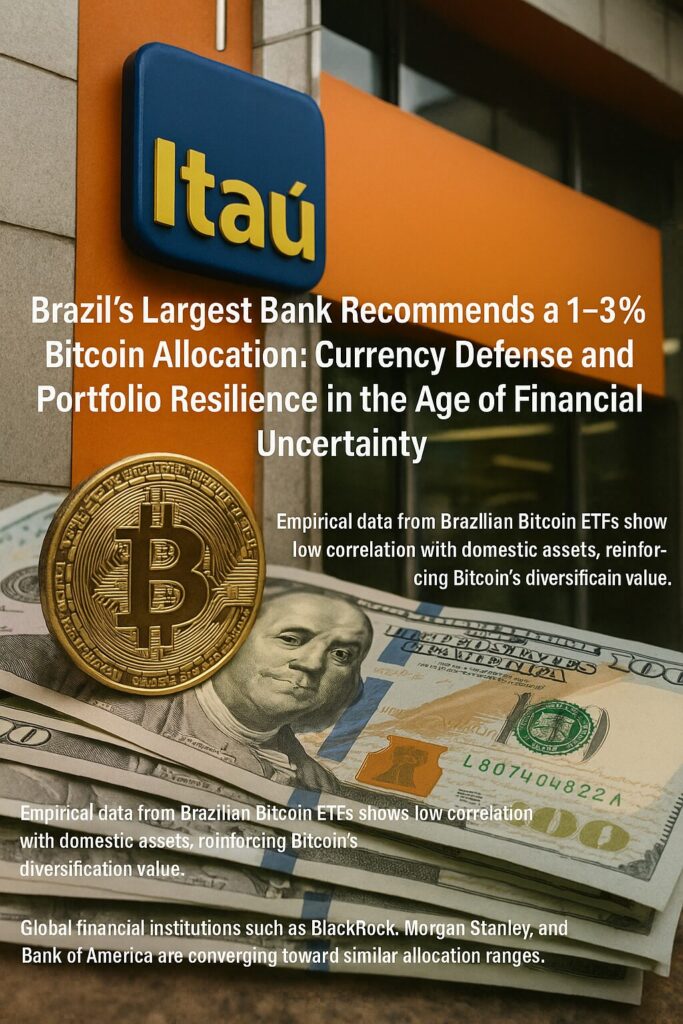
- Brazil’s largest bank, Itaú Unibanco, recommends allocating 1–3% of portfolios to Bitcoin as a dual strategy for currency defense and diversification.
- Bitcoin is positioned not as a speculative core asset, but as a strategic complement to traditional portfolios.
- Empirical data from Brazilian Bitcoin ETFs shows low correlation with domestic assets, reinforcing Bitcoin’s diversification value.
- Global financial institutions such as BlackRock, Morgan Stanley, and Bank of America are converging toward similar allocation ranges.
- Bitcoin is increasingly framed as a macro hedge against currency depreciation and systemic uncertainty, rather than a short-term trading vehicle.
Itaú Unibanco’s 1–3% Bitcoin Allocation Proposal
Brazil’s largest private bank, Itaú Unibanco, has formally recommended that investors allocate between 1% and 3% of their portfolios to Bitcoin (BTC). The recommendation was articulated by Renato Eid, Head of Investments at Itaú, in a research note emphasizing what he described as a “dual opportunity”: currency protection and true portfolio diversification.
The proposal emerges against the backdrop of Brazil’s long-standing vulnerability to currency depreciation. While the Brazilian real has experienced periods of stability, it remains structurally exposed to global monetary tightening, commodity cycles, and domestic fiscal uncertainty. Within this context, Bitcoin is framed not as a speculative gamble, but as a non-sovereign monetary asset that behaves independently of Brazil’s domestic economic cycle.
Eid’s note underscores that Bitcoin’s value proposition only fully materializes when approached with a long-term holding mindset. Short-term volatility, while unavoidable, is not a flaw but a characteristic of an emerging monetary asset still undergoing global price discovery.
Strategic Positioning: Bitcoin as a Complement, Not a Core Asset
In its report titled “Bitcoin in 2026: Between Forecasts and Reality”, Itaú’s asset management division clarifies that Bitcoin should not replace traditional asset classes such as equities, fixed income, or real assets. Instead, it should function as a strategic overlay, designed to enhance portfolio robustness.
The bank explicitly warns against over-allocation. Bitcoin’s role, according to Itaú, is to serve as a convex return enhancer—an asset that can meaningfully improve risk-adjusted returns even at small weights, while limiting downside exposure when disciplined allocation thresholds are respected.
This framing aligns with modern portfolio theory extensions that emphasize non-linear return profiles and correlation asymmetry, areas where Bitcoin has increasingly distinguished itself from traditional instruments.
Market Volatility and the Limits of Timing
Bitcoin’s price behavior in 2025 illustrates the challenge of short-term forecasting. The asset surged to approximately $126,000, before retracing to around $90,000, marking one of the most volatile yet liquid trading periods in its history.
Eid highlights that attempting to time such movements precisely is inherently risky. The research note cautions investors against reactive trading strategies, arguing that “perfect timing” is largely illusory, particularly in markets driven by global liquidity flows, ETF inflows, and macro narratives.
Instead, Itaú advocates for systematic exposure, where Bitcoin’s allocation remains stable across market cycles. This approach transforms volatility from a source of anxiety into a structural feature that can enhance long-term returns.
Bitcoin’s Role in Portfolio Diversification
One of the most compelling arguments in Itaú’s analysis is Bitcoin’s historically low correlation with Brazilian domestic assets, including equities, government bonds, and real estate.
By allocating even a modest percentage to Bitcoin, investors can potentially reduce overall portfolio volatility while maintaining—or even improving—expected returns. Importantly, this diversification effect does not rely on Bitcoin outperforming every year, but on its tendency to move differently during periods of domestic stress.
Bitcoin’s global, permissionless nature allows it to function as an external return stream, decoupled from local economic shocks. For Brazilian investors, this effectively introduces an international diversification component without relying on foreign equity or bond markets alone.
Empirical Evidence from Bitcoin ETFs
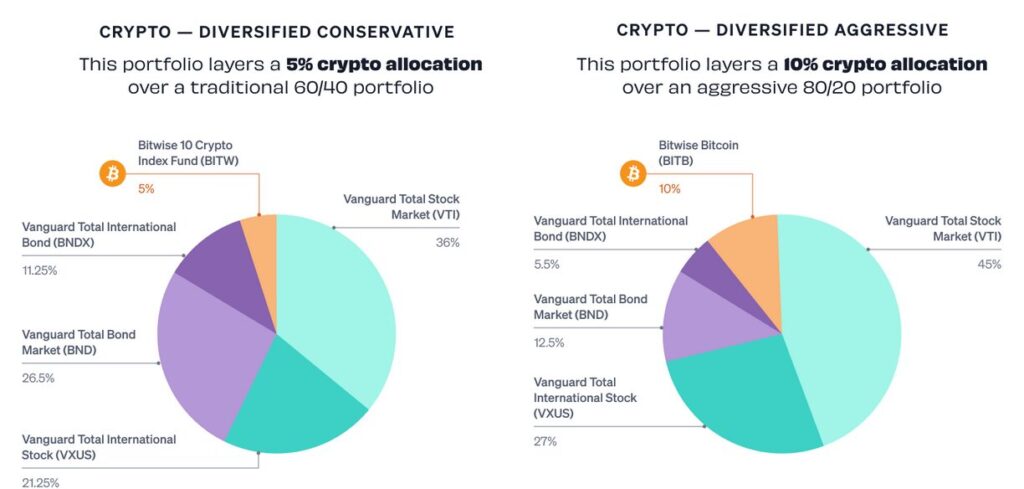
The research note cites data from Brazil’s locally listed Bitcoin ETF, BITI11, which demonstrates consistently low correlation with traditional asset classes. According to Itaú, simulations indicate that a 1–3% allocation is sufficient to capture most of Bitcoin’s diversification benefits.
[Correlation matrix showing Bitcoin ETF vs Brazilian equities, bonds, and FX]
This empirical grounding is critical. Rather than relying on theoretical arguments, Itaú anchors its recommendation in observable market data, reinforcing Bitcoin’s evolving legitimacy within institutional portfolio construction.
Bitcoin as a Currency Hedge and Global Value Store
Beyond diversification, Itaú emphasizes Bitcoin’s role as a currency hedge. Unlike gold, Bitcoin is natively digital, globally transferable, and operates outside the control of any single central bank.
For investors in emerging markets, this characteristic is particularly valuable. Bitcoin exposure effectively represents implicit access to global liquidity, providing insulation against domestic monetary debasement without requiring direct capital flight.
The bank frames this dual function—international diversification plus currency defense—as Bitcoin’s defining strategic advantage.
Discipline and Risk Management
Despite its endorsement, Itaú repeatedly stresses the importance of discipline. Investors are advised to cap exposure at 1–3%, rebalance periodically, and avoid emotional responses to short-term price swings.
Bitcoin’s volatility, while attractive for convexity, can undermine portfolio stability if allowed to dominate allocation decisions. Itaú’s guidance reflects a broader institutional consensus: Bitcoin is most powerful when deliberately constrained.
Investment Vehicles: ETFs and Direct Ownership
For practical implementation, Itaú recommends Brazil-listed Bitcoin ETFs such as BITI11, citing regulatory clarity, custody safeguards, and ease of access. Direct purchases through cryptocurrency exchanges are acknowledged as an alternative for more experienced investors.
This dual-track approach reflects a pragmatic recognition of investor heterogeneity, allowing both traditional and crypto-native participants to engage according to their operational comfort.
Global Financial Institutions Converge on Bitcoin Allocation
Itaú’s recommendation does not exist in isolation. Across global finance, major institutions are converging toward similar allocation ranges.
- BlackRock (2024): Recommended up to 2% Bitcoin exposure in diversified portfolios.
- Morgan Stanley (2025): Suggested up to 4% crypto allocation for high-risk-tolerant investors.
- Bank of America (2026 outlook): Indicated 1–4% crypto exposure may be appropriate for wealthy clients.
[Timeline of institutional Bitcoin allocation recommendations]
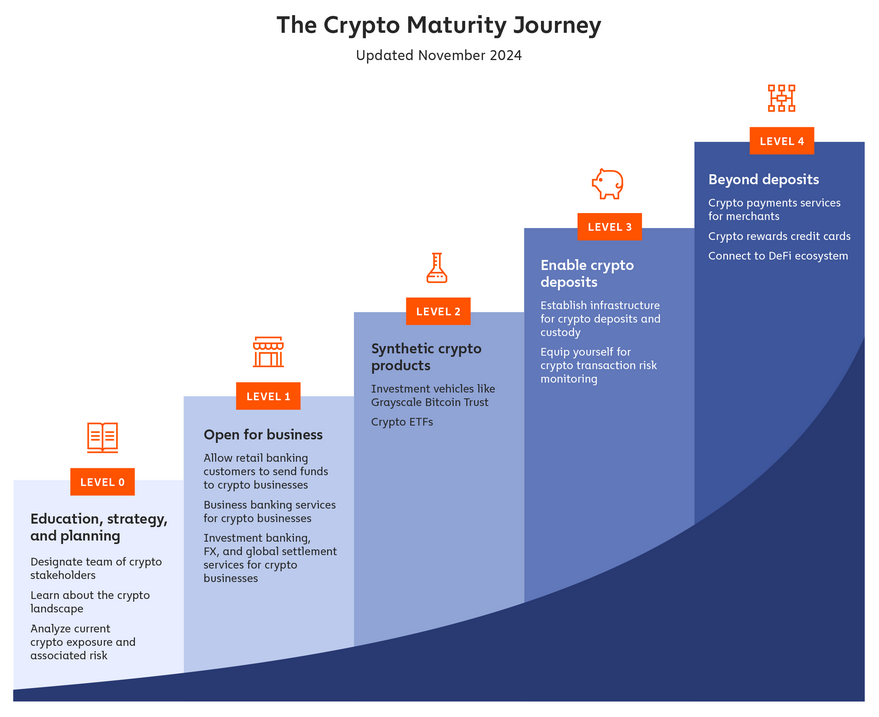
This alignment suggests a structural shift: Bitcoin is no longer treated as an anomaly, but as a recognized portfolio component.
Conclusion: Bitcoin’s Institutional Maturation
Itaú Unibanco’s endorsement of a 1–3% Bitcoin allocation marks a significant milestone in Bitcoin’s institutional evolution. Framed not as speculation, but as risk management, Bitcoin is increasingly understood as a tool for navigating monetary uncertainty, currency risk, and portfolio fragility.
For investors seeking new asset classes, alternative revenue sources, or practical blockchain exposure, Bitcoin’s role is becoming clearer: small in size, but meaningful in impact. As global banks continue to refine their frameworks, Bitcoin’s transition from fringe asset to strategic allocation appears increasingly irreversible.