Main Points :
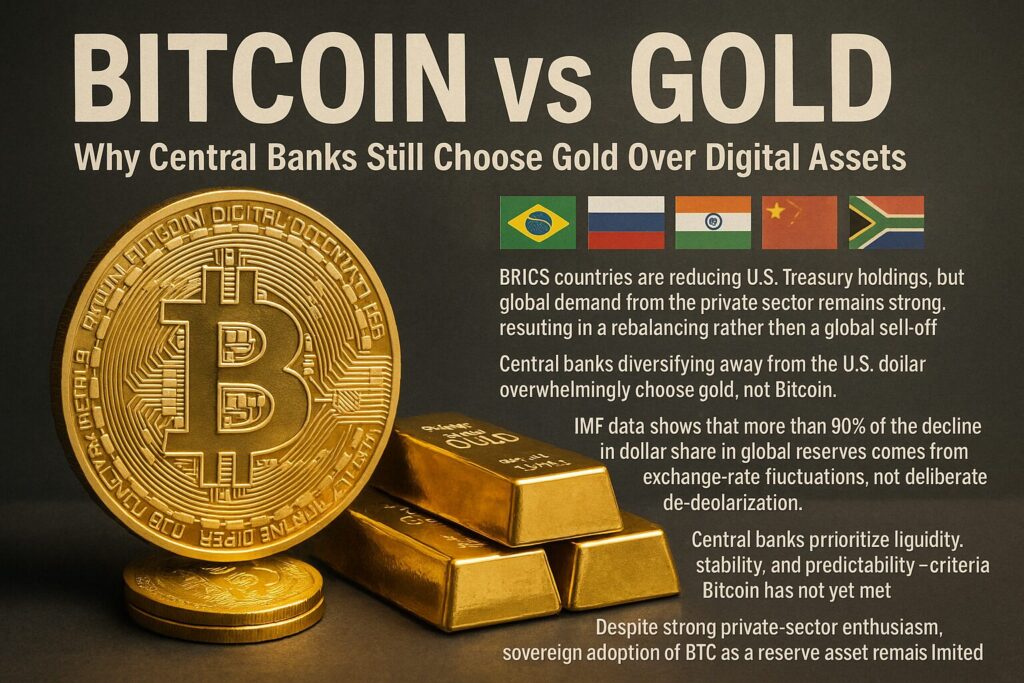
- BRICS countries are reducing U.S. Treasury holdings, but global demand from the private sector remains strong, resulting in a rebalancing rather than a global sell-off.
- Central banks diversifying away from the U.S. dollar overwhelmingly choose gold, not Bitcoin.
- IMF data shows that more than 90% of the decline in dollar share in global reserves comes from exchange-rate fluctuations, not deliberate de-dollarization.
- Bitcoin’s role as a hedge depends heavily on real yields and market perception, making it less stable for national reserves.
- Central banks prioritize liquidity, stability, and predictability—criteria Bitcoin has not yet met.
- Despite strong private-sector enthusiasm, sovereign adoption of BTC as a reserve asset remains limited.
Bitcoin’s Reserve Asset Debate: Why Central Banks Continue to Favor Gold
Global financial markets are undergoing a structural shift as BRICS nations accelerate their diversification strategies. The central question emerging from this transition is whether Bitcoin (BTC) can evolve into a credible reserve asset—or whether gold will remain the uncontested safe-haven asset for governments. Recent movements in U.S. Treasury holdings, central bank reserve allocations, and market perception show that the answer is far more nuanced than Bitcoin advocates suggest.
1. The BRICS Sell-Off: A Rebalancing, Not a Rejection of U.S. Treasuries
Over the past year, China has reduced its U.S. Treasury holdings by approximately $71.5 billion, with India, Brazil, and other emerging economies following similar patterns. On the surface, these moves appear to support the narrative of global de-dollarization.
However, the total foreign holdings of U.S. Treasuries have increased to roughly $9.25 trillion, mainly because private institutional investors continue purchasing U.S. debt.
This signals two important realities:
- Emerging-market central banks are diversifying, reducing their dependence on the dollar.
- Private capital still trusts U.S. Treasuries as the safest, deepest, most liquid market in the world.
The result is not a collapse of demand for U.S. debt, but a rebalancing where sovereign actors adjust their portfolios while the private sector fills the gap.
2. What Central Banks Actually Choose: Gold, Not Bitcoin
IMF data confirms that the percentage of U.S. dollars in global foreign exchange reserves has declined. But more than 90% of that decline is due to currency fluctuations, not active liquidation.
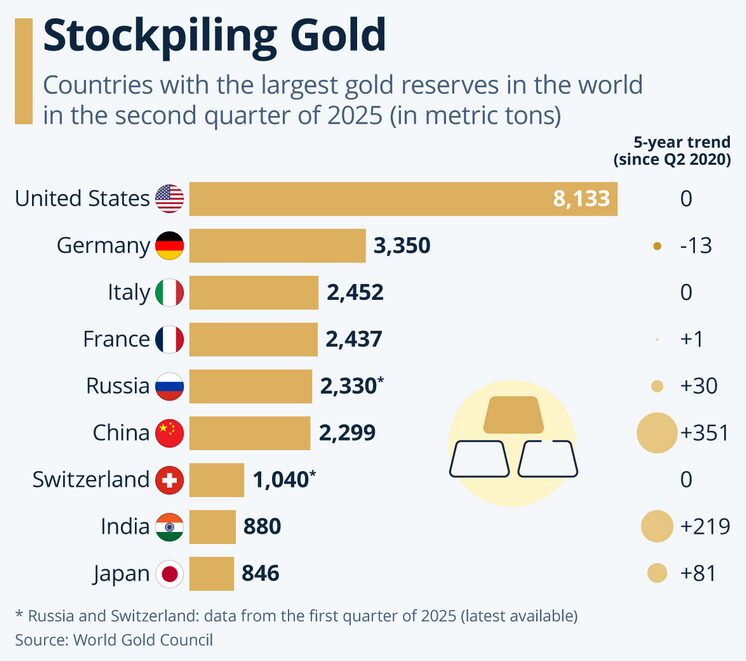
More importantly, when central banks do diversify, the destination is overwhelmingly gold.
Gold offers:
- centuries of stability
- universal acceptance
- deep liquidity
- minimal technological risk
- low correlation with equities
- predictable behavior during crises
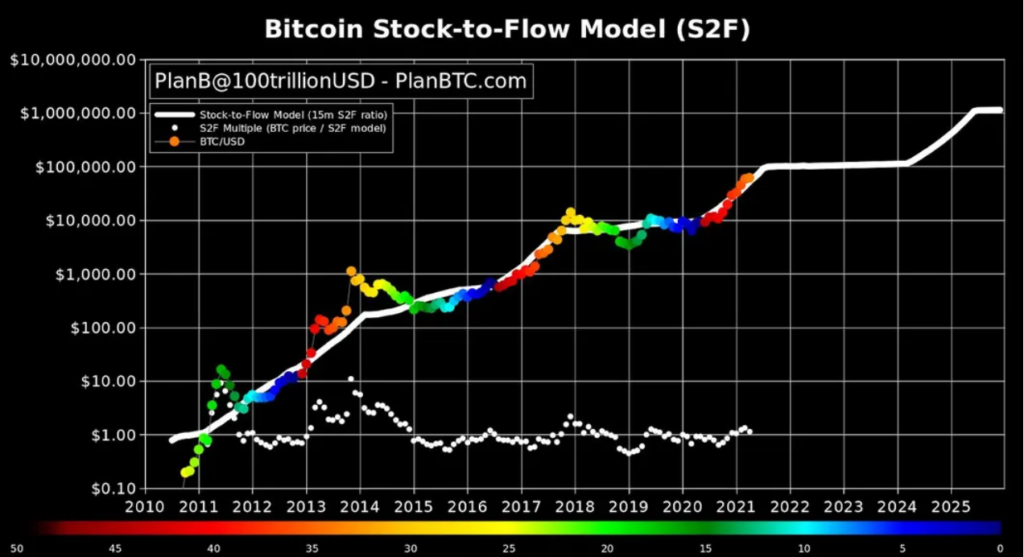
Bitcoin cannot yet match these characteristics. Even though BTC is praised as “digital gold,” it behaves more like a high-volatility risk asset than a traditional reserve.
Recent Trends Supporting Gold Over BTC
- In 2024–2025, global central banks accumulated gold at one of the fastest rates in modern history.
- Turkey, China, India, and Poland continued adding gold to their reserves, reinforcing it as the preferred defense asset.
- No major central bank—aside from El Salvador’s symbolic holdings—has adopted Bitcoin as a strategic reserve asset.
Gold’s expanding role underscores a critical truth: governments value certainty over innovation when it comes to national reserves.
3. Can Bitcoin Function as a Hedge Like Gold?
Bitcoin’s correlation structure is complex. In different market phases, BTC can behave like:
- a high-beta tech stock
- a hedge against monetary debasement
- a speculative asset driven by liquidity cycles
Its performance as an inflation hedge depends not just on inflation expectations, but on real yields (inflation-adjusted interest rates). When real yields rise, non-yielding assets such as gold and Bitcoin typically face headwinds.
However:
- If rising real yields are interpreted as inflationary stress, BTC demand may increase.
- If yields rise due to economic tightening and reduced liquidity, BTC tends to fall.
This duality makes BTC unsuitable as a predictable hedge at the national level.
4. Why Central Banks Are Still Wary of Bitcoin
The Swiss National Bank (SNB) publicly denied the possibility of holding Bitcoin as part of its strategic reserves in April 2025, citing:
- concerns about extreme volatility
- insufficient historical stability
- regulatory ambiguity
- unclear liquidity capacity during a crisis
- market manipulation risks
- technological and custody vulnerabilities
Even more fundamentally, central banks require assets that behave predictably across economic cycles. Bitcoin remains too young and too volatile to satisfy these requirements.
Institutional vs Sovereign Adoption: The Gap
While:
- ETFs add billions in BTC exposure,
- asset managers promote digital hedges, and
- private investors increasingly treat BTC as a long-term store of value,
government institutions remain cautious.
This divide suggests that Bitcoin’s path to reserve-asset legitimacy will likely unfold over decades—not years.
5. Private-Sector Enthusiasm Contrast with Public-Sector Skepticism
Consider the following:
- BlackRock and Fidelity continue absorbing BTC through spot ETFs.
- Corporate treasuries—led by MicroStrategy—treat BTC as a treasury reserve commodity.
- Retail and high-net-worth investors view BTC as a hedge against long-term currency debasement.
But these actors are risk-tolerant and independent. Central banks face political and systemic constraints that the private sector does not.
Until Bitcoin demonstrates multi-decade resilience, consistent behavior under stress, and regulatory normalization, public-sector adoption will remain limited.
6. Discussion: Under What Conditions Could Bitcoin Become a Reserve Asset?
Bitcoin could gradually transition into a sovereign reserve asset if:
- Volatility decreases through deeper global liquidity
- Regulatory clarity is standardized across major economies
- Custody infrastructure reaches central-bank-grade reliability
- Real-world settlement networks adopt BTC or Lightning-based rails
- Commodity markets begin denominating contracts in BTC
- A major G20 nation conducts partial reserve diversification into BTC
These conditions would shift Bitcoin from a speculative asset to a structural component of financial stability.
However, none of these conditions are fully met today.
Conclusion: Bitcoin’s Future Is Promising—but Not Yet as a Reserve Asset
Bitcoin has proven itself as:
- a globally recognized digital asset
- an increasingly important macro hedge for private investors
- a tool for wealth preservation in countries facing inflation and capital controls
- a technological breakthrough enabling trustless global settlement
But central banks do not operate like private investors. Their incentives differ, their risk tolerance is lower, and their priority is stability above all else.
For now, gold remains the world’s preferred reserve hedge, while Bitcoin continues rising as a complementary asset for individuals and institutions seeking long-term appreciation and protection from monetary debasement.
Bitcoin’s long-term trajectory remains strong—but its path to becoming a formal reserve asset will be gradual, contingent on structural, regulatory, and technological evolution.
Main Points :
- BRICS countries are reducing U.S. Treasury holdings, but global demand from the private sector remains strong, resulting in a rebalancing rather than a global sell-off.
- Central banks diversifying away from the U.S. dollar overwhelmingly choose gold, not Bitcoin.
- IMF data shows that more than 90% of the decline in dollar share in global reserves comes from exchange-rate fluctuations, not deliberate de-dollarization.
- Bitcoin’s role as a hedge depends heavily on real yields and market perception, making it less stable for national reserves.
- Central banks prioritize liquidity, stability, and predictability—criteria Bitcoin has not yet met.
- Despite strong private-sector enthusiasm, sovereign adoption of BTC as a reserve asset remains limited.
Bitcoin’s Reserve Asset Debate: Why Central Banks Continue to Favor Gold
(Insert Graph 1 here: /mnt/data/gold_reserves_trend.png — “Gold Reserves Trend”)
Global financial markets are undergoing a structural shift as BRICS nations accelerate their diversification strategies. The central question emerging from this transition is whether Bitcoin (BTC) can evolve into a credible reserve asset—or whether gold will remain the uncontested safe-haven asset for governments. Recent movements in U.S. Treasury holdings, central bank reserve allocations, and market perception show that the answer is far more nuanced than Bitcoin advocates suggest.
1. The BRICS Sell-Off: A Rebalancing, Not a Rejection of U.S. Treasuries
Over the past year, China has reduced its U.S. Treasury holdings by approximately $71.5 billion, with India, Brazil, and other emerging economies following similar patterns. On the surface, these moves appear to support the narrative of global de-dollarization.
However, the total foreign holdings of U.S. Treasuries have increased to roughly $9.25 trillion, mainly because private institutional investors continue purchasing U.S. debt.
This signals two important realities:
- Emerging-market central banks are diversifying, reducing their dependence on the dollar.
- Private capital still trusts U.S. Treasuries as the safest, deepest, most liquid market in the world.
The result is not a collapse of demand for U.S. debt, but a rebalancing where sovereign actors adjust their portfolios while the private sector fills the gap.
2. What Central Banks Actually Choose: Gold, Not Bitcoin
IMF data confirms that the percentage of U.S. dollars in global foreign exchange reserves has declined. But more than 90% of that decline is due to currency fluctuations, not active liquidation.
More importantly, when central banks do diversify, the destination is overwhelmingly gold.
Gold offers:
- centuries of stability
- universal acceptance
- deep liquidity
- minimal technological risk
- low correlation with equities
- predictable behavior during crises
Bitcoin cannot yet match these characteristics. Even though BTC is praised as “digital gold,” it behaves more like a high-volatility risk asset than a traditional reserve.
Recent Trends Supporting Gold Over BTC
- In 2024–2025, global central banks accumulated gold at one of the fastest rates in modern history.
- Turkey, China, India, and Poland continued adding gold to their reserves, reinforcing it as the preferred defense asset.
- No major central bank—aside from El Salvador’s symbolic holdings—has adopted Bitcoin as a strategic reserve asset.
Gold’s expanding role underscores a critical truth: governments value certainty over innovation when it comes to national reserves.
3. Can Bitcoin Function as a Hedge Like Gold?
Bitcoin’s correlation structure is complex. In different market phases, BTC can behave like:
- a high-beta tech stock
- a hedge against monetary debasement
- a speculative asset driven by liquidity cycles
Its performance as an inflation hedge depends not just on inflation expectations, but on real yields (inflation-adjusted interest rates). When real yields rise, non-yielding assets such as gold and Bitcoin typically face headwinds.
However:
- If rising real yields are interpreted as inflationary stress, BTC demand may increase.
- If yields rise due to economic tightening and reduced liquidity, BTC tends to fall.
This duality makes BTC unsuitable as a predictable hedge at the national level.
(Insert Graph 2 here: /mnt/data/btc_price_trend.png — “Bitcoin Price Trend”)
4. Why Central Banks Are Still Wary of Bitcoin
The Swiss National Bank (SNB) publicly denied the possibility of holding Bitcoin as part of its strategic reserves in April 2025, citing:
- concerns about extreme volatility
- insufficient historical stability
- regulatory ambiguity
- unclear liquidity capacity during a crisis
- market manipulation risks
- technological and custody vulnerabilities
Even more fundamentally, central banks require assets that behave predictably across economic cycles. Bitcoin remains too young and too volatile to satisfy these requirements.
Institutional vs Sovereign Adoption: The Gap
While:
- ETFs add billions in BTC exposure,
- asset managers promote digital hedges, and
- private investors increasingly treat BTC as a long-term store of value,
government institutions remain cautious.
This divide suggests that Bitcoin’s path to reserve-asset legitimacy will likely unfold over decades—not years.
5. Private-Sector Enthusiasm Contrast with Public-Sector Skepticism
Consider the following:
- BlackRock and Fidelity continue absorbing BTC through spot ETFs.
- Corporate treasuries—led by MicroStrategy—treat BTC as a treasury reserve commodity.
- Retail and high-net-worth investors view BTC as a hedge against long-term currency debasement.
But these actors are risk-tolerant and independent. Central banks face political and systemic constraints that the private sector does not.
Until Bitcoin demonstrates multi-decade resilience, consistent behavior under stress, and regulatory normalization, public-sector adoption will remain limited.
6. Discussion: Under What Conditions Could Bitcoin Become a Reserve Asset?
Bitcoin could gradually transition into a sovereign reserve asset if:
- Volatility decreases through deeper global liquidity
- Regulatory clarity is standardized across major economies
- Custody infrastructure reaches central-bank-grade reliability
- Real-world settlement networks adopt BTC or Lightning-based rails
- Commodity markets begin denominating contracts in BTC
- A major G20 nation conducts partial reserve diversification into BTC
These conditions would shift Bitcoin from a speculative asset to a structural component of financial stability.
However, none of these conditions are fully met today.
Conclusion: Bitcoin’s Future Is Promising—but Not Yet as a Reserve Asset
Bitcoin has proven itself as:
- a globally recognized digital asset
- an increasingly important macro hedge for private investors
- a tool for wealth preservation in countries facing inflation and capital controls
- a technological breakthrough enabling trustless global settlement
But central banks do not operate like private investors. Their incentives differ, their risk tolerance is lower, and their priority is stability above all else.
For now, gold remains the world’s preferred reserve hedge, while Bitcoin continues rising as a complementary asset for individuals and institutions seeking long-term appreciation and protection from monetary debasement.
Bitcoin’s long-term trajectory remains strong—but its path to becoming a formal reserve asset will be gradual, contingent on structural, regulatory, and technological evolution.