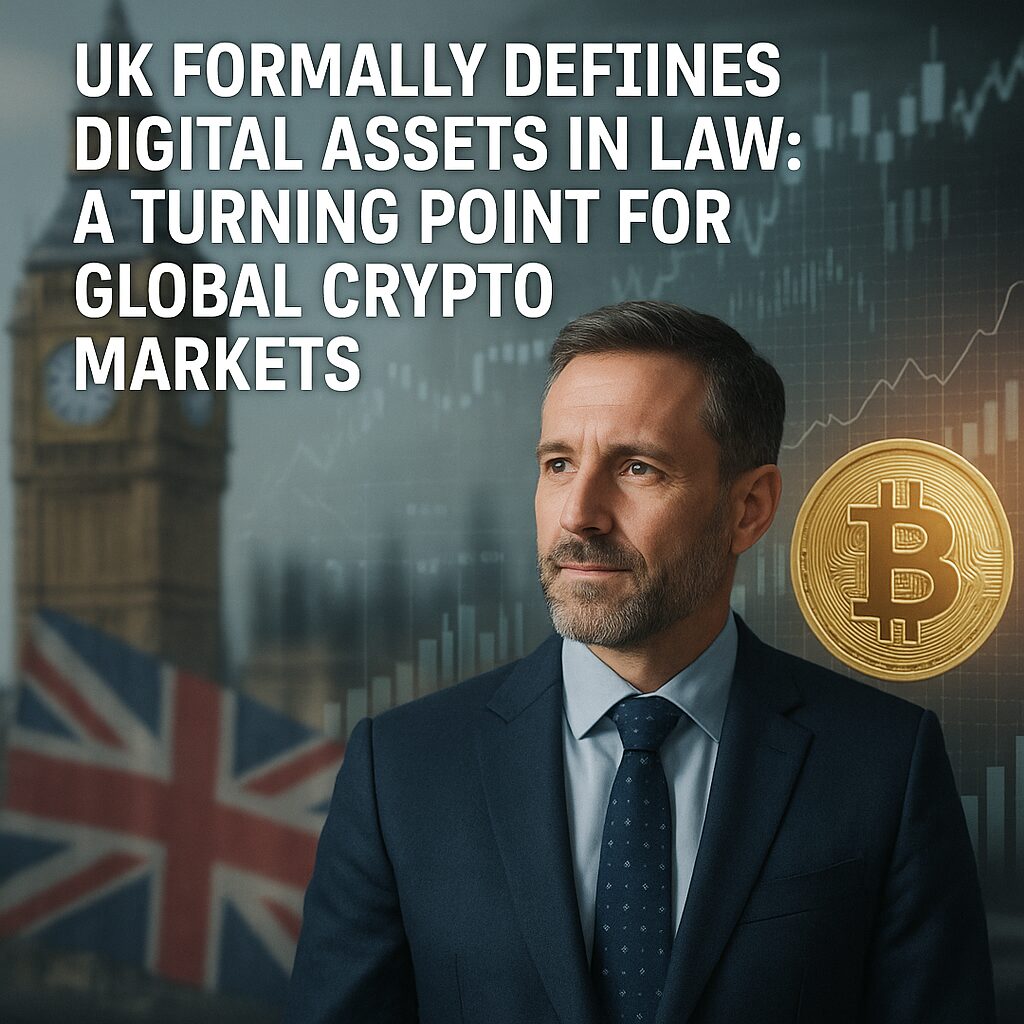
Main Points :
- The United Kingdom has enacted a law that formally defines digital assets as a new, standalone category of property—neither “physical objects” nor “legal rights.”
- This resolves long-standing legal ambiguity surrounding asset recovery, bankruptcy, and ownership disputes involving cryptocurrencies.
- The reform strengthens legal infrastructure for institutional finance, enabling enforceable collateralization and clearer investor protections.
- The UK’s move aligns partially with global frameworks such as EU MiCA but represents a uniquely common-law-based approach.
- Analysts expect this development to accelerate institutional adoption, unlock new financial products, and support cross-border blockchain innovation.
- For crypto investors seeking new opportunities, UK legal clarity may catalyze new asset issuance, stablecoin frameworks, and regulated DeFi integrations.
- Recent global trends—including Russia’s retail access reforms and increasing ETF-based inflows—show a synchronized global shift toward mainstreaming digital assets.
1. Introduction — Why the UK’s New Legal Definition Matters Now
The digital asset market is entering a new regulatory era. On December 8, 2025, the United Kingdom officially granted royal assent to a landmark bill defining digital assets as an independent property category under UK law. Unlike traditional common-law property divisions—“things in possession” (physical items) and “things in action” (legal rights)—cryptocurrencies and blockchain-based tokens now occupy a new, third category.
This is not a symbolic gesture. For years, courts in the UK and US have struggled to fit cryptocurrencies into outdated frameworks. Hack recovery, exchange bankruptcy, loan collateral, and even simple ownership disputes required legal improvisation rather than established rules.
The new law closes that gap. The UK—one of the world’s leading financial jurisdictions—has now created a formal legal home for Bitcoin, Ethereum, stablecoins, and tokenized assets. This clarity represents a foundational shift, with real implications for investors, institutions, and regulators worldwide.
2. Global Market Context: Why This Law Arrives at a Critical Moment
The timing is no coincidence. Global crypto adoption is accelerating:
- Bitcoin ETF inflows in 2025 have surpassed $40 billion.
- Tokenization pilots by major banks (e.g., JPMorgan, HSBC) are maturing.
- Russia has announced the removal of its “Ultra-Qualified Investor” barrier, opening regulated retail access to Bitcoin.
- Asia-Pacific economies, including Singapore and Hong Kong, are racing to standardize digital asset custody and stablecoin issuance.
The UK’s announcement therefore lands in a market hungry for regulatory certainty.
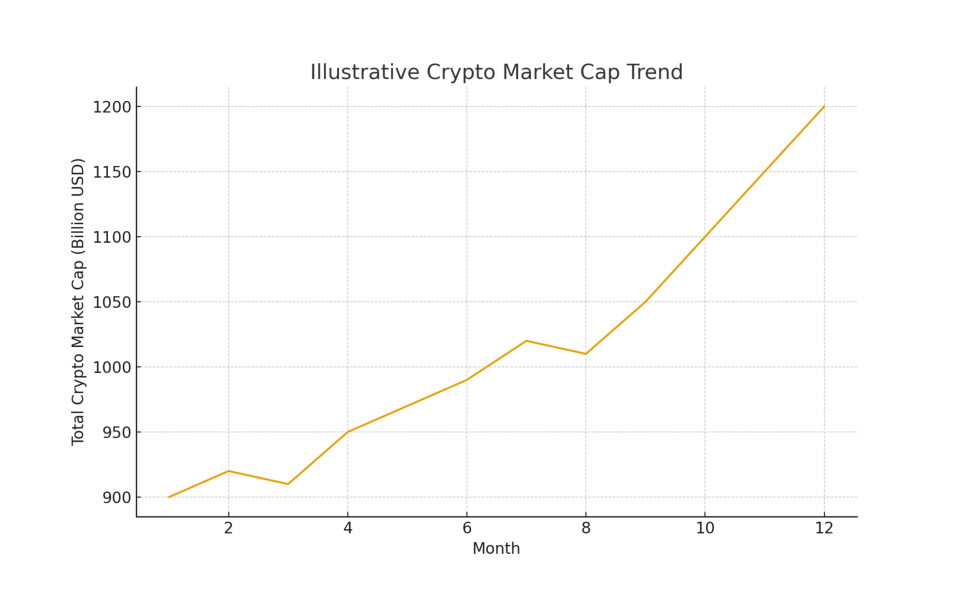
A visual representation of the global crypto market cap trend (illustrative).
3. What the UK Law Actually Changes
3.1 Digital Assets Become a Fully Recognized Property Class
Until now, property law required courts to treat crypto as:
- quasi-physical property (when frozen or controlled),
or - quasi-intangible rights (when treated within claims or bankruptcy).
Both were imperfect. The new framework recognizes crypto assets explicitly, eliminating ambiguity.
3.2 Faster, More Certain Legal Action for Hacks and Exchange Failures
Because digital assets are now clearly defined property, courts can:
- Freeze stolen crypto more rapidly
- Order recovery with clearer authority
- Protect customer assets during insolvency
This raises confidence in centralized exchanges and custodians operating under UK jurisdiction.
3.3 Institutional Finance Receives a Stronger Foundation
The new rules support:
- Legally enforceable collateralization of crypto
- Tokenized loan structures
- Digital asset-based repo markets
- More sophisticated institutional trading products
These mechanisms previously lacked explicit legal footing.
3.4 The Law Does Not Change Taxation—Yet
Important:
This legislation focuses on property classification, not tax or AML rules.
However, by defining digital assets clearly, HM Treasury now has a stronger basis for future reforms in taxation, exchange licensing, and stablecoin oversight.
4. How This Affects Investors Seeking New Assets and Revenue Opportunities
4.1 Increased Institutional Liquidity
Legal certainty is among the top triggers for institutional inflows.
When the UK strengthened its derivatives framework in the 2000s, capital surged into GBP-denominated products. A similar pattern may emerge for crypto.
A clearer UK regime could accelerate:
- Corporate treasuries adopting stablecoins
- Asset managers issuing tokenized funds
- Pension funds exploring regulated Bitcoin exposure
4.2 Expansion of Crypto-Backed Lending Markets
Banks and fintech lenders could now treat digital assets more like traditional collateral.
This opens revenue opportunities such as:
- Overcollateralized crypto credit lines
- Institutional staking products
- Asset-backed commercial lending for miners and infrastructure operators
4.3 Rise of UK-Based Tokenization and Asset Issuance
For founders and investors searching for the next growth sector, tokenization under UK law could become:
- Cheaper
- Safer
- More globally recognized in cross-border contracts
Given London’s role in derivatives, FX, and commodities, tokenizing real-world assets (RWAs) under English law may become a global standard.
5. Comparison with Global Regulatory Models
5.1 EU MiCA: Comprehensive but Civil-Law Based
MiCA regulates:
- Issuers
- Exchanges
- Stablecoin operators
But does not deeply reform property law itself.
The UK has done the opposite—starting with a foundational legal concept that affects all applications.
5.2 U.S. Enforcement-Driven Approach
The U.S. remains uncertain because:
- No unified federal crypto law exists
- The SEC relies on enforcement rather than statutory clarity
- Court rulings differ by jurisdiction
UK reforms therefore offer a more predictable environment for businesses.
5.3 Asia’s Strategic Legibility
- Singapore: Emphasizes custody and risk management
- Hong Kong: Focuses on exchange licensing
- Japan: Strongest consumer protection and segregation rules
The UK adds something unique—a property-law-first model.
6. Economic Impact: Market Confidence and Long-Term Adoption
6.1 Improved Cross-Border Settlement
The UK is a major node in global FX. With digital asset property clarity:
- On-chain settlement for cross-border transfers
- Tokenized treasury products
- Enterprise-level stablecoin integrations
become more feasible for large financial institutions.
6.2 Increased Innovation in DeFi and Web3
Developers gain:
- Stronger intellectual property protection
- More predictable legal rights in smart contract disputes
- More defensible risk disclosures when fundraising
This supports both early-stage startups and institutional-grade DeFi platforms.
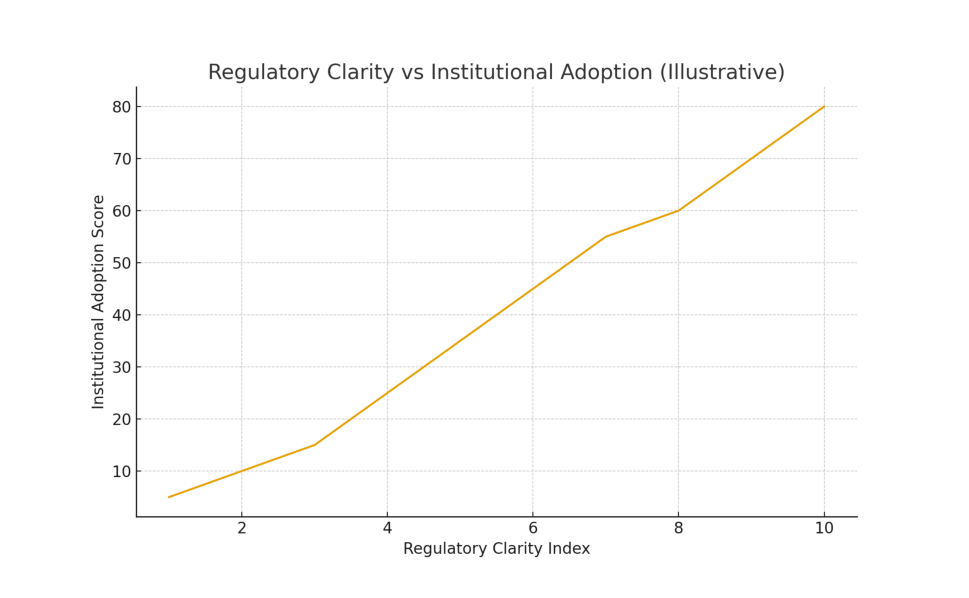
Illustrates the relationship between regulatory clarity and institutional adoption (illustrative).
7. Recent Trends Supporting the UK’s Direction
7.1 Bitcoin and Ethereum Volatility Declining
As institutional products increase, price swings have moderated compared to early cycles.
This strengthens the case for classification as a stable asset class.
7.2 Expansion of Stablecoin Regulation Worldwide
The UK’s property framework will support its upcoming stablecoin licensing regime.
Globally:
- The U.S. is considering a stablecoin bill
- Japan has implemented a fully collateralized model
- Singapore requires strict custody segregation
7.3 Retail Adoption Trends
In Russia, retail investors will soon be able to purchase Bitcoin under regulated frameworks—suggesting global political willingness to normalize crypto markets.
8. Conclusion — A Defining Moment for Digital Asset Legitimacy
The UK’s legal definition of digital assets represents more than regulatory housekeeping. It is a structural reform that elevates cryptocurrencies from a misunderstood technological novelty to a recognized asset class with enforceable rights.
For investors searching for new opportunities, this shift may accelerate:
- Institutional capital inflows
- Global tokenization markets
- Novel lending and yield-generating products
- Increased demand for legally robust digital asset platforms
As the world converges on clearer frameworks—from MiCA in Europe to retail reforms in Russia—the industry is entering a phase where regulation becomes a catalyst rather than a constraint.
The UK has chosen to lead with legal sophistication.
And the global crypto ecosystem will very likely follow.