Main Points :
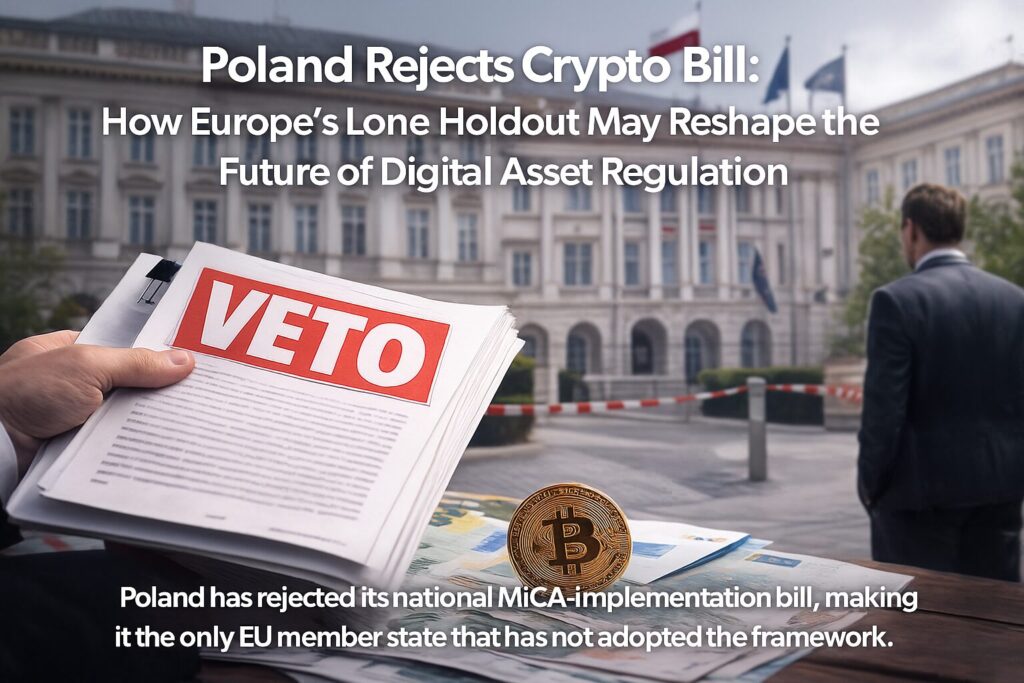
- Poland has rejected its national MiCA-implementation bill, making it the only EU member state that has not adopted the framework.
- The rejected law exceeded 100 pages, contained unusually strict provisions, and included authority for website blocking with minimal oversight.
- Crypto industry leaders welcome the veto, citing overreach and the risk of stifling innovation.
- Government leaders criticize the veto, warning that consumer fraud—already affecting 20% of Polish investors—may worsen.
- If no law is passed before July 1, 2026, crypto firms may migrate abroad, risking loss of tax revenue and weakening Poland’s competitiveness.
- Recent EU-wide developments show accelerating institutional adoption and tightening compliance expectations, amplifying the consequences of Poland’s delay.
Introduction: A Nation at a Regulatory Crossroads
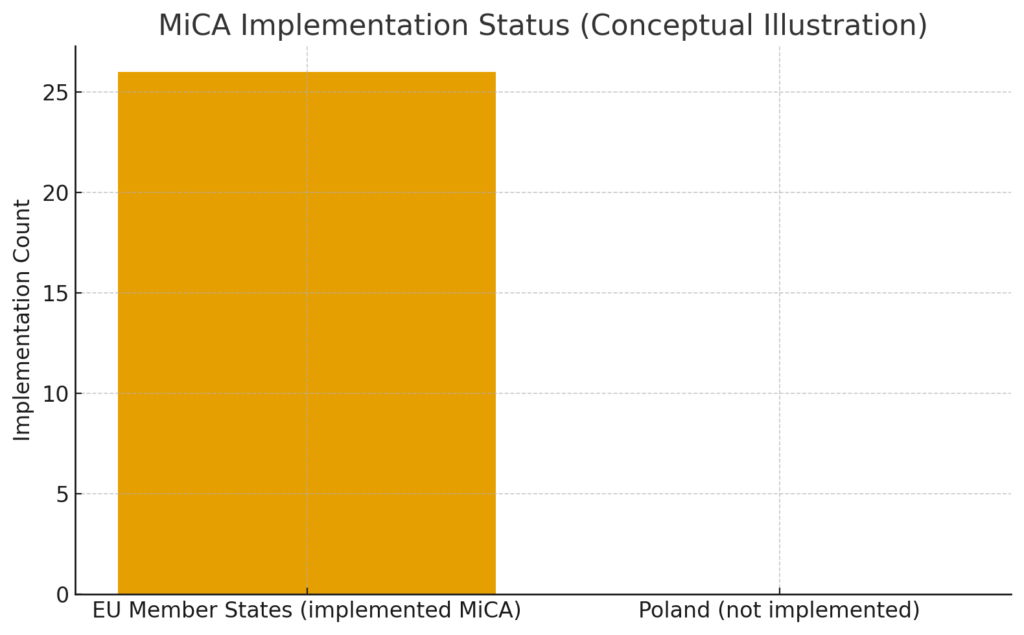
In a move that has sent shockwaves through both political and financial circles, Poland has vetoed its long-awaited cryptocurrency regulatory bill—legislation intended to implement the EU’s Markets in Crypto-Assets (MiCA) framework. As a result, Poland now stands alone as the only EU member state that has not implemented MiCA, despite the bloc’s looming activation date of July 1, 2026.
While the decision has been celebrated by portions of the crypto community, the government and financial regulators see it as a dangerous retreat from investor protections. Over 1 million Polish citizens already invest in digital assets, making the vacuum especially consequential.
To illustrate Poland’s new position within Europe, we insert the following conceptual chart:
1. Why Poland Rejected the Bill: Overreach, Surveillance, and the Threat to Innovation
President Karol Nawrocki invoked his veto power on the grounds that the bill threatened civil liberties, property rights, and competitive fairness. Unlike neighboring states that adopted MiCA through relatively lean legislation, Poland’s proposal exceeded 100 pages and introduced multiple strict domestic requirements.
1.1 Website Blocking With Minimal Oversight
The most controversial provision allowed authorities to block cryptocurrency-related websites with minimal procedural checks.
According to the presidential office, such a mechanism could be used arbitrarily, potentially restricting access to legitimate platforms.
This aligns with broader privacy and governance concerns emerging globally, as governments try to balance fraud reduction with freedom of digital commerce.
1.2 Excessive Fees on Startups
Polish crypto startups expressed fears that the bill’s oversight fees were too burdensome, making them less competitive than foreign entities.
Instead of leveling the playing field, critics argued the bill favored international companies that could more easily absorb compliance costs.
1.3 Severe Penalties That Could Criminalize Developers
Przemysław Kral, CEO of ZondaCrypto, warned that fines as high as 10 million PLN (≈$2.5 million) and potential prison sentences could discourage not only exchanges but also basic blockchain development activity.
For a sector where innovation often originates from small teams and early-stage projects, harsh punitive structures could freeze growth entirely.
2. Government Backlash: “The President Has Chosen Chaos”
Finance Minister Andrzej Domański lashed out publicly, claiming that the veto deepens national vulnerability.
He cited that 20% of Polish digital-asset investors have already suffered fraud losses, arguing that without MiCA alignment, domestic risks will escalate.
2.1 Political Pressure Builds
Deputy Prime Minister Radosław Sikorski added that the veto delays essential consumer protections and undermines Poland’s integration with broader European financial governance.
2.2 A Difficult Path to Override the Veto
To overturn the decision, parliament would need a three-fifths supermajority, a threshold analysts consider unlikely.
Thus, Poland’s non-implementation stance may continue well into 2026.
3. Implications for Investors: Opportunity or Instability?
3.1 Short-Term Upside for Crypto Enthusiasts
Many investors and entrepreneurs welcome the veto, believing it preserves an open environment for:
- new token projects
- decentralized finance (DeFi) innovation
- self-custody wallet development
- cross-border exchange operations
The absence of strict national rules, combined with MiCA being enforced externally, may create regulatory arbitrage opportunities.
3.2 Long-Term Risks If Poland Fails to Implement MiCA
However, MiCA is not optional at the EU level.
Once the framework takes full effect on July 1, 2026:
- crypto firms operating in Poland must register in another EU country,
- Poland could lose millions in tax revenue,
- domestic companies may migrate,
- foreign investors may avoid the Polish market entirely.
This creates a paradox:
The more Poland resists regulation, the more it risks damaging its crypto economy.
4. Broader EU and Global Trends: Compliance Is Tightening Everywhere
To place Poland’s situation in context, it is crucial to examine recent developments across Europe and globally.
4.1 EU States Are Racing to Finalize MiCA Compliance
Countries such as Germany, France, Estonia, and the Netherlands have accelerated licensing pathways. Many exchanges—including Coinbase, Binance, Bitstamp, and local European players—have already aligned with:
- stringent AML requirements
- reserve transparency rules
- stablecoin issuance restrictions
The result is a unified EU crypto market where firms can operate across 27 countries with a single license.
Poland, by not aligning, risks exclusion from this integrated digital economy.
4.2 Institutional Adoption Signals Growing Maturity
Across Europe and the US, digital asset adoption continues to expand:
- Exchange-Traded Products (ETPs) in BTC and ETH now exceed $80 billion globally.
- Major banks such as HSBC, Société Générale, and Deutsche Bank are developing tokenization platforms.
- Stablecoin issuance has grown again in 2024–2025, reversing the contraction seen in 2022.
Investors reading this article—especially those seeking new opportunities—should recognize that policy fragmentation can create undervalued markets and early-stage investment points, but also introduces risk.
4.3 Regulatory Pressure Is Increasing Worldwide
From the US SEC’s enforcement actions to Asia’s licensing surge (Hong Kong, Singapore, Japan), regulators now demand:
- full transparency
- travel-rule compliance
- real-world asset backing
- consumer risk disclosures
Poland’s veto positions it as a regional outlier at a time when the world is moving in the opposite direction.
5. What Opportunities Does This Create for Entrepreneurs and Investors?
Despite the political turbulence, several emerging opportunities are worth noting:
5.1 Cheaper Entry for Startups
Without the heavy oversight fees proposed in the bill, Poland may temporarily offer a more cost-effective base for blockchain development.
5.2 Increased Demand for Self-Custodial Wallets
As regulation delays create uncertainty for centralized exchanges, more users may shift to:
- hardware wallets
- non-custodial mobile apps
- on-chain asset management tools
This aligns with the broader global migration toward self-sovereign custody.
5.3 Cross-Border Platforms May Gain Market Share
Because Polish users cannot rely on national licensing clarity, they may gravitate toward:
- EU-licensed exchanges in Lithuania, France, or Germany
- global OTC desks
- decentralized and smart-contract-based protocols
This opens doors for compliant firms elsewhere in Europe to attract Poland’s 1+ million investors.
6. The Road to 2026: What Happens Next?
Poland has two options:
6.1 Draft a New, Simpler, MiCA-Compatible Bill
This path would address:
- excessive penalties
- arbitrary censorship powers
- disproportionate fees
and rebuild trust with both the industry and investors.
6.2 Maintain the Veto and Risk Forced Externalization
If no domestic law is passed before the EU enforcement date:
- Polish crypto firms will be forced to register in another EU country
- innovation may relocate
- tax revenues will shift abroad
- investors will face an even larger regulatory vacuum
Most analysts expect a revised bill to surface in 2025.
Conclusion: Poland’s Regulatory Gamble Could Define the Next Phase of Europe’s Crypto Market
Poland’s rejection of its MiCA implementation bill has ignited a profound debate that extends far beyond national borders. It highlights the tension between innovation and compliance, between freedom and oversight, and between open markets and investor protection.
For crypto investors and entrepreneurs seeking new opportunities, Poland represents both:
- a potentially fertile ground for early-stage blockchain development, and
- a regulatory uncertainty zone that may shift dramatically by 2026.
In a rapidly maturing global market, the country’s next move will determine whether it becomes a haven for innovation—or a cautionary tale of missed economic potential.