Main Points :
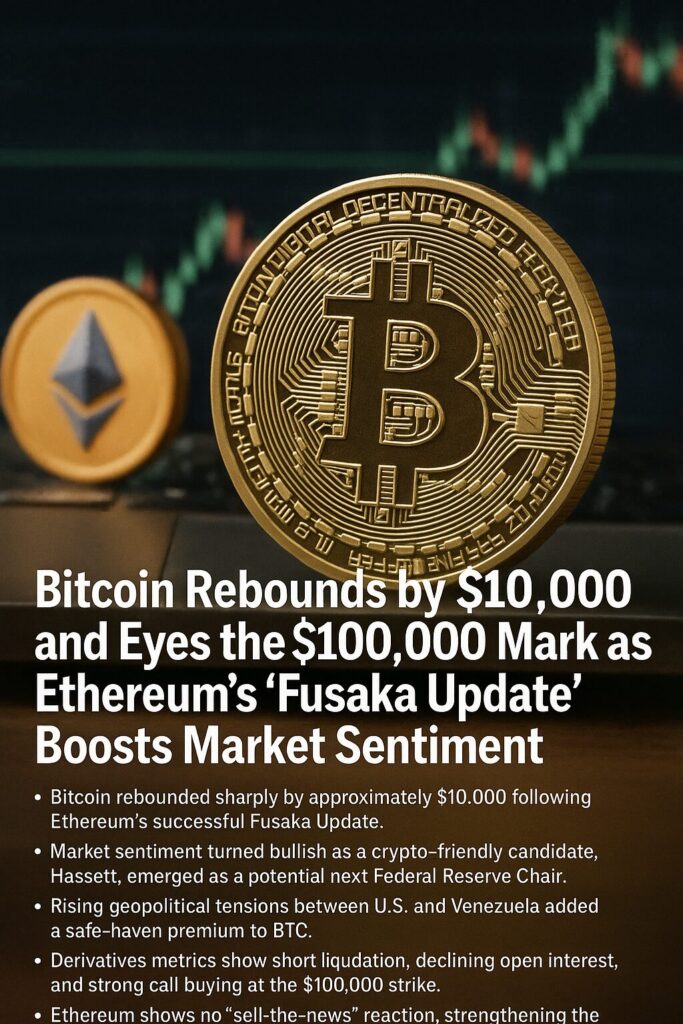
- Bitcoin rebounded sharply by approximately $10,000 following Ethereum’s successful Fusaka Update.
- Market sentiment turned bullish as a crypto-friendly candidate, Hassett, emerged as a potential next Federal Reserve Chair.
- Rising geopolitical tensions between the U.S. and Venezuela added a safe-haven premium to BTC.
- Derivatives metrics show short liquidation, declining open interest, and strong call buying at the $100,000 strike.
- Ethereum shows no “sell-the-news” reaction, strengthening the bullish cycle.
- Bitcoin may attempt $100,000 by mid-December if macro shocks do not occur, but year-end liquidity risks remain high.
Introduction: A Critical Moment for the Digital Asset Market
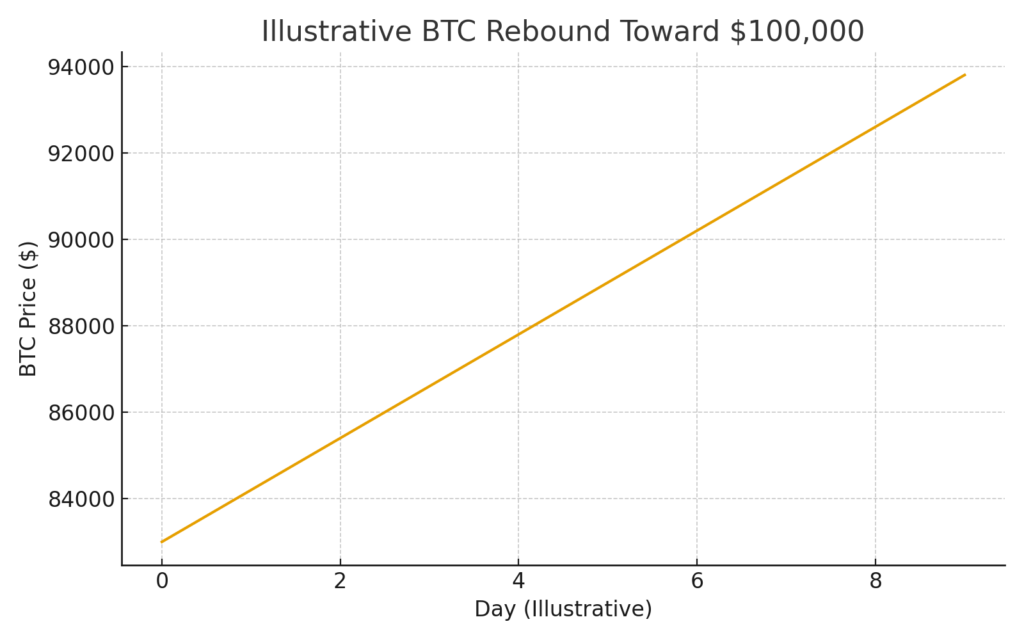
The cryptocurrency market is once again entering a decisive phase. As of December 4, Bitcoin (BTC) has staged a strong rebound of roughly $10,000, climbing from the low $83,000 level to above $93,000. This recovery coincides with the successful execution of Ethereum’s long-awaited Fusaka Update, which reduced Layer-2 transaction costs and improved scalability.
At the same time, macro narratives continue to support bullish positioning. Reports surfaced that Kevin Hassett, known for his positive stance on digital assets, may become the next Chair of the U.S. Federal Reserve. Combined with geopolitical tensions between the United States and Venezuela, the market is pricing in a diversification demand for non-sovereign assets such as Bitcoin.
This article provides a comprehensive 2,000-word analysis of the current market structure, referencing the original Japanese article and integrating the latest global data and trends. It is designed for readers who are actively searching for new crypto assets, income opportunities, and practical blockchain applications.
Bitcoin Derivatives Market: Open Interest Declines Despite Rising Prices
One of the most important indicators in the current environment is the behavior of active open interest (OI) in the Bitcoin derivatives market. Surprisingly, OI has declined even as BTC prices rose.
Under normal conditions, rising prices accompanied by falling OI signal:
- Short liquidation — traders betting on downside are wiped out.
- Capital rotation into Ethereum, triggered by the Fusaka upgrade.
- Cooling of speculative leverage, which strengthens long-term trend health.
Additionally, long positions have increased moderately, indicating that market participants are attempting to buy dips while maintaining upward bias.
Together, these data points suggest that Bitcoin is likely forming a bullish continuation, supported by short-covering momentum rather than excessive leverage.
Ethereum: No “Sell-the-News” Reaction and Strong Fundamentals
A typical concern during major upgrades is a “sell-the-news” event. However, Ethereum has shown no significant post-upgrade selling pressure.
This lack of selling is important because:
- It indicates confidence in the update’s utility.
- Investors are shifting capital into ETH without abandoning BTC.
- The Layer-2 cost reductions open new doors for real-world blockchain applications.
These dynamics reinforce the broader narrative that both BTC and ETH may rise simultaneously—a structure usually observed before major bull-market expansions.

Options Market Positions Point Toward the $100,000 Milestone
The options market often provides clearer insight into traders’ expectations than spot or futures.
Key observations:
- The put-call ratio has fallen, signifying growing bullish sentiment.
- Strong put positioning at $80,000–$85,000 forms a clear downside support zone.
- The largest concentration of call options has accumulated at $100,000, making it the market’s most important psychological and technical target.
In simple terms:
Market participants believe $100,000 is the next magnetic level.
With the Federal Reserve expected to shift from tightening to easing, liquidity conditions may further enhance bullish price action.
Macro Drivers: Fed Leadership, QT Ending, and Geopolitical Stress
1. Potential Pro-Crypto Fed Chairman
Reports indicate that Kevin Hassett, known for advocating innovation-friendly policies, might be appointed as the next Federal Reserve Chair.
Such leadership could:
- reduce regulatory uncertainty
- support capital market growth
- indirectly strengthen digital asset adoption
2. End of Quantitative Tightening (QT)
On December 1, the U.S. officially ended its 3.5-year quantitative tightening program.
This development improves liquidity conditions for:
- risk assets
- crypto markets
- Web3 investment flows
If the December FOMC leads to a dovish stance or even rate cuts, Bitcoin could rally into mid-December.
3. U.S.–Venezuela Tensions
Safe-haven behavior remains a strong driver of BTC demand.
Geopolitical stress often leads to inflow into:
- gold
- defensive equities
- Bitcoin (in modern markets)
The current environment supports this thesis.
Short-Term Outlook: Momentum Toward $100,000 by Mid-December
Given current market data, Bitcoin appears primed to attempt the $100,000 level by mid-December, assuming:
- no exchange hacks
- no sudden macro shocks
- liquidity remains stable
The present rebound largely recovered the sharp decline from December 1, driven by:
- short-covering
- rotation into ETH
- improving macro backdrop
This suggests the market is entering a controlled bullish trend rather than a speculative blow-off phase.
Year-End Risks: Liquidity Drop and Index Adjustments
From late December onward, several risks could reduce upward momentum:
- Christmas and New Year holidays → U.S. markets face severely reduced liquidity.
- Strategy index inclusion/exclusion decisions → scheduled for January 15, may create uncertainty.
- Lower trading volumes → historically lead to choppy price action.
As a result, while mid-December may see strong upward price movement, late December could bring stagnation or mild pullbacks.
Long-Term Perspective: Structural Factors Remain Bullish
Beyond short-term fluctuations, multiple structural drivers support Bitcoin:
- institutional adoption continues
- ETFs have stabilized inflows
- ETH upgrades accelerate Layer-2 adoption
- geopolitical diversification favors non-sovereign assets
- Fed policy is shifting to a more accommodative stance
For investors seeking new digital assets or income opportunities, this environment presents multiple strategic angles:
- exposure to BTC for macro-driven appreciation
- exposure to ETH for ecosystem-based growth
- participation in L2 networks benefiting from Fusaka efficiency
- staking and liquidity-providing yields
- exploration of emerging mid-cap assets tied to real-world use cases
Conclusion
The digital asset market is once again at the center of global financial attention. Bitcoin’s $10,000 rebound, Ethereum’s successful Fusaka upgrade, and a supportive macro environment together frame a strong bullish scenario for the coming weeks.
However, investors should remain aware of year-end liquidity risks and potential volatility as markets slow down during holiday periods.
Overall, if macro risks remain contained, Bitcoin is well-positioned to test the $100,000 level by mid-December, with Ethereum reinforcing the broader momentum through strong technical progress.