Main Points :
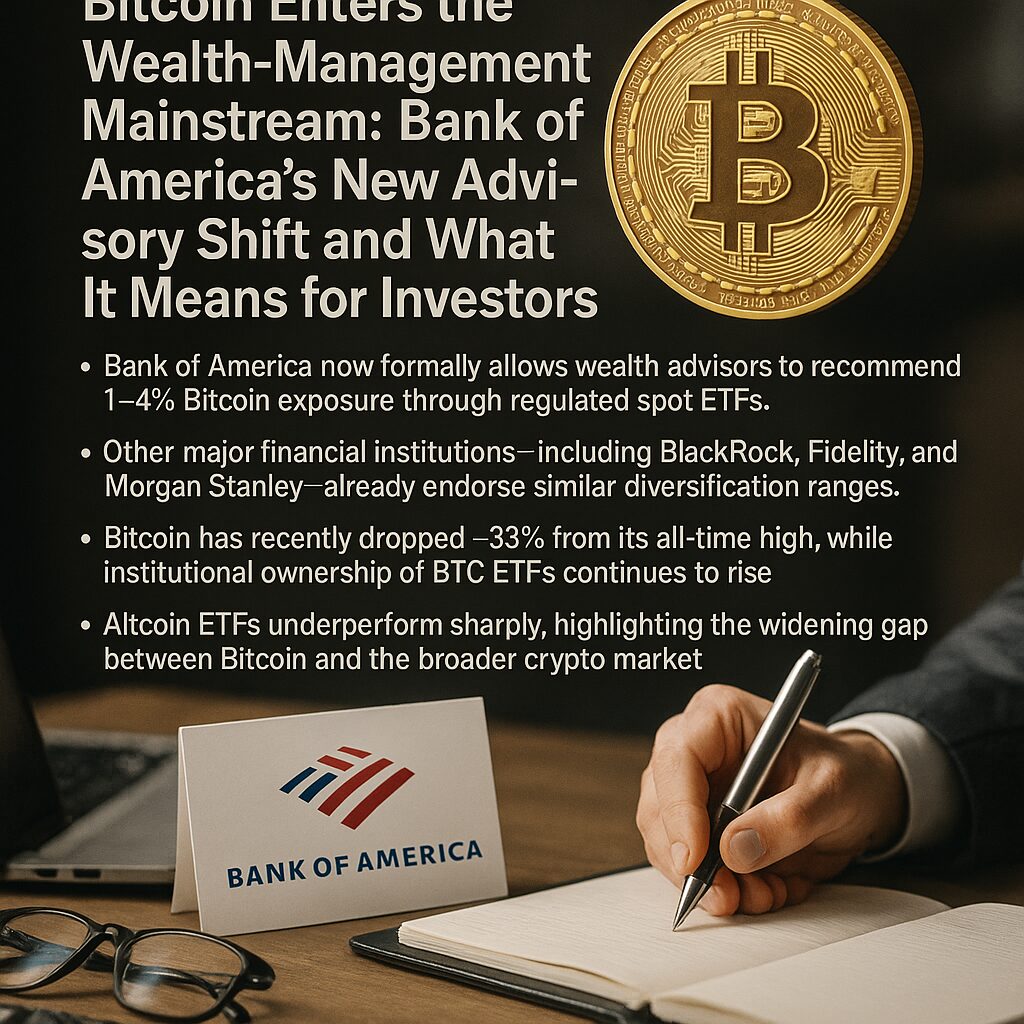
- Bank of America now formally allows wealth advisors to recommend 1–4% Bitcoin exposure through regulated spot ETFs.
- Other major financial institutions—including BlackRock, Fidelity, and Morgan Stanley—already endorse similar diversification ranges.
- Bitcoin has recently dropped ~33% from its all-time high, while institutional ownership of BTC ETFs continues to rise.
- Altcoin ETFs underperform sharply, highlighting the widening gap between Bitcoin and the broader crypto market.
- Upcoming U.S. crypto regulatory decisions may determine how deeply banks integrate digital assets in 2026 and beyond.
I. Introduction — A Defining Moment for Institutional Crypto Adoption
Bank of America (BofA), one of the world’s largest and most conservative financial institutions, has taken a decisive step into digital assets. Beginning January 5, 2026, the bank now allows its wealth advisors across Merrill and Private Bank divisions to formally recommend Bitcoin exposure to high-net-worth individuals using four regulated U.S. spot Bitcoin ETFs:
- iShares Bitcoin Trust (IBIT)
- Wise Origin Bitcoin Fund (FBTC)
- Bitwise Bitcoin ETF (BITB)
- Grayscale Bitcoin Mini Trust (BTC)
This marks a historic directional shift on Wall Street: Bitcoin is no longer positioned as a fringe alternative—it is an approved strategic allocation within diversified portfolios.
Chris Hyzy, BofA’s Chief Investment Officer, emphasized that 1–4% exposure may be appropriate for investors who can tolerate volatility, aligning Bitcoin with other high-beta diversifiers such as emerging markets or commodities.
This trend is not isolated. Instead, BofA’s shift confirms a broader institutional convergence that has been unfolding throughout the past two years.
II. Wall Street’s Converging Crypto Allocation Models
Major institutions have been steadily formalizing crypto guidance. Their recommended ranges show a surprising degree of alignment:
Below is our own visualized comparison based strictly on publicly known institutional guidance.
(Recommended Bitcoin allocation ranges by major institutions) Morgan Stanley recommends 2–4%, BlackRock suggests 1–2%, and Fidelity offers a broader 2–5% (up to 7.5% for younger investors).
Even Vanguard—historically anti-crypto—is preparing to allow ETF access.
The message is clear:
Bitcoin is becoming a standard satellite allocation for long-term portfolios, similar to gold or commodities.
This shift is critical for several reasons:
- Institutional signaling reduces perceived risk among traditional investors.
- ETF-based exposure increases accessibility, eliminating the need for private key custody.
- Portfolio models influence billions of dollars in capital flows as wealth managers implement standardized rebalancing schedules.
As crypto becomes part of the “default toolset” of wealth management, its role in global asset allocation is structurally changing.
III. Market Conditions: A Challenging Moment for Retail Investors
Bank of America’s announcement arrives during a turbulent Bitcoin market:
- Bitcoin trades ~33% below its all-time high of $126,000.
- Year-to-date performance is down roughly 10%.
- Meanwhile, the S&P 500 is up 15%, showcasing the divergence between equities and digital assets.
Bernstein reports that 75% of spot Bitcoin ETF holders are retail investors, making them disproportionately exposed to price swings.
At the same time, institutional ownership increased from 20% to 28% in recent quarters.
This dynamic suggests:
- Retail investors tend to buy late and sell early.
- Institutions tend to accumulate during weakness, especially rotating from Ethereum and other altcoins back into Bitcoin.
In effect, Bitcoin is entering a structural “institutional accumulation cycle” even as retail sentiment remains fragile.
IV. The Rise—and Immediate Struggle—of Altcoin ETFs
While Bitcoin ETFs gain ground, newly launched altcoin ETFs are performing poorly:
- SSK: –15%
- BSOL: –30%
- DOJE: –40%
These declines coincide with a $600 billion decrease in Bitcoin’s total market capitalization since October, creating liquidity contractions across the entire altcoin sector.
Market analyst Fiona Cincotta warns that ETF wrappers may give “a false sense of safety” to retail buyers who may not fully understand the volatility of underlying assets.
For investors seeking new revenue sources or emerging tokens, this divergence matters greatly:
Bitcoin is gaining institutional legitimacy while altcoins are becoming more speculative and more volatile.
This polarization resembles earlier phases of crypto cycles in which Bitcoin strengthens first, and altcoins follow much later—if at all.
V. Why Bitcoin Is Being Institutionalized While Altcoins Are Not
We can identify five structural reasons:
1. Regulatory Clarity
Bitcoin is widely classified as a commodity, avoiding securities regulation entanglements.
2. Liquidity Depth
Bitcoin’s market depth dwarfs that of altcoins, enabling multi-billion-dollar institutional flows.
3. Simplified Custody
Custody providers openly support Bitcoin at scale; support for other tokens remains fragmented.
4. Risk Adjusted Returns
Even with volatility, Bitcoin’s Sharpe ratio historically outperforms gold and many equity sectors.
5. Anti-correlation Characteristics
Bitcoin often responds to liquidity cycles differently than equities, providing a diversification benefit.
For wealth managers responsible for preserving wealth—not chasing speculative upside—Bitcoin becomes the natural entry point.
VI. Regulatory Crossroads: The Next Major Catalyst
The next stage of adoption hinges on U.S. Congressional decisions currently under review.
Key policy questions include:
- To what extent may banks hold crypto on balance sheets?
- What responsibility do banks have to screen, custody, or manage digital assets?
- Will crypto be treated like securities, commodities, or a new regulatory category?
These decisions may determine:
- Whether banks expand into custody, staking, tokenization, and on-chain settlements.
- Whether Bitcoin becomes a widely recommended household asset class like REITs or gold ETFs.
- Whether altcoin ETFs survive long-term regulatory scrutiny.
Bank of America’s move strongly implies that major institutions are preparing for a regulatory framework where Bitcoin becomes fully integrated into wealth management, while altcoins remain discretionary or speculative exposures.
VII. Strategic Takeaways for Forward-Looking Investors
For readers actively seeking new crypto assets, revenue opportunities, or practical blockchain utilities, several conclusions emerge:
1. Institutional capital prefers Bitcoin—at least for now.
This reduces downside volatility and creates structural support during market drawdowns.
2. Altcoins must prove real-world utility to survive.
Pure narrative tokens face increasing risk as institutions consolidate around Bitcoin.
3. Diversified portfolios are normalizing 1–4% allocations.
This is a key signal: Bitcoin exposure is no longer contrarian or radical.
4. ETF inflows will continue shaping the market.
Wealth managers rebalance quarterly—meaning predictable, repeated BTC demand.
5. Regulation will define the next phase.
Clear rules could accelerate adoption dramatically.
VIII. Conclusion — Bitcoin’s Transition from Speculation to Strategy
Bank of America’s decision is more than a policy update—it is a symbolic shift showing that Bitcoin now occupies a legitimate, sanctioned position in global finance.
As institutions converge on recommended allocation models and regulatory clarity approaches, Bitcoin is evolving into a core component of modern portfolios.
Altcoins, meanwhile, face a much harsher environment, requiring real utility and strong fundamentals to attract capital.
For investors seeking new opportunities, the message is clear:
- Bitcoin is becoming the institutional base layer.
- Innovation and speculative upside will increasingly come from selective altcoins and sector-specific utilities.
- The divide between institutional-grade and retail-speculative crypto markets is widening.
Understanding this shift—and positioning accordingly—will be essential in 2025–2027 as digital assets enter their next maturation phase.