
Main Points :
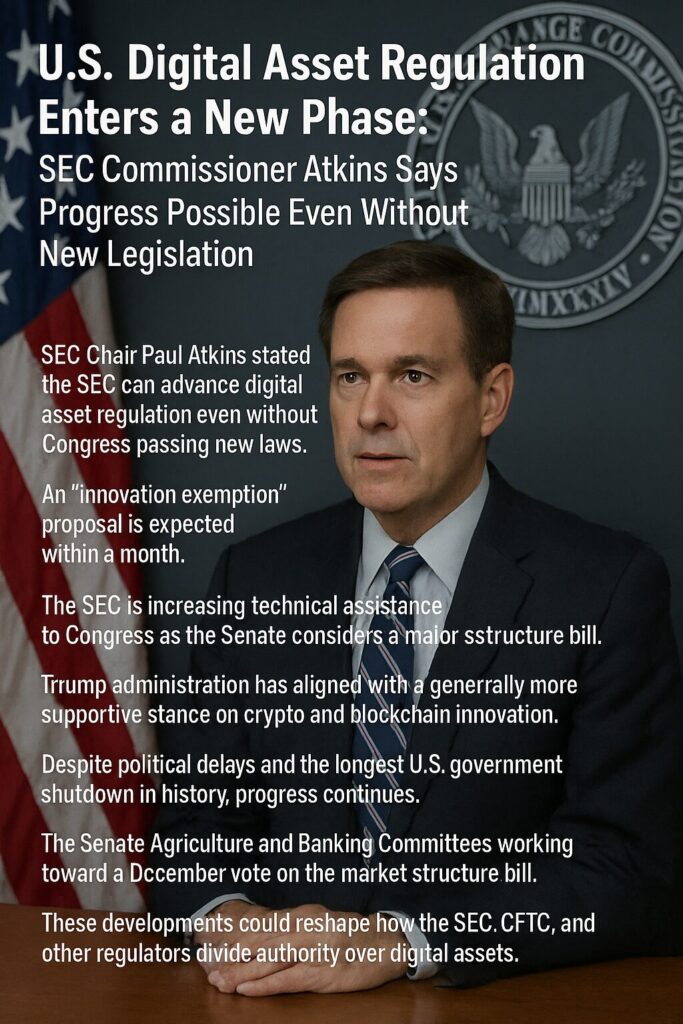
- SEC Chair Paul Atkins stated the SEC can advance digital asset regulation even without Congress passing new laws.
- An “innovation exemption” proposal is expected within a month.
- The SEC is increasing technical assistance to Congress as the Senate considers a major market structure bill.
- The Trump administration has aligned with a generally more supportive stance on crypto and blockchain innovation.
- Despite political delays and the longest U.S. government shutdown in history, progress continues.
- The Senate Agriculture and Banking Committees are working toward a December vote on the market structure bill.
- These developments could reshape how the SEC, CFTC, and other regulators divide authority over digital assets.
- For investors seeking new crypto assets and practical blockchain applications, regulatory clarity is likely to accelerate institutional adoption and new revenue opportunities.
1. Introduction: A Turning Point for U.S. Digital Asset Regulation
In early December, SEC Chair Paul Atkins made a decisive statement: the U.S. Securities and Exchange Commission can move forward on digital asset regulation even without Congress passing new crypto laws. This comment, made during a CNBC interview, is more than a procedural note. It marks a significant shift in the regulatory landscape for cryptocurrencies, blockchain innovators, and investors exploring new income opportunities.
At a time when digital asset markets are rapidly expanding, institutional interest is accelerating, and governments worldwide are issuing comprehensive regulatory frameworks, the U.S. has appeared gridlocked. Congressional debates have stalled several digital asset bills, and the recent political environment—including what became the longest government shutdown in U.S. history—raised concerns that regulatory progress would be frozen.
Atkins’ assertion signals the opposite: the SEC intends to proactively regulate, offering clearer rules for innovators and market participants even in the absence of legislative consensus.
2. The SEC’s Expanded Authority: “We Have Enough Power to Move Forward”
During the CNBC interview, Chairman Atkins emphasized that the SEC already holds sufficient statutory authority to implement meaningful rules for digital assets.
He highlighted three core areas:
- Innovation Exemption
This proposal—expected to be unveiled in a month—aims to allow controlled experimentation for emerging crypto projects without imposing the full weight of securities law during early development. - Reduced Enforcement Actions
Under Atkins, the SEC has actively evaluated how to reduce punitive measures against legitimate crypto companies, focusing instead on guidance, no-action letters, and compliance pathways. - Support for Congress
Atkins noted that the SEC is providing “technical assistance” to the U.S. Senate as lawmakers review a major market structure bill. The SEC is helping shape the legal parameters, even if Congress is slow to pass new laws.
This combination of leadership action and administrative authority suggests the agency can shape the near-term regulatory environment regardless of legislative bottlenecks.
3. The Role of DePIN and No-Action Letters
One of the most concrete actions under Atkins’ tenure has been the issuance of no-action letters to decentralized physical infrastructure networks (DePIN projects). These frameworks operate at the intersection of real-world infrastructure—such as wireless networks, transport grids, or sensor systems—and tokenized incentives.
No-action letters allow businesses to operate without fear of enforcement, provided they follow specific guidelines. For emerging sectors like DePIN, which blend utility tokens with real-world services, regulatory clarity is essential.
By supporting DePIN with formal non-enforcement guidance, the SEC signals:
- Practical recognition of new blockchain business models
- A willingness to diverge from the previous era of strict enforcement
- Regulatory alignment with the Trump administration’s broader innovation-friendly posture
This shift is a major development for investors exploring new opportunities in the Web3-enabled physical infrastructure economy.
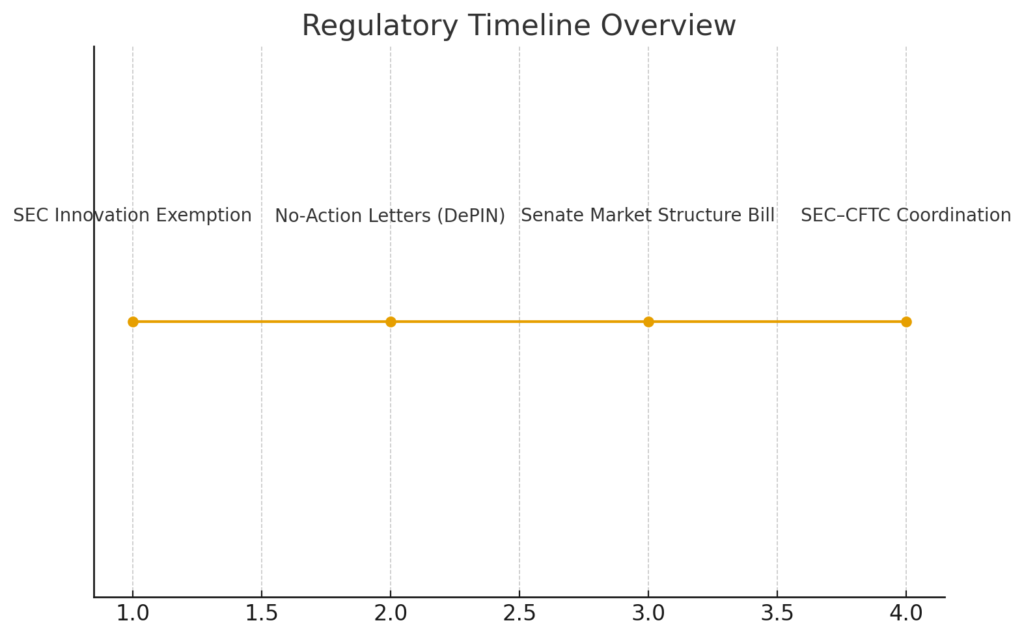
“Conceptual Regulatory Pathway for Digital Assets”
4. Market Structure Bill: The Next Breakthrough
While the SEC expands its independent authority, Congress is simultaneously working on a digital asset market structure bill expected to define how federal agencies share regulatory power. The primary committees involved are:
- Senate Agriculture Committee
(which oversees the Commodity Futures Trading Commission — CFTC) - Senate Banking Committee
(which oversees the SEC)
Senate Banking Committee Chairman Tim Scott stated that his committee aims to finalize the bill for a vote within December.
The bill’s objectives include:
- Defining which digital assets are commodities versus securities
- Establishing jurisdictional boundaries between the SEC and CFTC
- Creating unified compliance standards for exchanges, custodians, and token issuers
- Strengthening consumer protection and market transparency
For investors seeking emerging digital assets or high-growth sectors such as DePIN, GameFi, decentralized finance (DeFi), and tokenized infrastructure, regulatory clarity will lower risk and attract institutional liquidity.
5. How These Changes Affect Investors and Crypto Entrepreneurs
5.1 Acceleration of New Token Listings and Market Access
Clearer rules—especially an innovation exemption—will make it easier for legitimate projects to launch compliant tokens. When regulatory uncertainty decreases, exchanges can diversify asset listings more confidently, creating new opportunities for early-stage investors.
5.2 Institutional Capital is More Likely to Enter
Large financial institutions require predictable regulatory frameworks. If the SEC proceeds with structured, transparent rulemaking, investment firms, hedge funds, banks, and even pension funds will expand their crypto allocations.
5.3 Improved Compliance for Cross-Border Exchanges
U.S. rules often influence global standards. As the SEC and CFTC formalize roles, exchanges in Asia, Europe, and emerging markets will mirror those frameworks to ensure compatibility with U.S. investors and liquidity.
5.4 Practical Blockchain Applications Gain Legitimacy
Sectors such as:
- supply-chain tokenization
- decentralized identity
- infrastructure staking
- Web3 mobility and energy markets
- data tokenization
will benefit from regulatory structures that distinguish utility tokens from securities.
For builders seeking real-world Web3 use cases, the regulatory environment is becoming more supportive than at any previous time in U.S. history.
6. Global Trends Strengthening the Case for U.S. Crypto Reform
Atkins’ stance aligns with global regulatory momentum:
- The EU MiCA framework is being implemented, offering the world’s most comprehensive crypto rules.
- Japan continues to integrate digital assets into mainstream finance with strict but clear regulatory definitions.
- Singapore and Hong Kong are opening regulated retail access to crypto ETFs and licensed exchanges.
- Middle Eastern markets, particularly the UAE, are aggressively attracting Web3 companies with clear licensing pathways.
If the U.S. delays clarity, capital and innovation may continue shifting abroad. Thus, Atkins’ proactive posture also serves as a strategic countermeasure to global competition.
7. Economic Context: Why Now Matters
Crypto markets are experiencing one of the strongest institutional inflows in years. The approval of Bitcoin and Ethereum ETFs in several major jurisdictions has accelerated demand.
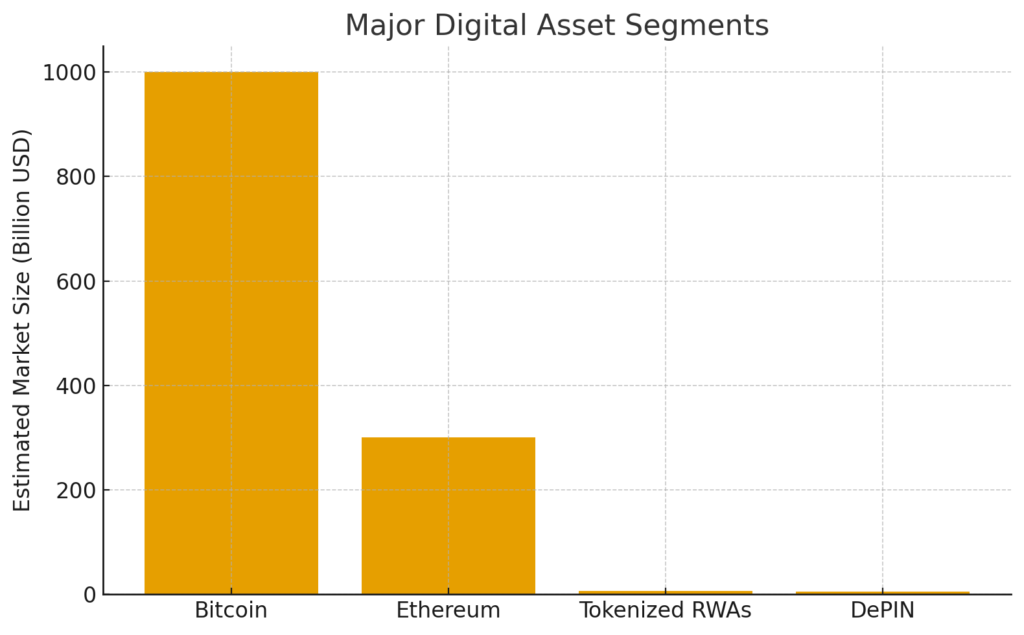
As of the latest data:
- Bitcoin market cap approaches $1 trillion (USD)
- Ethereum remains above $300 billion (USD)
- Tokenized real-world asset (RWA) markets surpass $7 billion (USD)
- DePIN networks represent a fast-emerging multi-billion-dollar category
In such an environment, regulatory stagnation risks slowing capital formation. By asserting that the SEC is ready to move independently, Atkins is helping ensure the U.S. remains competitive.
8. Conclusion: A New Era for Digital Asset Regulation
Paul Atkins’ declaration represents a pivotal moment in U.S. digital asset policy. By confirming that the SEC will not wait for Congress, he has set the stage for:
- near-term regulatory clarity
- reduced enforcement uncertainty
- expanded adoption of digital assets in mainstream finance
- accelerated innovation through structured exemptions and guidance
For crypto investors searching for new opportunities, as well as entrepreneurs building practical blockchain solutions, this regulatory momentum may signal the beginning of a new growth phase—one that rewards innovation while establishing robust consumer protections.
As the Senate prepares to vote on the market structure bill and the SEC prepares its innovation exemption proposal, the next several months could reshape the future of the entire digital asset ecosystem.




