Main Points :
- Bitcoin’s sharp November decline reflects weakened liquidity, ETF outflows, and long-term holders selling.
- Coinbase believes December could mark the beginning of a rebound as the Federal Reserve is expected to begin rate cuts.
- Stablecoin supply contraction signals liquidity stress, but large “money-on-the-sidelines” may return once volatility stabilizes.
- Technical support zones broke down, but historical December performance (+9.7% average) remains encouraging.
- Institutional behavior, ETF flows, and macro policy are the key drivers for year-end recovery potential.
Introduction — A Market Under Pressure but Not Without Opportunity
Bitcoin’s dramatic price decline in November 2025 left many investors questioning whether the market had entered a deeper bearish period or whether the move was merely a violent shakeout before a year-end reversal. Coinbase Institutional, one of the most influential research desks in the digital asset industry, has released a detailed report arguing that despite significant structural weaknesses in November, several macro catalysts may position Bitcoin for a December rebound.
For investors actively seeking new digital assets, income opportunities, and practical blockchain use cases, understanding the macro-cycle and liquidity dynamics behind Bitcoin’s volatility is critical. This article synthesizes the Coinbase report, incorporates recent global macro developments, and evaluates how these signals translate into actionable insights for crypto market participants.
Section 1 — Why November’s Bitcoin Breakdown Matters
1.1 Technical Failure and Liquidity Erosion
In late November, Bitcoin plunged to roughly $84,000, marking an $18,000 intra-month decline — the largest since 2021. According to Coinbase, this drop was not merely a reaction to speculative selling but a structural breakdown triggered by:
- The loss of multiple key technical indicators
- Weak institutional and retail bid support
- A decline in on-chain liquidity and stablecoin supply
Bitcoin decisively broke below its 200-day moving average, the average acquisition cost of short-term holders, and the historically important “75% profit line” — where 25% of the circulating supply enters unrealized loss territory. Once these levels collapsed, sell pressure intensified and liquidity thinned rapidly.
Coinbase notes that long-term holders (LTHs), historically one of the most resilient supportive cohorts, began distributing coins over the past month. This shift weakened the market’s resilience and contributed to the speed of the decline.

1.2 ETF Outflows Accelerated the Downturn
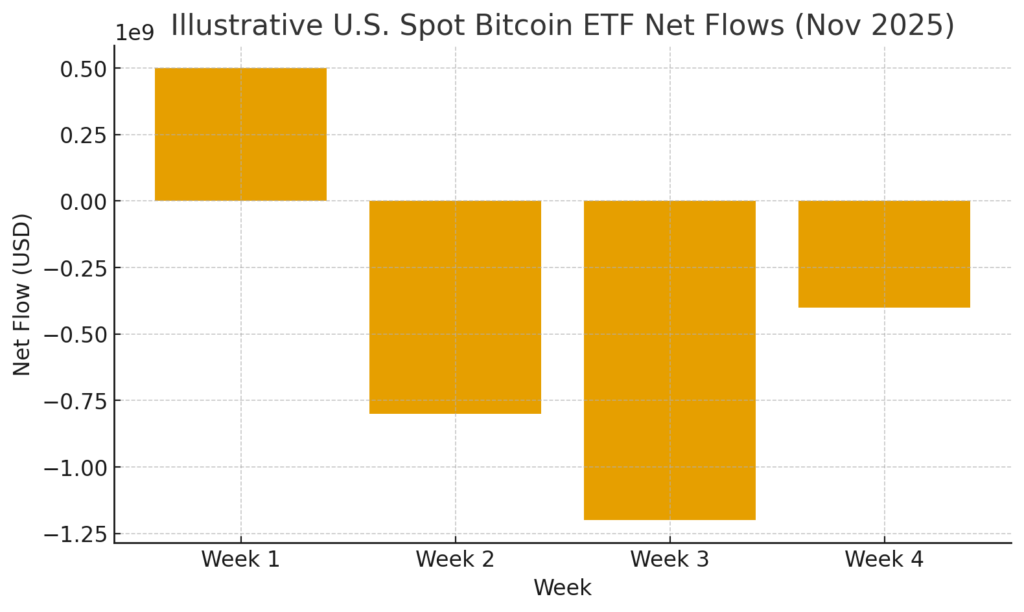
One of the most decisive contributors to November’s price decline was record-level outflows from U.S. spot Bitcoin ETFs. These products, which previously acted as strong demand drivers earlier in the year, saw institutional investors withdraw capital aggressively.
As Coinbase explains, once Bitcoin fell below the major support band at $98,000–$100,000, the market moved into a low-ownership zone. With fewer historical holders in this range, there was little natural support, enabling price to cascade downward toward the $85,000 region.
The combination of ETF outflows, weakening LTH conviction, and fragile liquidity created a feedback loop that compressed prices quickly and violently.
Section 2 — Conditions for a December Rebound
2.1 Monetary Policy Pivot: The Central Catalyst
Coinbase emphasizes the importance of a significant macro shift:
The Federal Reserve is expected to begin cutting interest rates in December 2025, with markets pricing an 87% probability of a 0.25% rate reduction at the upcoming FOMC meeting.
Additionally, the Fed halted Quantitative Tightening (QT) earlier than anticipated, signaling a shift toward a more accommodative stance. These developments are typically bullish for risk assets because:
- Lower interest rates reduce the opportunity cost of holding Bitcoin
- Liquidity conditions improve
- Investors rotate capital toward higher-growth assets
Coinbase argues that a Fed pivot often precedes strong performance in Bitcoin, as seen during previous easing cycles.
2.2 A Surge in “Dry Powder” on the Sidelines
Despite weakened spot demand in November, Coinbase highlights a critical counterforce: a record level of idle money in U.S. money-market funds. These funds have attracted trillions of dollars during the high-interest-rate period, yet much of this capital is “waiting” for risk conditions to stabilize.
Once volatility declines and macro signals improve, Coinbase expects capital to flow back into regulated cryptocurrency products such as:
- U.S. spot Bitcoin ETFs
- Institutional-grade custodial solutions
- Regulated derivatives markets
Such inflows may significantly restore Bitcoin’s liquidity and buying power in December.
2.3 Stablecoin Supply Contraction: A Warning, but Also a Setup
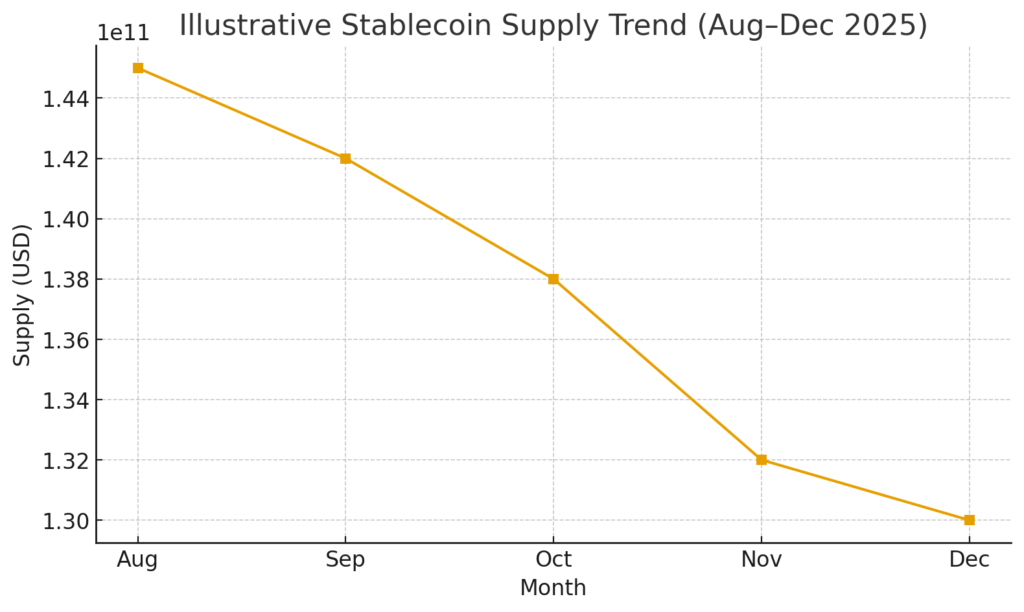
Stablecoin supply — a proxy for market liquidity — began contracting in October and is now at its lowest level since 2023. While this contraction contributed to November’s weakened market depth, it also indicates a potential reversal point.
Historically:
- Sharp contractions in stablecoin liquidity often precede periods of renewed inflows
- Market participants rebuild dry-powder reserves before re-entering positions
Coinbase emphasizes that as soon as stablecoin issuance resumes, it typically signals the beginning of a broader market recovery cycle.
Section 3 — Institutional Behavior and Market Psychology
3.1 MicroStrategy’s Forecast Revision Reflects Caution
MicroStrategy (rebranded as MicroStrategy Inc., one of the world’s largest corporate Bitcoin holders) revised its full-year 2025 performance targets downward amid the November price weakness. This adjustment reflects broader sentiment caution among corporations heavily exposed to Bitcoin.
While corporate pessimism often fuels fear among retail investors, historical patterns show that such downgrades frequently occur near corrective cycle bottoms rather than tops.
3.2 December’s Historical Performance Remains Strong
Despite short-term turbulence, historical seasonal patterns cannot be ignored:
- Bitcoin has averaged +9.7% returns in December since inception
- Many of Bitcoin’s major recoveries began in Q4
- Post-selloff rebounds are common when macro catalysts align
Indeed, following the December 1 crash, Bitcoin rebounded to approximately $93,500, recovering nearly $10,000 from the low.
Section 4 — The Rebound Scenario: How December Could Unfold
4.1 The Three Conditions for Recovery
Coinbase identifies three conditions that must be met before a sustained reversal can begin:
1. Clear reclaiming of technical support levels
Bitcoin must recover critical levels such as the 200-day moving average and the short-term holder realized price.
2. Resumption of inflows into Bitcoin ETFs and stablecoin markets
ETF inflows typically precede major bull cycles.
3. A confirmed macro easing cycle
A Fed rate cut or explicit forward guidance may serve as the ignition point.
4.2 Why December May Offer a Unique Opportunity
Coinbase emphasizes that December 2025 is uniquely positioned because:
- The Fed may appoint a new Chair before Christmas, adding further political clarity
- Rate cuts are increasingly probable
- Liquidity reversal signs appear stronger
- Historically, December is a strong month for crypto risk appetite
For investors searching for new digital assets or yield opportunities, understanding these broader liquidity cycles is essential. If the December pivot materializes, the rebound may extend into Q1 2026, potentially reshaping market structure.
Conclusion — A Month of Risk but Also Significant Opportunity
November’s rapid decline exposed clear weaknesses across Bitcoin’s technical structure, on-chain metrics, and institutional demand. ETF outflows and liquidity contraction amplified the damage, pushing Bitcoin into its deepest correction in years.
Yet, as Coinbase argues, the forces that caused the decline are cyclical rather than structural. With a potential Federal Reserve pivot, abundant sidelined liquidity, and historical seasonal strength, December may indeed mark the beginning of a broader recovery phase.
Investors seeking new crypto opportunities should monitor:
- ETF inflows
- Stablecoin supply expansion
- Macro policy announcements
- Reclaims of key technical price zones
If these signals align, the November crash may ultimately be remembered not as the start of a bear market but as a rare window of opportunity ahead of a renewed bullish cycle.