
Main Points :
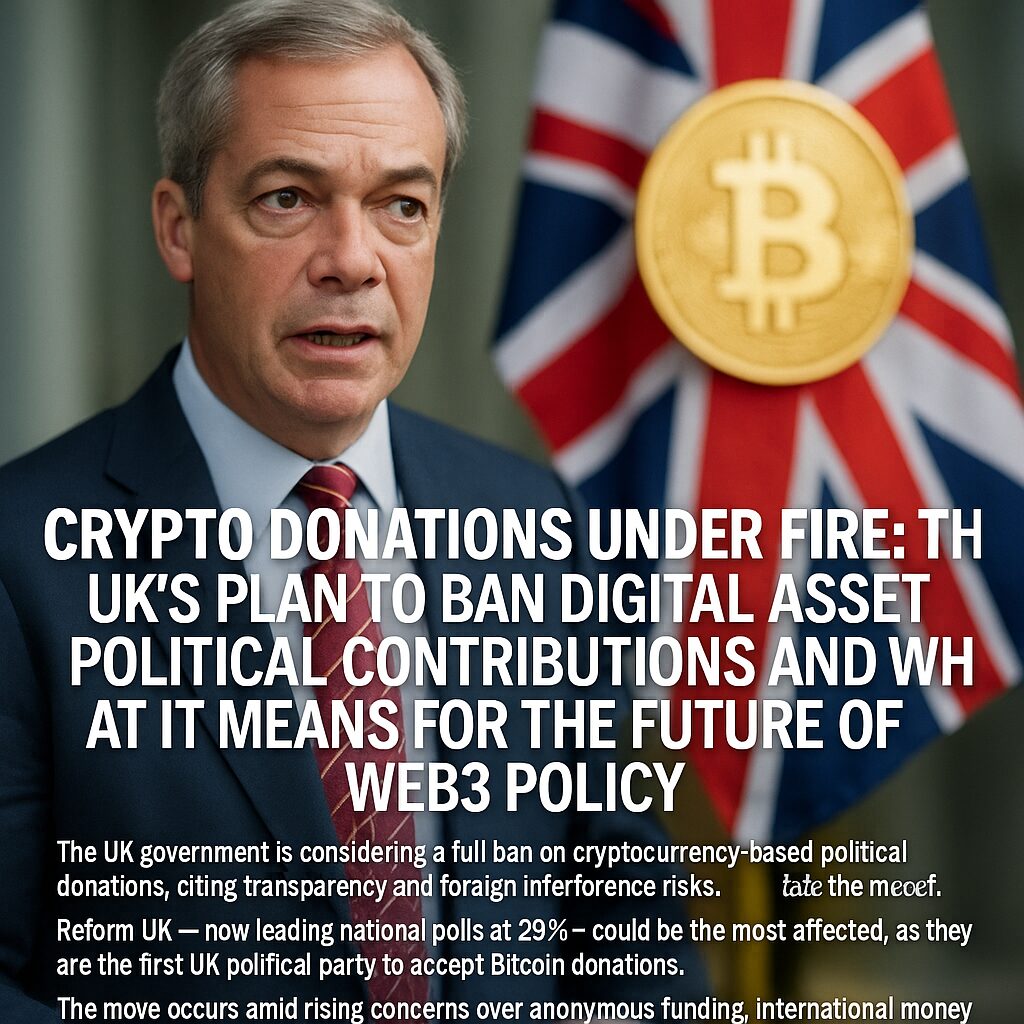
- The UK government is considering a full ban on cryptocurrency-based political donations, citing transparency and foreign interference risks.
- Reform UK — now leading national polls at 29% — could be the most affected, as they are the first UK political party to accept Bitcoin donations.
- The move occurs amid rising concerns over anonymous funding, international money flows, and recent scandals involving former Reform UK officials.
- A broader election law reform bill is expected to tighten rules for shell companies, unregistered groups, and foreign-linked donations.
- The implications extend far beyond the UK: this debate signals a coming global trend toward regulating crypto’s role in political financing.
- For crypto investors, builders, and Web3 entrepreneurs, the UK’s regulatory stance may shape regional hubs, on-chain transparency standards, and project compliance costs.
Introduction
In a rapidly evolving digital economy, cryptocurrencies have become not only a vehicle of investment and innovation but also a potential channel for political influence. The United Kingdom — long positioning itself as a future “crypto hub of Europe” — is now taking a significant step back from digital asset political funding. According to reports from Politico, the UK government is actively considering a ban on cryptocurrency donations to political parties.
If implemented, this move could have profound implications for political financing transparency, public trust, and the country’s broader digital asset strategy — especially when the party most affected, Reform UK, has recently surged to the top of national polling.
This article provides a detailed, structured overview of the issue, integrates additional insights from other credible global sources, and explores the direction of crypto regulation, political financing, and blockchain transparency in the UK and worldwide.
1. The UK Government’s Push to Ban Crypto Political Donations
The proposed ban originates from ongoing discussions surrounding a new election law reform bill aimed at strengthening trust in the political process. While the government has not publicly confirmed details, spokespeople have not denied the consideration of such a ban.
Although the initial policy documents released did not explicitly mention a ban, senior government members reportedly indicated that the final bill may close loopholes associated with anonymous or hard-to-trace political contributions.
The rationale for the possible ban centers around:
- Difficulty in tracing the true source of crypto funds
- Risk of foreign interference
- Risk of criminal proceeds being disguised as legitimate donations
These concerns echo ongoing global discussions about blockchain-based political finance, with regulators increasingly warning that pseudonymous crypto transactions can challenge traditional anti–money laundering (AML) and political transparency frameworks.
2. Reform UK: The First British Party to Accept Crypto Donations — and Now the Most Exposed
Reform UK made headlines earlier this year when its leader, Nigel Farage, announced at Bitcoin 2025 in Las Vegas that the party would begin accepting cryptocurrency donations including Bitcoin (BTC). Shortly afterward, the party launched a dedicated donation portal.
This move was widely seen as a symbolic gesture toward younger, tech-savvy voters and a broader statement of support for digital freedom and innovation.
But now, unexpectedly, the same step that originally positioned Reform UK as progressive may become a liability. With the government considering banning crypto donations, Reform UK — the UK’s only party currently accepting such contributions — is squarely in the crosshairs.
The timing is especially impactful given the party’s rise in popularity.
3. Reform UK Surges to the Top of National Polls
Recent national polling shows that Reform UK now holds a commanding lead:
| Party | National Support (%) |
|---|---|
| Reform UK | 29% |
| Labour | 18% |
| Conservative | 17% |
Reform UK’s support has climbed steadily through 2025 and appears stable at its new elevated level. Political analysts believe this represents a structural shift away from the UK’s traditional two-party dominance.
This context makes the proposed crypto donation ban far more politically significant. Any new restriction on Reform UK’s fundraising could alter campaign financing and influence power dynamics ahead of the next election cycle.
4. Why Critics Are Pushing for a Ban: Transparency, Tracking Challenges, and Foreign Interference
Government officials leading the push for action include:
- Pat McFadden (former minister)
- Liam Byrne (Chair, Business Committee)
- Phil Brickell (Head, Anti-Corruption and Fair Tax cross-party group)
Their primary arguments are as follows:
4.1 Difficulty Tracking Funding Sources
Unlike traditional bank transfers, cryptocurrencies can obscure:
- Real beneficial owners
- Origin jurisdictions
- Source of funds
- Intermediary chains
- Wallet control structures
Although blockchain analytics firms (Chainalysis, TRM Labs) have improved tracing capabilities, opponents argue that sophisticated actors can still obfuscate trails through mixers or cross-chain hopping.
4.2 Risk of Criminal Proceeds
Crypto-related breaches, ransomware payments, and illicit transfers remain a global issue. Critics fear that political donations could become a natural extension for laundering illicit funds.
4.3 Fear of Foreign Influence
This argument gained traction after a former Reform UK official, Nathan Gill, was imprisoned for accepting payments linked to pro-Russia messaging. Farage has denied any relationship or involvement, but the incident has accelerated scrutiny around the party.
4.4 Shell Corporations and Unregistered Groups
The expected election bill will likely include:
- Tighter verification for donor identity
- Restrictions on shell companies
- Mandatory risk assessments for political parties on foreign-linked donations
Together, these are expected to raise compliance requirements dramatically.
5. What Other Sources Say: The Global Landscape of Crypto and Political Funding
To enhance context, this article references several reputable international sources beyond Politico, including:
- BBC
- Financial Times
- Reuters
- CoinDesk
- UK Electoral Commission publications
5.1 United States: Crypto Donations Are Legal (With Limits)
The U.S. Federal Election Commission allows crypto donations but treats them as “in-kind contributions” requiring:
- Full donor identity disclosure
- Valuation in USD at contribution time
- AML checks by political committees
This suggests that the UK may be moving in a stricter direction than the U.S.
5.2 European Union: Tightening Political Finance Laws
The EU Parliament has flagged crypto political donations as a potential avenue for:
- Money laundering
- Undue influence
- Cross-border interference
Several EU lawmakers are pushing for harmonized restrictions.
5.3 Canada: Studying a Full Ban
Canadian regulators have publicly discussed the idea of prohibiting cryptocurrency political contributions.
5.4 Japan: Currently No Explicit Ban but Watching Closely
Japan, a global leader in crypto regulation, allows political donations but requires strict identity verification. The Japanese government continues to evaluate crypto’s role in political finance as part of its broader Web3 promotion strategy.
6. What This Means for Cryptocurrency Investors and Builders
The proposed ban is not just a political issue — it is a signal to the entire digital asset industry.
6.1 Heightened Scrutiny of On-Chain Identity
The UK seems poised to favor compliance-first blockchain journalism, demanding:
- On-chain transparency
- Verifiable sender identity
- AML/KYC-compliant donation flows
This hints at a world where Web3 projects must integrate robust compliance layers to operate in regulated markets.
6.2 Potential Impact on Web3 Advocacy Movements
If political parties cannot accept crypto donations:
- Web3 lobbying influence may weaken
- Crypto-friendly political platforms may face fundraising disadvantages
- Grassroots digital asset advocacy movements may lose momentum
6.3 Impact on UK’s Ambition to Become a “Crypto Hub”
A ban could be interpreted in two ways:
- A setback to crypto innovation
- A stabilization of regulatory clarity
The final impact will depend on accompanying legislation and the UK’s broader digital policy direction.
6.4 Strategic Considerations for Crypto Projects
For investors seeking new opportunities and revenue streams, these trends reveal:
- Growth in regtech and compliance automation
- Increasing demand for identity-linked blockchain infrastructure
- New opportunities for political transparency tools built on-chain
7. The Bigger Picture: Political Trust and the Fight Against Disinformation
The proposed ban is part of a broader UK government initiative to:
- Combat foreign interference
- Protect electoral integrity
- Increase public trust in campaign financing
- Prevent scandals like the recent pro-Russia payment case
The political environment has changed rapidly. Digital assets have allowed money to move faster and more freely, but this freedom also demands new forms of oversight.
Conclusion
The UK’s potential ban on cryptocurrency political donations represents a critical intersection between digital innovation and democratic governance. While Reform UK stands to be the most immediately affected, the implications reach far beyond any single political party.
For the crypto asset community — investors, developers, and entrepreneurs — the debate signals a deeper global shift: regulators are no longer treating cryptocurrencies as isolated financial tools but as influential instruments in political and societal systems.
Whether the UK ultimately bans crypto donations or opts for a more controlled regulatory framework, one thing is clear: the political use of digital assets will remain a major focal point in the evolution of global governance and financial innovation.




