
Main Points :
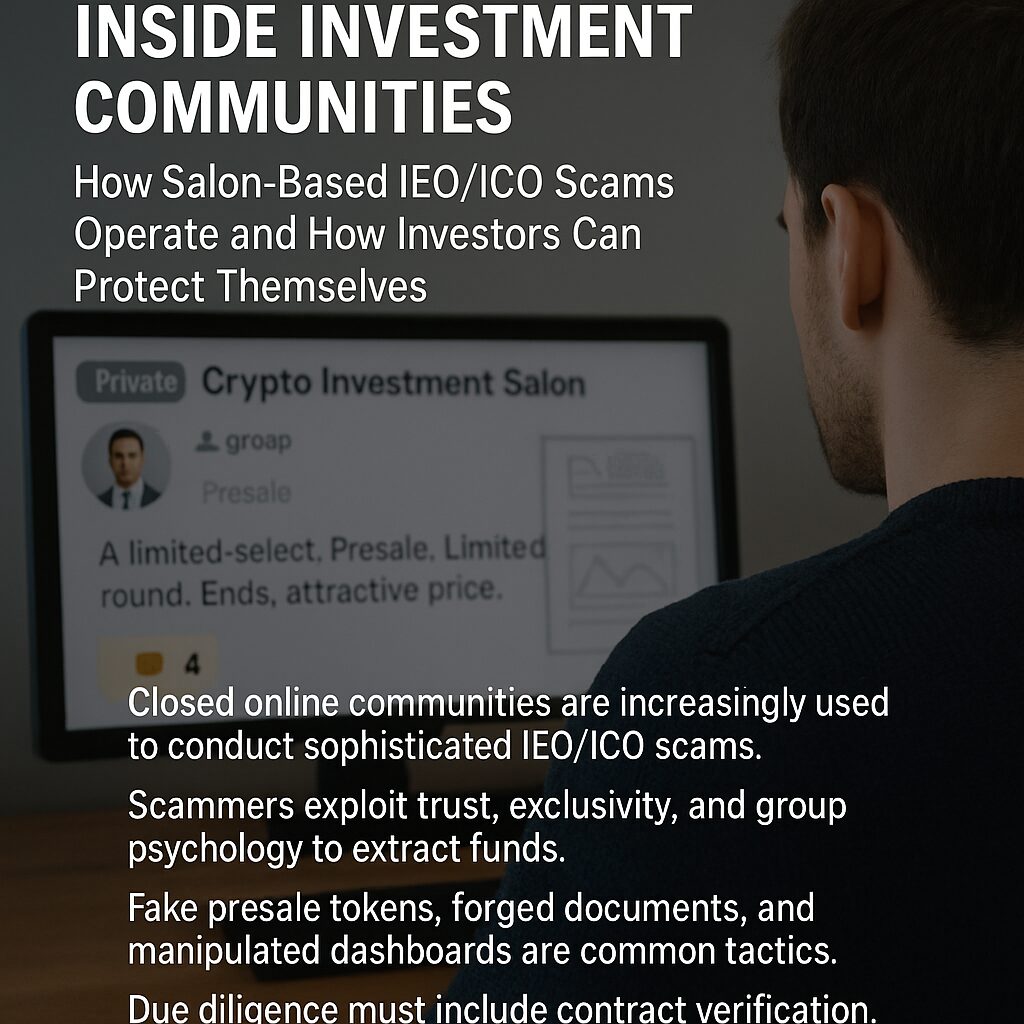
- Closed online communities are increasingly used to conduct sophisticated IEO/ICO scams.
- Scammers exploit trust, exclusivity, and group psychology to extract funds.
- Fake presale tokens, forged documents, and manipulated dashboards are common tactics.
- Due diligence must include contract verification, identity checks, and cross-checking with official exchange announcements.
- Early evidence preservation and prompt consultation are essential when scams occur.
Introduction
In the last several years, scams connected to Initial Exchange Offerings (IEOs) and Initial Coin Offerings (ICOs) have surged across the global cryptocurrency market. Although scams have existed since the early days of blockchain, one particularly dangerous trend has emerged: the use of closed investment salons, online communities, and private membership groups to conduct large-scale fraud. These communities create a sense of exclusivity, trust, and insider advantage—ideal psychological conditions for manipulation.
This article analyzes how these scams operate, why they are so effective, and how investors can protect themselves. It incorporates insights from additional global cases observed in the U.S., Europe, and Asia, and integrates recent developments such as AI-generated identities and increasingly polished fake dashboards.
1. How Salon-Based IEO/ICO Scams Work
Salon-based scams leverage the structure of online communities—Discord groups, Telegram invite-only channels, and private investment “salons”—to stage fraudulent presales. Unlike traditional scams that target the public, these schemes rely on controlled environments where skepticism is minimized and social influence is maximized.
Typical Characteristics
- Exclusive “pre-sale rights” limited to members
- Fake or nonexistent token white lists
- Fraudulent whitepapers produced using AI tools
- False claims of partnerships with exchanges or blockchain foundations
- Communication restricted entirely within the community to avoid scrutiny
The fundamental goal is to create a sense of privilege and urgency, encouraging participants to believe they have access to opportunities unavailable elsewhere.
2. Why Scammers Prefer Closed Communities
2.1 Exclusivity Creates Psychological Blind Spots
Closed membership gives users a false sense of belonging. Humans instinctively trust groups they feel they were “selected” to join. Scammers intentionally use phrases such as:
- “Only for elite members”
- “General public cannot access this”
- “This comes directly from the project team”
2.2 Group Dynamics Suppress Skepticism
When momentum builds inside a group, critical thinking weakens. Members fear appearing negative or “missing out,” especially when fake success stories or “seed investors” (actually planted accounts) post fabricated results.
2.3 Isolation Prevents Verification
Because all discussions occur within the closed community:
- Contract addresses are not publicly posted
- Exchanges do not confirm listings
- Developers cannot be independently verified
- External reviews do not exist
This environment ensures victims cannot compare information with outside sources.
3. The Standard Flow of the Scam
Below is the typical sequence, which is almost identical across scams worldwide.
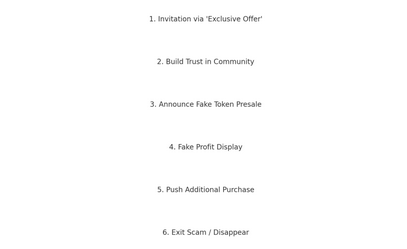
Step 1: The “Exclusive Invitation”
Victims are targeted via X (Twitter), Instagram, and Telegram with promises of:
- Private IEOs
- Special allocations
- “Guaranteed” returns
Step 2: Trust Building in the Community
The group is populated with fake accounts portraying themselves as:
- High-net-worth investors
- Previous “successful” participants
- Admins with fabricated credentials
Fake screenshots showing consistent profits reinforce the illusion.
Step 3: Announcement of the Token Presale
Claims frequently include:
- “5x return after listing is confirmed”
- “Exchange has guaranteed an IEO slot”
- “Partnership with major blockchain firms”
Step 4: Fake Profit Reflection
Scammers display fake profits inside custom dashboards or wallet UIs. Some even modify standard DeFi dashboards to show inflated balances.
Step 5: Pressure for Additional Purchases
Participants are encouraged to invest more due to:
- “Remaining allocation shrinking”
- “Price increase next week”
- “Early investors already in profit”
Step 6: Sudden Disappearance
Once enough funds are collected:
- All group chats vanish
- Social accounts delete themselves
- Websites are taken offline
- Smart contracts (if any) are abandoned
4. Common Scam Tactics and Digital Manipulation
Modern scams frequently involve digitally enhanced materials, including:
- Fake token listings using domains resembling real exchanges
- AI-generated executive photos and LinkedIn profiles
- Fabricated screenshots of liquidity pools
- Altered smart contract explorers
- Logos of well-known blockchain firms (with zero real partnership)
These create a sense of legitimacy powerful enough to deceive even experienced investors.
5. How to Detect and Avoid These Scams
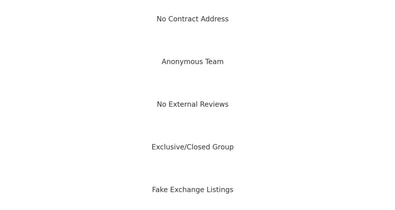
5.1 Is the Smart Contract Address Public?
A real token always has a publicly verifiable contract address.
Anything unverified is 100% fraudulent.
5.2 Do the Developers Exist Outside the Community?
Check:
- GitHub
- Previous projects
- Academic and work history
Fake teams will show no external footprint.
5.3 Is the Exchange Listing Confirmed on Official Channels?
Authentic IEOs are always announced by exchanges on:
- Official website
- Verified X (Twitter) account
- Press releases
5.4 Is the Group Overemphasizing “Exclusivity”?
Real blockchain projects seek broad adoption, not secrecy.
5.5 Are There Independent Third-Party Reviews?
If the only positive comments exist inside the community, assume fraud.
6. What to Do If You Are a Victim
When fraud is suspected, immediate action is crucial.
6.1 Preserve Evidence
Save:
- Transaction hashes
- Wallet addresses
- Chat logs
- Screenshots of presale pages
- Admin usernames
- Contract addresses
6.2 Report the Incident
Depending on jurisdiction:
- Local police cybercrime division
- Consumer protection agency
- Bank or payment provider
- Financial regulatory body
6.3 Consider Blockchain Investigation Services
Some specialized firms now:
- Trace funds on-chain
- Identify mixing behavior
- Prepare legal documentation
- Support recovery litigation
Timing matters—early reports significantly increase the likelihood of recovery.
7. Recent Global Trends in Crypto Scam Activity
AI-Generated Founders
Authorities in Singapore and the U.S. report cases where entire founding teams were generated using AI avatars.
Fake Centralized Exchange Dashboards
Some scams now clone real exchange UIs (e.g., Binance-style layouts), tricking users into believing they have tradable balances.
Cross-Chain Scam Infrastructure
Fraudsters increasingly move funds through:
- BNB Chain
- Polygon
- Arbitrum
- Tron
…to complicate forensic tracing.
Rise of “Hybrid” Scams
These combine romance scams + investment salons, especially in Southeast Asia.
Conclusion
Salon-based IEO/ICO scams represent a highly manipulative form of fraud leveraging trust, exclusivity, and psychological influence. Even experienced investors can fall victim to these engineered environments.
To stay safe:
- Verify all contract addresses
- Confirm exchange listings through official channels
- Research project teams externally
- Never rely on information from closed groups
- Seek help immediately if fraud occurs
By rigorously applying these principles, investors can avoid most modern crypto-related fraud schemes and focus on legitimate opportunities across the digital asset ecosystem.




