Main Points :
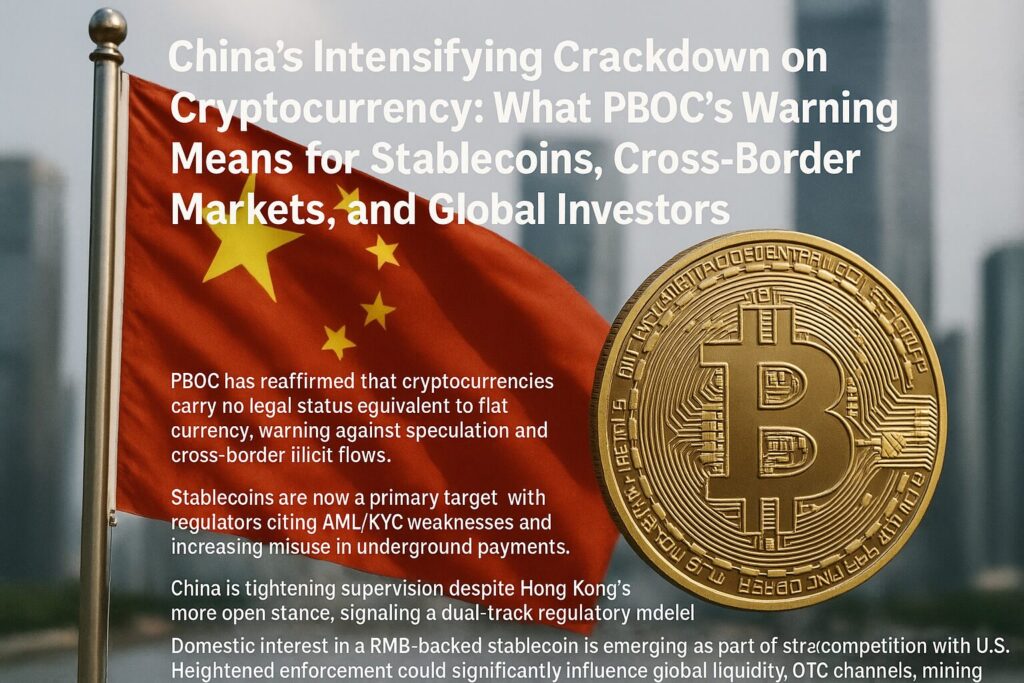
- PBOC has reaffirmed that cryptocurrencies carry no legal status equivalent to fiat currency, warning against speculation and cross-border illicit flows.
- Stablecoins are now a primary target, with regulators citing AML/KYC weaknesses and increasing misuse in underground payments.
- China is tightening supervision despite Hong Kong’s more open stance, signaling a dual-track regulatory model.
- Domestic interest in a RMB-backed stablecoin is emerging as part of strategic competition with the U.S.
- Heightened enforcement could significantly influence global liquidity, OTC channels, mining activity, and innovation across Asia.
Introduction
China’s central bank, the People’s Bank of China (PBOC), has once again entered the global spotlight after issuing a stern warning in late November 2025 regarding the resurgence of cryptocurrency speculation. Despite maintaining a longstanding prohibition on cryptocurrency trading and mining, Chinese regulators now observe a renewed surge in activity driven by global price rallies, social-media hype, and the rapid expansion of stablecoins.
In a multi-agency meeting held on November 28, 2025, PBOC—working jointly with the Ministry of Public Security and the Cyberspace Administration—announced a strengthened enforcement campaign designed to suppress illegal financial activities tied to digital assets. This move signals that China sees renewed crypto excitement not only as a market risk, but as a national-security issue involving cross-border fraud, illegal fundraising, and capital flight.
This article provides a comprehensive review of the PBOC announcement, the rising regulatory attention on stablecoins, the strategic contrast between Mainland China and Hong Kong, and how these developments shape opportunities and risks for global investors seeking new assets and revenue streams. Additional insights from international reports and market data are included to complete the picture.
1. PBOC Reasserts the Legal Status of Crypto: “Not Currency, Not Allowed”
The PBOC reiterated that cryptocurrencies do not possess the legal status of the renminbi (RMB) or any form of official fiat currency. This restatement may seem repetitive, but its timing is meaningful. As global crypto prices rise, retail participation inside China—despite restrictions—has been increasing through VPNs, offshore apps, and OTC intermediaries.
PBOC and participating agencies highlighted:
- Surging cross-border flows linked to digital asset speculation
- Growth in crypto-related fraud, especially investment grooming schemes
- Illegal fundraising activities facilitated by digital tokens
- Social-media driven hype influencing vulnerable groups
The message is clear: cryptocurrency activity remains classified as illegal financial activity, and enforcement is accelerating.
This policy posture serves two purposes. First, it suppresses domestic risk where financial scams have historically led to social unrest. Second, it consolidates government control over monetary sovereignty at a time when global interest in decentralized and dollar-indexed stablecoins is rising.
2. Stablecoins Become the Primary Regulatory Target
Why Stablecoins Worry China
While China outlawed crypto trading years ago, regulators increasingly see stablecoins—not Bitcoin—as the more immediate risk. Stablecoins are widely used for:
- Circumventing cross-border capital controls
- Settling illicit transactions anonymously
- Enabling underground USD liquidity
- Serving as a gateway into offshore crypto exchanges
In the joint meeting, PBOC officials emphasized that most stablecoins fail to meet Chinese standards for:
- KYC compliance
- AML/CFT controls
- Transaction traceability
- Foreign-exchange law adherence
Furthermore, enforcement agencies reported expanding evidence that stablecoins were used in fraud rings, telecom scams, and cryptocurrency-based laundering networks.
For a country with strict capital controls, stablecoins represent a highly efficient channel for capital flight—a scenario regulators find unacceptable.
3. China Strengthens Surveillance Infrastructure
Regulators revealed plans to improve:
- Real-time monitoring of digital asset flows
- Information sharing among agencies
- Automated early-warning systems for suspicious blockchain activity
- Stricter oversight of domestic firms experimenting with digital asset payments
While public cryptocurrency is restricted, Chinese tech firms have been quietly experimenting with distributed ledger technologies and tokenized payment rails. These pilots are under scrutiny, and PBOC stressed that no privately issued digital asset can circulate as money.
This reinforces the central bank’s dominance in managing monetary innovation through the Digital Yuan (e-CNY) program.
4. Hong Kong vs Mainland China: A Diverging Regulatory Approach
Hong Kong continues promoting itself as a digital-asset hub, building structured frameworks for:
- Stablecoin licensing
- Tokenized securities
- Virtual asset exchanges
- Institutional trading infrastructure
This contrasts sharply with Mainland China’s strict prohibition. However, the contrast is strategic rather than contradictory: Hong Kong operates as a controlled testing ground for financial innovation, while Beijing ensures macro-level capital protection.
There are even emerging reports that China is considering a state-backed RMB-pegged stablecoin, not to liberalize crypto policy, but to compete with the U.S. dollar and maintain influence over global digital-asset markets.
5. Bitcoin Mining Quietly Reemerges in Certain Provinces
Despite the 2021 mining ban, underground reports indicate a modest revival of Bitcoin mining in regions with surplus hydropower or cheap electricity. These operations are small and discreet and often shift locations to avoid detection.
The persistence of mining highlights two realities:
- Local governments seek economic benefits, even from prohibited industries.
- Chinese miners remain globally competitive, relying on low-cost resources and established supply chains.
Although this development is unofficial and unregulated, it could again influence global hash-rate distribution should enforcement weaken.
6. Global Trends Reinforcing China’s Regulatory Movements
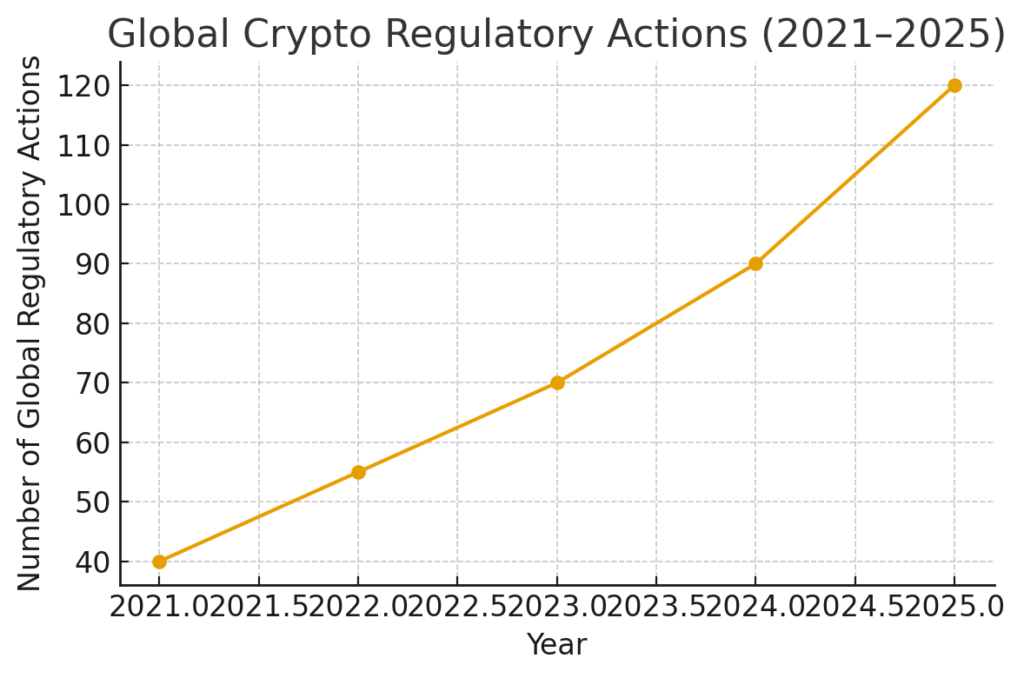
China’s actions mirror a broader global trend toward tighter crypto regulation.
United States
- The SEC continues to pursue unregistered securities offerings.
- Stablecoin legislation is under active debate, especially regarding reserve transparency.
Europe
- MiCA regulation is entering full effect, imposing strict licensing and disclosure rules.
Asia
- Japan and Singapore strengthen AML/CFT frameworks.
- South Korea expands oversight on centralized exchanges.
For investors looking for new digital assets, the regulatory landscape is becoming increasingly structured and compliance-driven.
This rewards responsible projects but pressures anonymous or offshore operations.
7. Implications for Global Crypto Investors and Builders
Investors seeking new tokens, yield opportunities, and blockchain utility must interpret China’s stance carefully.
Opportunities
- Projects aligned with AML compliance, stablecoin transparency, or tokenized finance may benefit.
- Hong Kong may become a gateway for RMB-related digital asset innovation.
- Institutional infrastructure for tokenization is rapidly expanding in Asia.
Risks
- Cross-border OTC channels may face tighter restrictions.
- Stablecoin regulatory pressure could reduce liquidity in Asia.
- Offshore exchanges serving Chinese users may face coordinated enforcement scrutiny.
For builders in DeFi, OTC, remittances, or Web3 payments, compliance-friendly architecture will increasingly determine survivability.
Conclusion
China’s renewed crackdown is not a simple repeat of past measures. It reflects a sophisticated understanding of how digital assets affect capital flows, financial stability, and geopolitical competition. Stablecoins—especially USD-pegged ones—pose a unique challenge to China’s monetary sovereignty.
Yet at the same time, China is watching global developments closely and may pursue its own RMB-based digital asset initiatives to maintain influence.
For crypto investors seeking new assets and real-world revenue opportunities, the message is twofold: understand the regulatory momentum, and look for opportunities in jurisdictions balancing innovation with compliance.