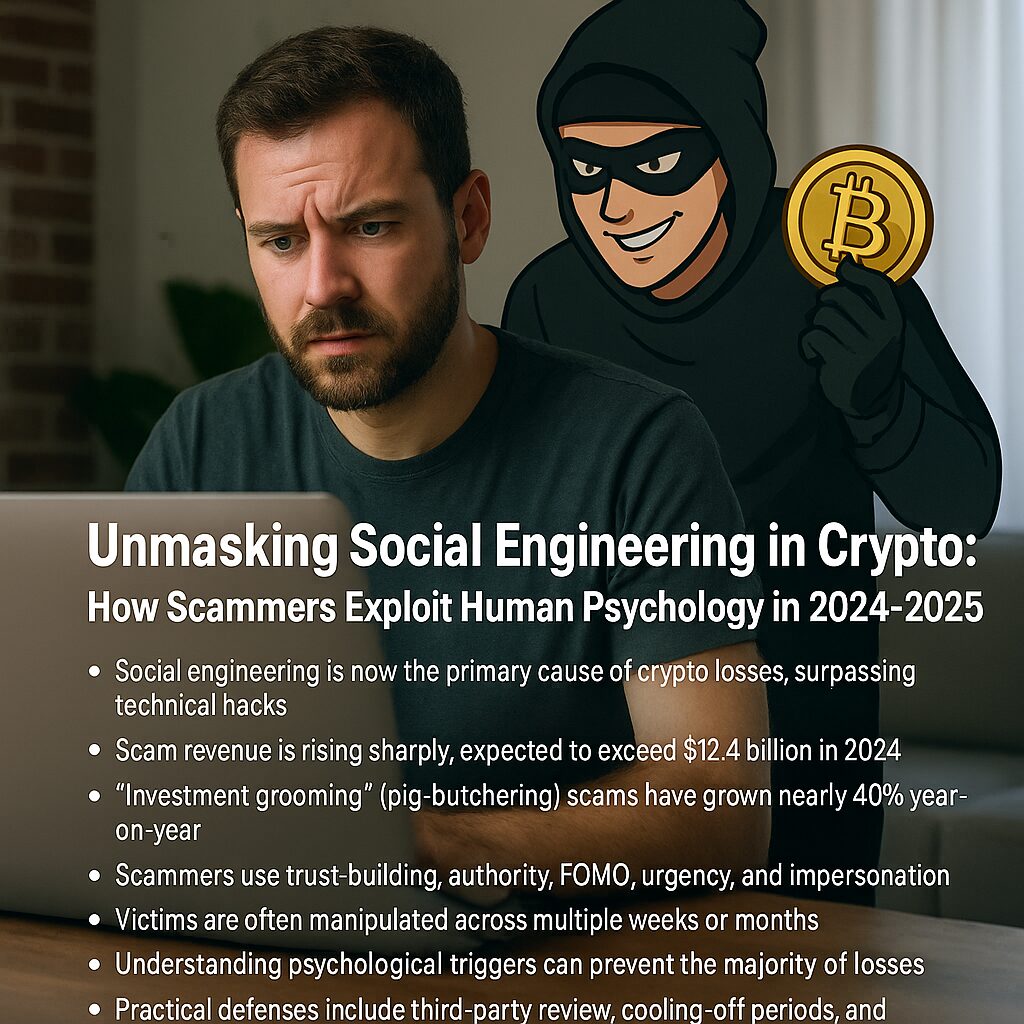
Main Points :
- Social engineering is now the primary cause of crypto losses, surpassing technical hacks
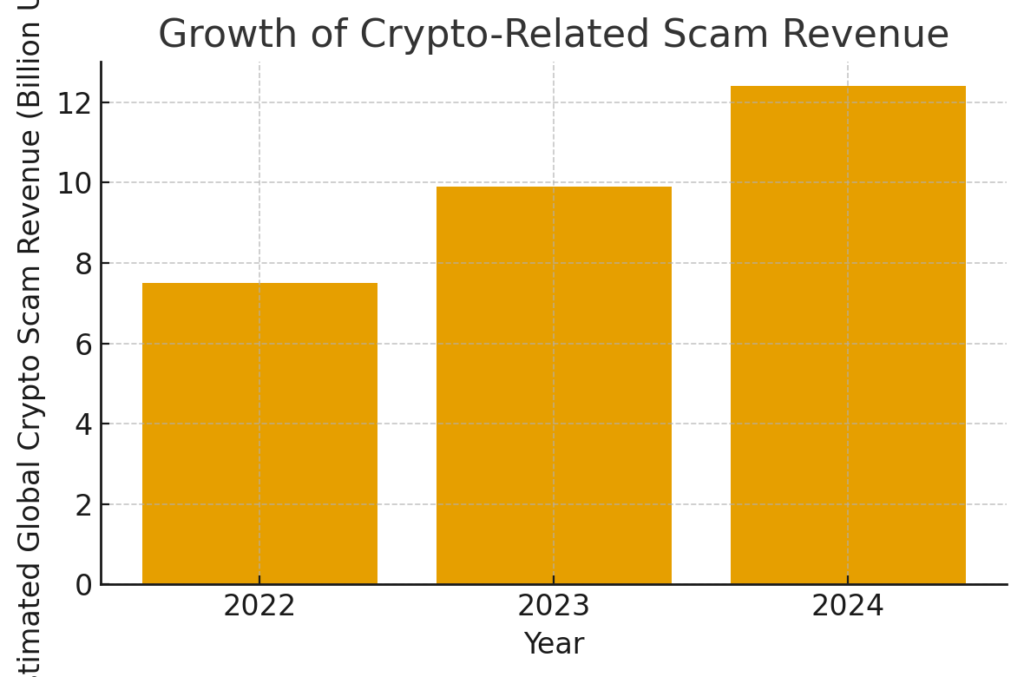
- Scam revenue is rising sharply, expected to exceed $12.4 billion in 2024
- “Investment grooming” (pig-butchering) scams have grown nearly 40% year-on-year
- Scammers use trust-building, authority, FOMO, urgency, and impersonation
- Victims are often manipulated across multiple weeks or months
- Understanding psychological triggers can prevent the majority of losses
- Practical defenses include third-party review, cooling-off periods, and verification of identities
- Once fraud is suspected, immediate preservation of data and rapid reporting are crucial
Introduction — Why Social Engineering Has Become Crypto’s Greatest Threat
In recent years, global crypto crime has shifted away from sophisticated protocol exploits and toward something far more personal: the direct manipulation of human psychology. Instead of attacking blockchains, scammers are attacking people—using emotional pressure, trust deception, and carefully engineered social cues.
Reuters estimates that crypto-linked scam revenue reached $9.9 billion in 2024, and as more datasets are analyzed, this figure may reach $12.4 billion. The FBI classifies crypto investment fraud as the costliest category of online crime, with victims reporting over $5.6 billion in losses in 2023 alone.
This article examines how social engineering works, why it has become the dominant method of crypto fraud, and how investors can protect themselves while pursuing legitimate opportunities in the digital asset space.
1. Understanding Social Engineering in the Crypto Ecosystem
Social engineering refers to any method of obtaining information, access, or assets through psychological manipulation rather than technical intrusion. Unlike hacking a blockchain, scamming a human requires no coding—only persuasion.
Common attack vectors include:
- extracting wallet information
- convincing users to disclose seed phrases
- manipulating investment decisions
- driving victims to malicious websites
- pressuring them into urgent transfers
The danger lies in the fact that humans—unlike blockchains—are fallible. Even experienced investors with strong technical backgrounds can fall victim when trust and emotion cloud judgment.
2. Key Manipulation Tactics Used by Crypto Scammers
2.1 Building Trust (Rapport Engineering)
Fraudsters rarely begin with financial requests. They first build a relationship:
- daily messages
- creating shared emotional space
- mirroring the victim’s hobbies or beliefs
- gradual transition from casual talk to financial topics
Once rapport is built, victims naturally drop their defenses. This phenomenon is heavily exploited in pig-butchering schemes, where scammers maintain long-term communication (weeks or months) before introducing investment proposals.2.2 Using Authority to Influence Judgment
Humans naturally trust perceived authority. Scammers assume roles such as:
- licensed financial advisors
- crypto analysts with “proprietary signals”
- trading platform operators
- bank or exchange support specialists
These personas are supported with:
- fake certifications
- professional-looking PDFs
- fraudulent KYC or investment dashboards
Victims often comply because the scammer appears more sophisticated or knowledgeable.2.3 Creating Urgency and Scarcity
Emotional overload is a powerful tool. Scammers weaponize phrases like:
- “Only 30 minutes left to join.”
- “Prices will double tonight.”
- “I can hold a slot for you, but only if you send now.”
Urgency shuts down rational evaluation. The goal is to force action before the victim has time to consult others.2.4 Triggering FOMO (Fear of Missing Out)
Crypto is uniquely vulnerable to FOMO due to rapid market cycles.
Scammers exploit this by claiming:
- “Everyone is already making money.”
- “You’re missing a once-in-a-lifetime opportunity.”
- “This token will 10× soon. Insiders already know.”
When FOMO outweighs caution, victims stop evaluating risk and begin chasing potential reward.2.5 Impersonation and Fake Accounts
Modern scam networks operate like corporations. They employ:
- impersonation of legitimate exchanges
- fake Telegram/WhatsApp “customer support”
- cloned websites with identical UIs
- deepfake videos of executives
- simulated dashboards showing fake profits
The closer the resemblance to authentic services, the easier it becomes to guide victims into traps.2.6 Mixing Truth With Lies
Effective scammers rarely fabricate everything.
Instead, they blend:
- real projects + fake promises
- genuine market data + manipulated charts
- legitimate exchange addresses + fraudulent wallet flows
This mix creates the illusion of credibility, rendering the scam extremely difficult to detect.
3. How Victims Are Systematically Guided Into Fraud
Crypto social engineering follows a predictable multi-step progression:
Step 1: Initial Contact
Usually through:
- social media
- dating apps
- Telegram/WhatsApp
- “wrong number” texts
Once communication begins, scammers test the victim’s responsiveness.Step 2: Rapport and Emotional Bond
This may continue for weeks. The scammer becomes a confidant, mentor, or romantic partner.Step 3: Introduction of “Exclusive” Investment
A curated opportunity is presented, often:
- arbitrage trading
- low-risk staking platforms
- insider token listings
- AI trading bots
Screenshots, dashboards, and fabricated performance data reinforce credibility.Step 4: Applying Pressure (Urgency + FOMO)
Here scammers deploy:
- countdown timers
- limited availability
- claims that “others already profited”
Step 5: Small Winning Phase
Victims typically “profit” early on:
- fake returns
- view-only wallet balances
- manipulated web dashboards
Scammers allow small withdrawals to build trust.Step 6: Large Investment Push
Once confidence peaks, the scammer demands:
- bigger deposits
- additional collateral
- “tax” or “unlock” fees
Victims usually comply at this stage.Step 7: Disappearance
Communication stops. Access to dashboards is removed. Funds are gone.
By the time victims recognize the situation, the damage has already occurred.
4. Global Trends in Crypto Social Engineering (2024–2025)
Explosive Growth of Grooming Scams
According to Chainalysis, these scams grew nearly 40% YoY in 2024, making them the fastest-growing category of crypto crime.Industrialization of Scam Operations
Reports from Southeast Asia reveal coordinated scam centers employing:
- scriptwriters
- social media specialists
- developers who clone webpages
- money launderers managing cross-border flows
This industrialization means scams are no longer amateur operations—they are enterprises.Deepfake Usage
Increasingly, AI-generated:
- voice calls
- video messages
- ID documents
are used to impersonate credible individuals.
Cross-Blockchain Movement
Funds often move through:
- Ethereum
- Tron
- Binance Smart Chain
- privacy mixers
Making tracking difficult for law enforcement.
5. How to Protect Yourself Against Social Engineering
5.1 Treat “Special Opportunities” as Red Flags
Especially when framed as:
- “Only for you”
- “Exclusive access”
- “Guaranteed profit”
5.2 Reject Any Sense of Urgency
Legitimate investments do not require immediate transfers.5.3 Consult a Third Party
A single conversation with an objective outsider can prevent catastrophic losses.5.4 Verify All Entities
Before sending any funds, verify:
- company registration
- licensing
- team members
- domain ownership
- exchange listings
5.5 Never Share Wallet Secrets
No legitimate service needs:
- your seed phrase
- private key
- recovery words
Under any circumstances.
6. What To Do If You Suspect You Are a Victim
Immediate Actions
- Save chats, screenshots, and transaction hashes
- Notify authorities
- Contact your exchange or bank
- Secure your wallet (change seed, transfer assets)
Professional Support
Crypto investigation services now offer:
- fund tracing
- scam classification
- exchange reporting assistance
- documentation for law enforcement
Rapid response dramatically increases the chance of preventing further loss.
Conclusion
Social engineering attacks exploit the most vulnerable component of the crypto ecosystem: human psychology. Even in a world protected by cryptographic security, investors remain susceptible to trust manipulation, emotional pressure, and false authority.
However, the key to prevention lies not in technology but in awareness.
Understanding the tactics—rapport building, authority mimicry, urgency, FOMO, impersonation—empowers users to identify red flags early. With disciplined verification, third-party consultation, and cautious evaluation, most of these scams become ineffective.
As the crypto industry grows, knowledge becomes the strongest defense. Protecting yourself means protecting your assets—and ultimately ensuring that your participation in Web3 remains safe and profitable.